 ABOUT US
NEWS

Time
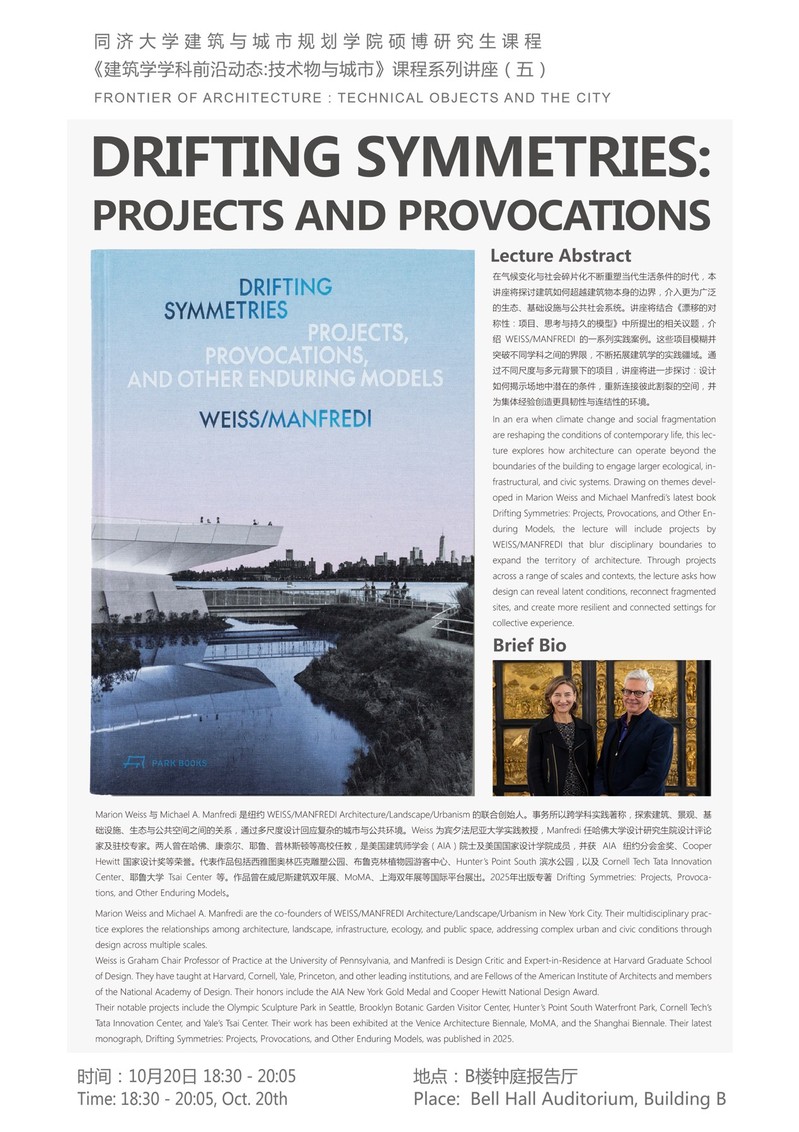
18:30-20:05 Tuesday, Oct. 20th
Venue
Bell Hall Auditorium, Building B, CAUP, Tongji University
Host
TAN Zheng
Associate Professor, CAUP, Tongji University
Lecturer
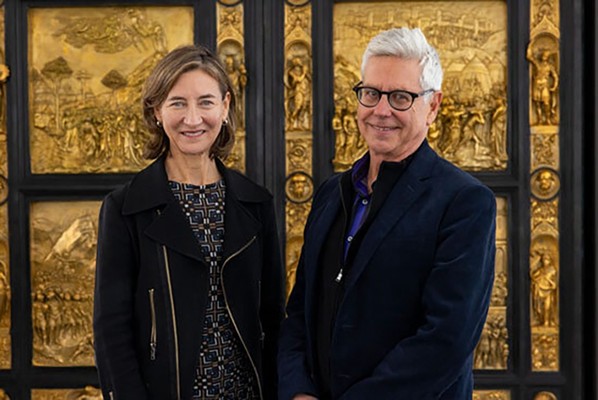

WEISS/MANFREDI
Marion Weiss and Michael A. Manfredi are the co-founders of WEISS/MANFREDI Architecture/Landscape/Urbanism in New York City. Their multidisciplinary practice explores the relationships among architecture, landscape, infrastructure, ecology, and public space, addressing complex urban and civic conditions through design across multiple scales.
Weiss is Graham Chair Professor of Practice at the University of Pennsylvania, and Manfredi is Design Critic and Expert-in-Residence at Harvard Graduate School of Design. They have taught at Harvard, Cornell, Yale, Princeton, and other leading institutions, and are Fellows of the American Institute of Architects and members of the National Academy of Design. Their honors include the AIA New York Gold Medal and Cooper Hewitt National Design Award.
Their notable projects include the Olympic Sculpture Park in Seattle, Brooklyn Botanic Garden Visitor Center, Hunter’s Point South Waterfront Park, Cornell Tech’s Tata Innovation Center, and Yale’s Tsai Center. Their work has been exhibited at the Venice Architecture Biennale, MoMA, and the Shanghai Biennale. Their latest monograph, Drifting Symmetries: Projects, Provocations, and Other Enduring Models, was published in 2025.
Introduction
In an era when climate change and social fragmentation are reshaping the conditions of contemporary life, this lecture explores how architecture can operate beyond the boundaries of the building to engage larger ecological, infrastructural, and civic systems. Drawing on themes developed in Marion Weiss and Michael Manfredi’s latest book Drifting Symmetries: Projects, Provocations, and Other Enduring Models, the lecture will include projects by WEISS/MANFREDI that blur disciplinary boundaries to expand the territory of architecture. Through projects across a range of scales and contexts, the lecture asks how design can reveal latent conditions, reconnect fragmented sites, and create more resilient and connected settings for collective experience.

NO.1239 Rd. Siping, SHANGHAI


