 ABOUT US
NEWS

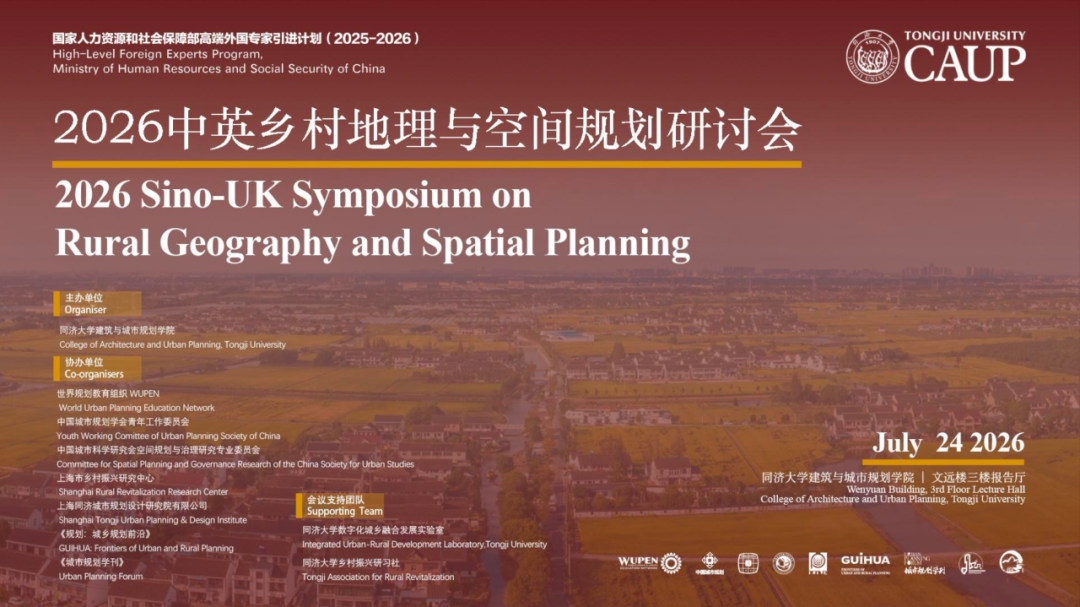
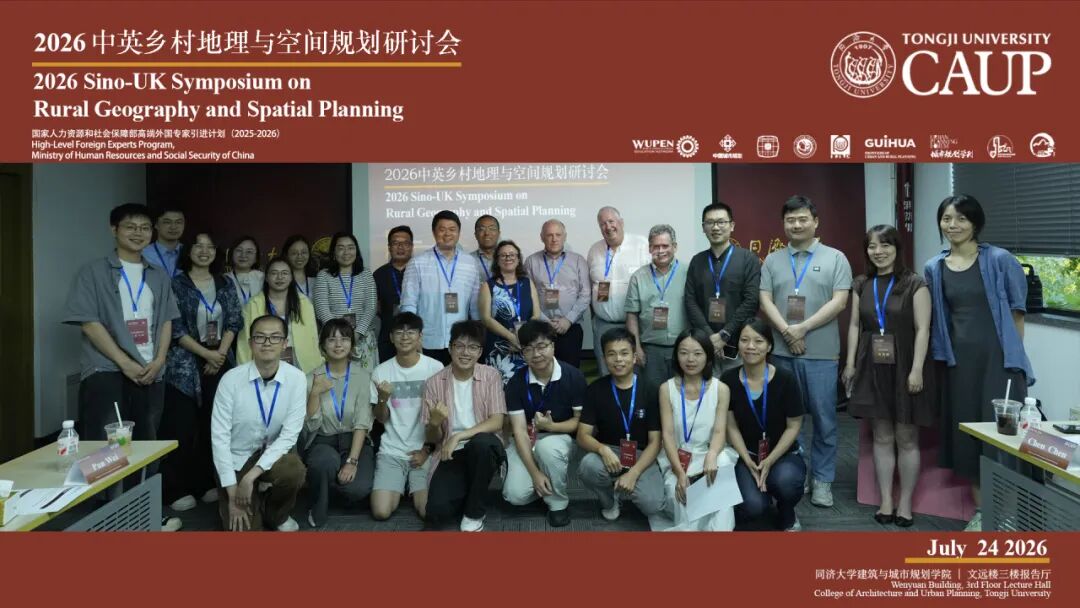
On July 24, 2026, the China-UK Rural Geography and Spatial Planning Symposium was convened at the College of Architecture and Urban Planning (CAUP), Tongji University. Co-organized by WUPEN, UPSC's Youth Working Committee, and several other institutions, the event was supported by the High-End Foreign Expert Program of China's Ministry of Human Resources and Social Security (2025–2026).
Under the theme Urban-Rural Integration, Rural Transformation and Spatial Planning in Metropolitan Regions, the symposium brought together leading scholars to address urban-rural interface restructuring, population mobility, rural gentrification, multifunctional rural transformation, digital platformization, and youth migration to the countryside.
Professor WU Zhiqiang of the Chinese Academy of Engineering opened the symposium by noting the global countryside's shift from production space to living space and from functional zoning to multi-dimensional symbiosis. Professor ZHANG Shangwu stressed the dual pressures on metropolitan villages — urban spillover opportunities alongside spatial squeeze and resource outflow. The opening was chaired by Professor CHEN Chen, Associate Dean of CAUP.
Morning Session
Professor Michael Woods (FAcSS, Aberystwyth University) advanced a planetary rural geography framework, depicting the countryside as a multispecies world where urban-rural interactions generate planetary-scale crises. Professor Darren Smith (FAcSS, Loughborough University) linked rising rural housing density and shrinking public services to growing social polarization. Dr. PAN Wei (CAS) compared how economic and governance talents shape rural development through distinct mechanisms. Professor LI Yuheng (Northeastern University) assessed global rural decline against digital-age vulnerabilities, while Associate Professor HUANG Huang (Tongji) called for a relational reframing of urban-rural linkages through Yangtze River Delta cases.
Mobility Index Launch
Professor CHEN Chen's team launched a township-level urban-rural mobility index for the Yangtze River Delta. The research distinguishes Chinese urban-rural mobility from Western counter-urbanization: it is predominantly temporary and non-permanent, shaped by the hukou system, non-tradable homesteads, land-use conversion approvals, and village governance. Early data show weekend returnees at 12%, commuters at 1.3%, tourists at 5.3%, while over 80% are delivery workers, repair technicians, and other service providers. High-value clusters concentrate around accessible metropolitan fringes, with northern Anhui exhibiting short-distance high-frequency consumption and Shanghai's periphery featuring long-distance low-frequency high-end consumption.
Afternoon Session
Chaired by Dr. XIN Shengxi, the afternoon session addressed rural gentrification and housing. Professor Martin Phillips (University of Leicester) revisited the metropolitan village concept. Assistant Professor ZHU Jin (HKU) introduced a managed gentrification paradigm from Shanghai's Mamen Village, where the government recruits artists and stabilizes rents to foster social integration. Professor Louise Holt (Loughborough) highlighted educational precarity among children in temporary accommodation. Presentations by Associate Researcher CHEN Cheng (CAS Nanjing), Associate Professor GU Hao (Hunan University), and Dr. XIN Shengxi addressed smallholder value-chain restructuring, collaborative governance, and indigenous theoretical frameworks. A roundtable moderated by Professor CHEN Chen deepened the comparative dialogue.
The symposium continues over two decades of Tongji-UK scholarly collaboration, reinforcing CAUP's commitment to advancing China-grounded rural research within international theoretical debates.

NO.1239 Rd. Siping, SHANGHAI


