 ABOUT US
NEWS

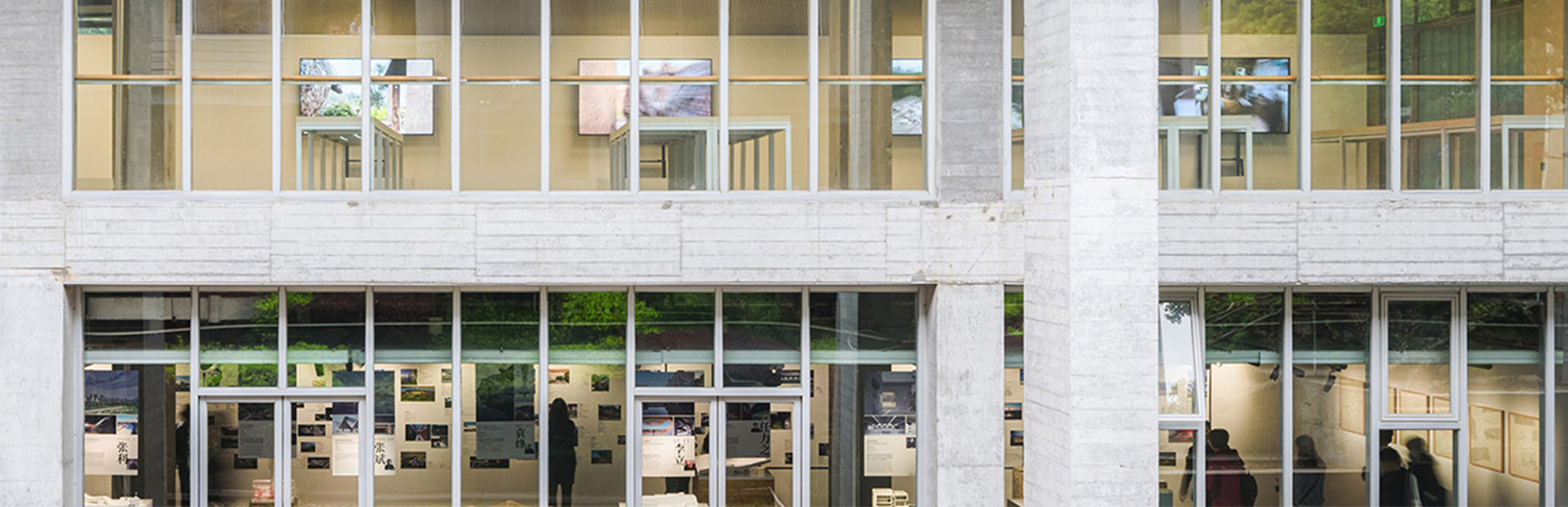
The Huanglong Acoustic Ecology Interpretation Trail, a collaborative project led by Associate Professor Xu Xiaoqing from the College of Architecture and Urban Planning (CAUP) at Tongji University, has won a 2026 Red Dot Award in the Brands & Communication Design category (Spatial Communication). The results were recently announced by the German Design Zentrum Nordrhein Westfalen.
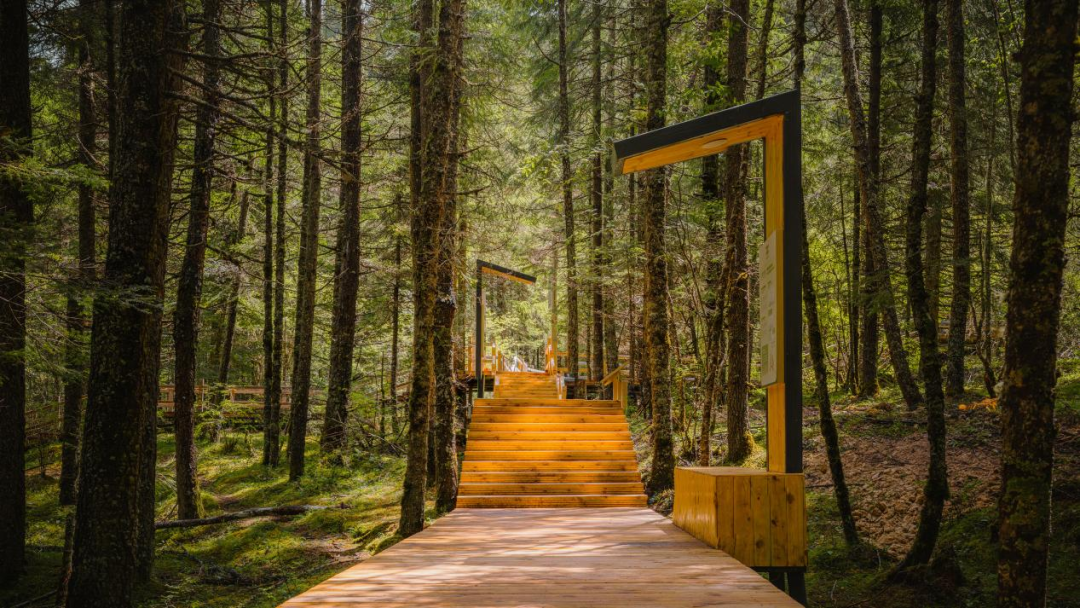
Jointly designed and built with the administration of Huanglong National Scenic Area—a UNESCO World Natural Heritage site on the eastern edge of the Qinghai-Tibet Plateau—the trail was inaugurated in June 2025. Spanning approximately 220 meters with eight interpretation nodes, it is recognized as the world's first acoustic-themed ecology trail, transforming biodiversity from an abstract concept into a tangible, immersive experience.
The project is grounded in three years of bioacoustic monitoring research. The team deployed sensor networks to identify over 59 common bird species in Huanglong, analyzing their spectral signatures, activity rhythms, and spatiotemporal distribution, while also examining the impact of human activity on the acoustic landscape. These findings—supported by a National Natural Science Foundation of China grant (No. 52478066) and resulting in over 10 high-impact publications—provided the scientific backbone for the trail's design.
Along the trail, visitors explore avian soundscapes through directional listening interfaces and synchronized visual cues, learning to distinguish, compare, and spatially locate different species. A digital exhibition hall, developed with Guangzhou Lingdong Ecological Technology Co., further translates bird calls into interactive media, AIGC-generated content, and sound-wave etchings—making ecological complexity both perceivable and memorable.
By integrating physical infrastructure, acoustic design, and digital augmentation into a cohesive system, the project establishes a new paradigm for ecological communication in protected areas: minimal environmental intervention paired with maximum public engagement.
The interdisciplinary team was drawn from CAUP's Bio-CPU Lab and the Ecology and Cultures Innovation Lab (led by Associate Professor Francesca Valsecchi), together with the College of Design and Innovation, Tongji University. Academic advisors included Professor Liu Yang (Sun Yat-sen University) and Professor Zhang Chengyun (Guangzhou University).
This award reflects international recognition of CAUP's strength in research-driven, cross-disciplinary design innovation. It also exemplifies how design, ecological science, spatial thinking, and AI technologies can converge to serve heritage conservation and public education at World Heritage sites.

NO.1239 Rd. Siping, SHANGHAI


