 ABOUT US
NEWS

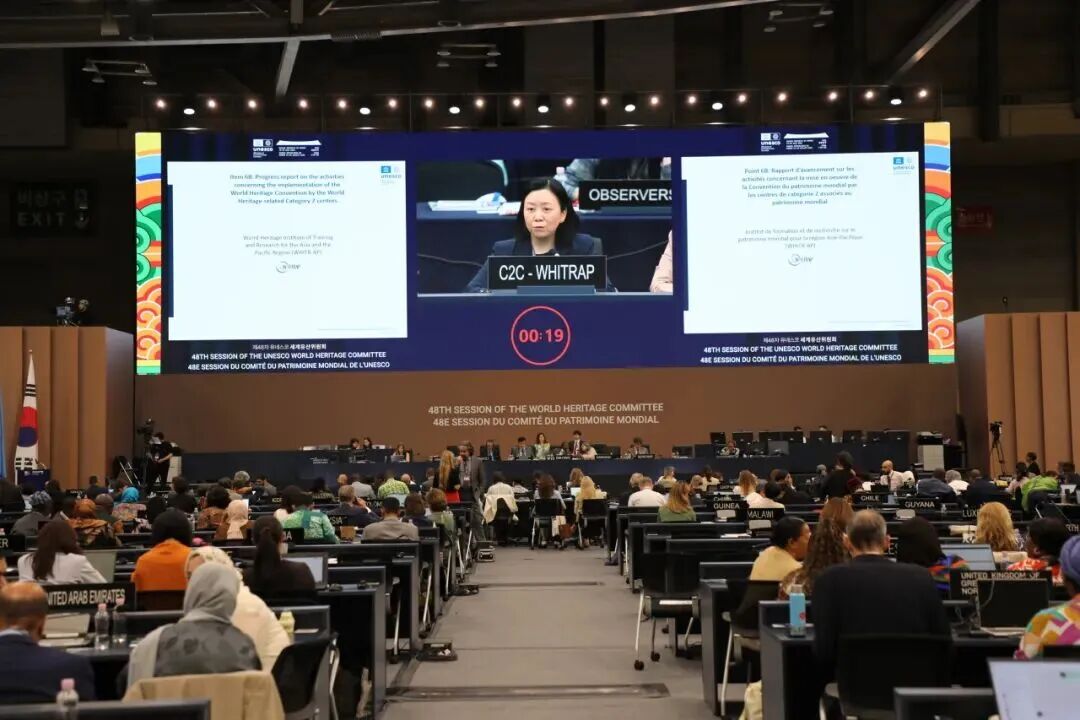
On the afternoon of 21 July 2026, in Busan, Republic of Korea, the 48th session of the World Heritage Committee convened. Professor Shao Yong, Secretary-General of the UNESCO World Heritage Institute of Training and Research for the Asia and the Pacific Region (WHITRAP) — a Category 2 centre under the auspices of UNESCO hosted by the College of Architecture and Urban Planning, Tongji University — presented the centre's annual work report to the Committee.
Over the past year, WHITRAP organized more than 50 activities across the Asia-Pacific region — including training programmes, conferences, lectures, and exhibitions — engaging nearly 14,000 participants from approximately 50 countries and territories. The centre's agreement with UNESCO was extended, and a successful on-site external evaluation of its Category 2 status was completed.
Professor Shao highlighted progress across four strategic areas. In heritage and sustainable development, WHITRAP jointly developed with the UNESCO World Heritage Centre and UN-Habitat the Five-Year Plan for Urban-Rural Heritage Conservation and Sustainable Development (2026–2030), and released the Guide on Cultural and Creative Industries Policy Recommendations for Gansu Province with support from the UNESCO Beijing Office. In capacity building, eight training courses and workshops reached over 300 professionals from 23 countries, and the official Chinese edition of the World Heritage Impact Assessment Guidance and Toolkit was launched. The centre also provided technical support for nominations — including a China–Egypt joint nomination — and extended assistance to Small Island Developing States and African countries. In partnership development, WHITRAP renewed a six-year cooperation agreement with ICCROM and launched the World Heritage Young Craftsmen programme.
Following review, the Committee adopted Decision 48 COM 6B, which welcomes the contributions of Category 2 centres, encourages their continued role in capacity building, knowledge-sharing, and resource mobilization, and recognises them as key partners in implementing the World Heritage Capacity-Building Strategy (2025–2035). The decision requests all Category 2 centres to submit their next progress reports by 1 March 2027 for examination at the 49th session.
This presentation underscores WHITRAP's growing role as a regional hub for heritage protection and Tongji University's commitment to advancing global cultural and sustainable development agendas.

NO.1239 Rd. Siping, SHANGHAI


