 ABOUT US
NEWS

DigitalFUTURES
2026 International Conference
on Computational Design and Robotic Fabrication
(DigitalFUTURES CDRF 2026)
Date: 8–10 July 2026
Location: School of Built Environment, UNSW Sydney, Australia
Hosted by: Arch_Manu ARC Centre for Next-Gen Architectural Manufacturing, UNSW Sydney
About the Conference
DigitalFUTURES was founded in 2011 by the College of Architecture and Urban Planning (CAUP) at Tongji University, and has since grown into one of the most influential academic exchange platforms in the field of computational architectural design worldwide. In 2026, the conference arrives in Australia for the first time. This edition (CDRF2026) will be held at UNSW Sydney, ranked #1 among Australian universities in the QS World University Rankings. Join us at UNSW Sydney for three days of research presentations, keynote talks, masterclasses, industry exchange, and international discussion on the future of circular, digitally enabled and robotically fabricated built environments.
The architecture, engineering and construction sector is undergoing a dual transformation: the shift towards digitalisation and the urgent transition towards circularity. Yet the integration of these two agendas remains at an early stage.
As one of the largest contributors to global carbon emissions, the built environment sector faces mounting pressure to reduce environmental impact, improve productivity and respond to workforce and supply chain challenges. These issues are intensified by industry fragmentation and the limited pathways available for research-led innovation.
Under the theme Circular Intelligence, CDRF2026 invites researchers, designers, engineers, technologists, fabricators and industry partners to explore how computational design, digital technologies, robotics and advanced manufacturing can support a circular transformation of the built environment.
Hosted by the ARC Centre for Next-Gen Architectural Manufacturing (Arch_Manu) at UNSW Sydney, CDRF2026 brings together an international community to exchange knowledge, prototype ideas and shape the next frontier of a digitally enabled, regenerative construction future.
Hosted by Arch_Manu ITTC at UNSW Sydney
CDRF2026 is hosted by the ARC Centre for Next-Gen Architectural Manufacturing, Arch_Manu ITTC, at UNSW Sydney. Arch_Manu brings together researchers, industry partners and institutions to advance next-generation architectural manufacturing through computational design, robotics, digital fabrication, advanced materials and future construction systems.

Conference Theme: Circular Intelligence
Circular Intelligence asks how digital and circular design practices can come together to reshape the way buildings, materials, systems and construction processes are imagined, produced, used, disassembled and reused.
The conference welcomes research across architecture, computational design, robotic fabrication, digital construction, artificial intelligence, extended reality, data-informed design, advanced manufacturing and circular systems thinking.
CDRF2026 focuses on three interconnected areas:
1.Circular Design
Research exploring data analytics for design decision-making, the reuse of data from past projects, automation for sustainability outcomes, digital twins, AI, machine learning, IoT, VR, AR and MR in support of circular design transformation.
2.Circular Construction
Research addressing digitally augmented design-to-manufacture processes, computational approaches to low-carbon and climate-positive construction, Modern Methods of Construction, additive and subtractive manufacturing, circular and bio-based materials, robotic deconstruction, disassembly and human-machine collaboration.
3.Circular Systems
Research examining future scenarios, circular collaboration, sector-wide workflows, resilient business models for architecture, engineering, construction and operation, and the future of architectural education and training.
All accepted papers identify the United Nations Sustainable Development Goals addressed by the research.
Keynote Speakers
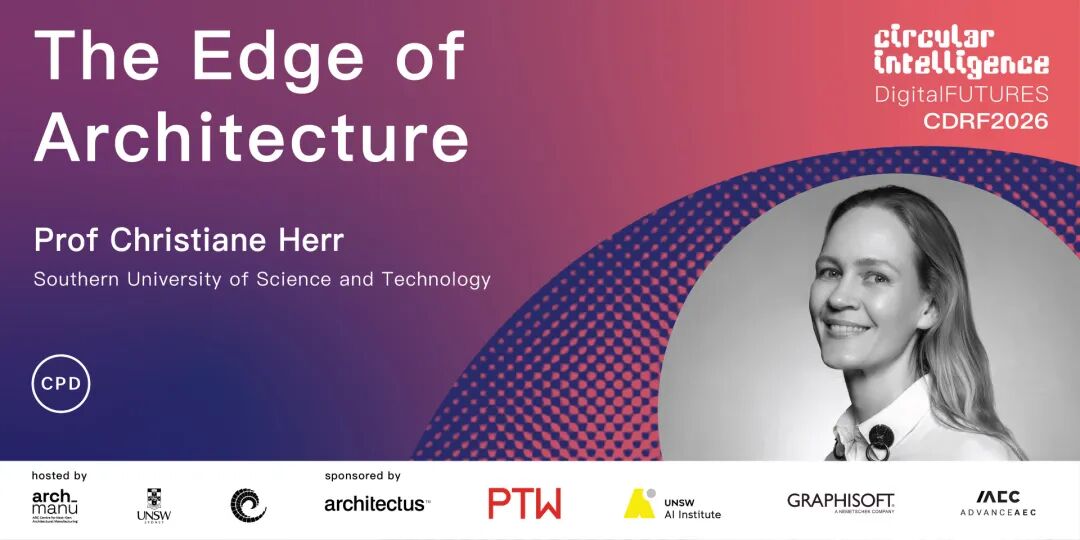
Christiane M. Herr
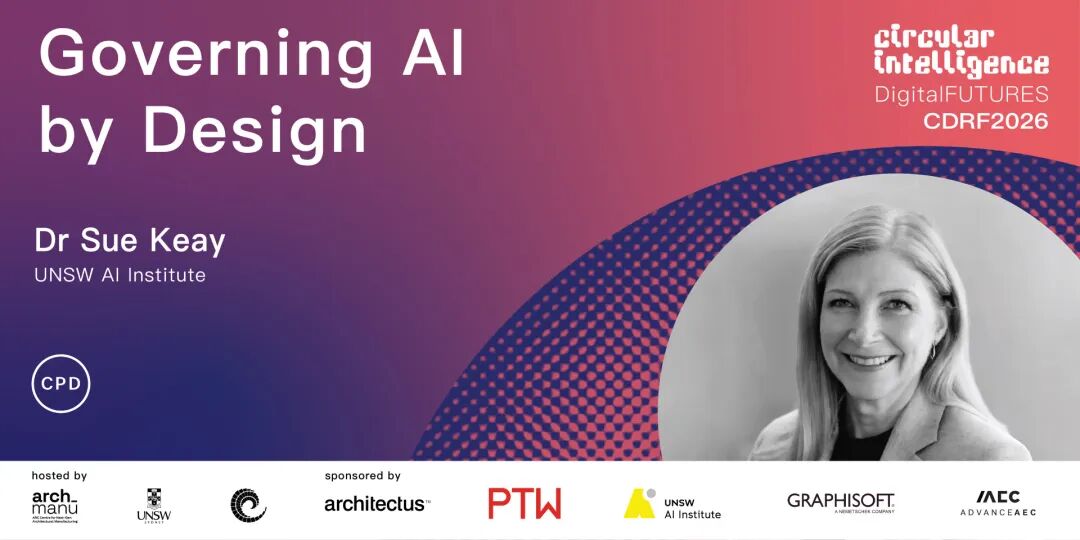
Sue Keay
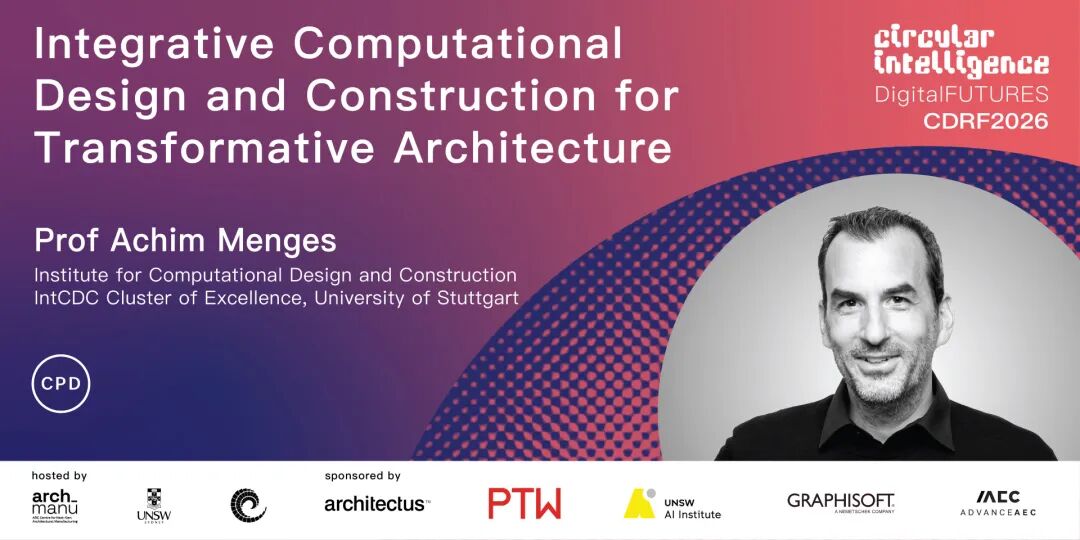
Achim Menges
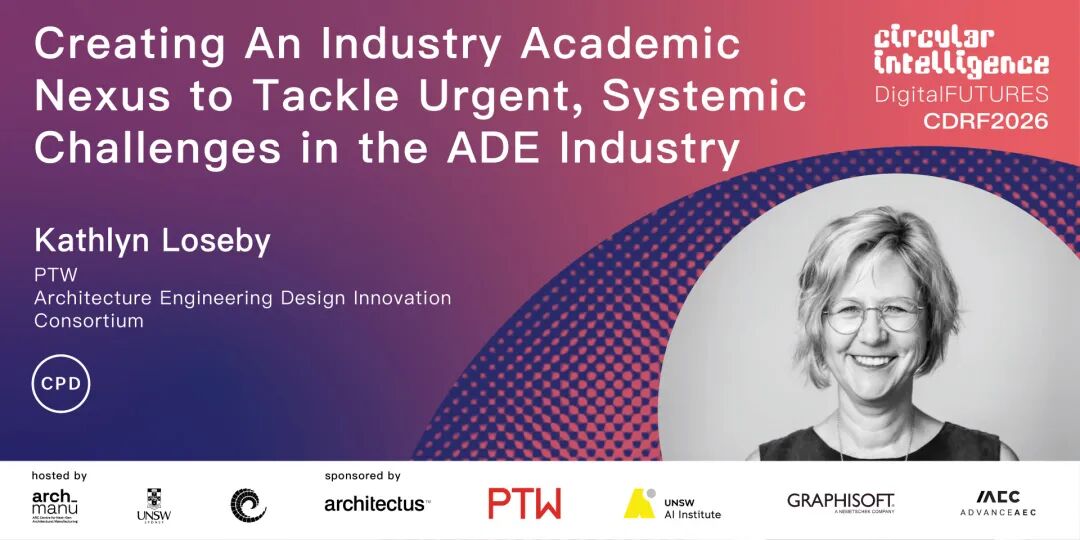
Kathlyn Loseby
CDRF2026 brings together leading international voices in computational design, artificial intelligence, circular construction, architecture, robotics and digital fabrication. Each keynote will be offered as a formal CPD activity (1 point) for registered architects.
Keynote-only tickets available. Want to see a keynote but unable to attend the whole conference? Limited tickets will be sold seperately for each keynote — see Eventbrite links below for details.
Prof Christiane M. Herr
Southern University of Science and Technology, Shenzhen
Prof Christiane M. Herr is a professor and researcher working across architectural design, ecological design, advanced façade technologies and digitally supported design. Her work connects design research, education and cross-disciplinary collaboration in response to complex environmental and technological challenges.
Dr Sue Keay
Director, UNSW AI Institute
Dr Sue Keay is a leader in robotics, artificial intelligence and automation. As Director of the UNSW AI Institute, her work supports the responsible development and application of emerging technologies across research, industry and society.
Prof Achim Menges
University of Stuttgart
Prof Achim Menges is a registered architect and professor at the University of Stuttgart, where he is the founding director of the Institute for Computational Design and Construction. His internationally recognised work explores computational design, robotic fabrication, material systems and integrative construction methods.
Kathlyn Loseby
ADEIC
Kathlyn Loseby is an architectural leader with extensive experience across practice, professional advocacy and the built environment. Further speaker details will be announced shortly.
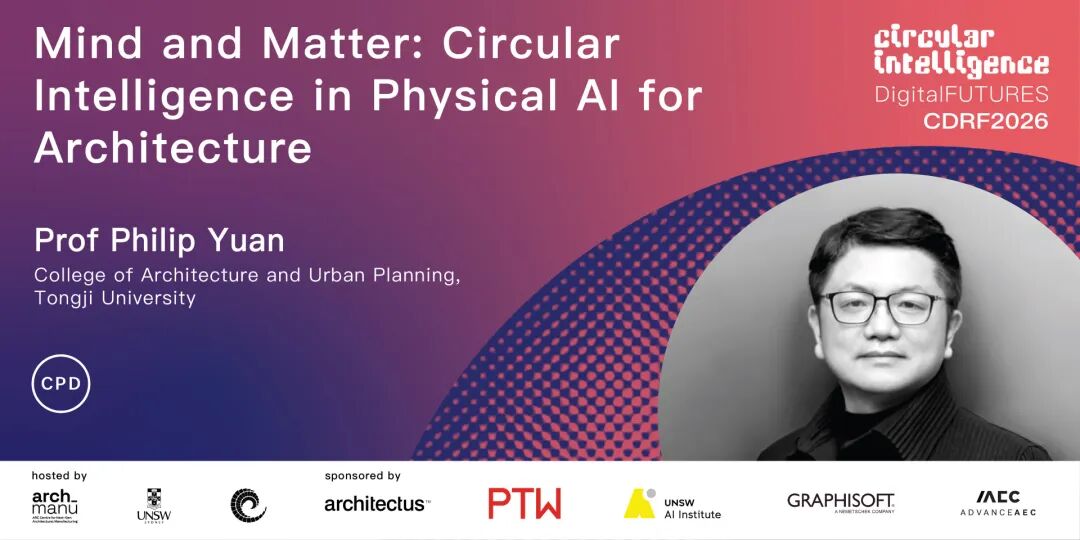
Prof Philip F. Yuan
Tongji University, Shanghai
Prof Philip F. Yuan is a leading scholar and practitioner in computational design and robotic fabrication. He is Professor and Dean of the College of Architecture and Urban Planning at Tongji University and a key figure in the DigitalFUTURES community.
Masterclasses
The DigitalFUTURES 2026 Masterclass program invites participants into hands-on experimentation at the intersection of computational design, circular construction and emerging digital fabrication workflows. Across a series of practical workshops, participants will explore 3D scanning for adaptive reuse and low-carbon documentation, robotic timber fabrication using industrial and collaborative robots, 3D concrete printing design through the Lamina platform, and Polyhedral Graphic Statics for structurally informed tensile and fabric-based structures. Together, these sessions translate the conference theme of Circular Intelligence into applied design methods, demonstrating how digital tools can support more resource-efficient, adaptable and materially aware approaches to the built environment.
The program also introduces emerging design-to-construction workflows using augmented reality-assisted assembly, AI-enabled BIM management and Model Context Protocol connections between large language models and building information modelling software. Participants will work with tools and platforms such as Rhino, Grasshopper, HoloLens, Archicad and Claude to investigate model validation, robotic sequencing, digital-to-physical coordination, information quality control and data-informed decision-making. Designed for researchers, students, designers, architects and technologists, the masterclasses offer a practical environment to test ideas, build new skills and engage directly with the technologies shaping the future of circular architectural practice.
All masterclasses will be linked to the workflows involved in developing and delivering the CDRF2026 Demonstrator structure, which will be on display during the conference. Each masterclass will offer 3 formal CPD points for registered architects.
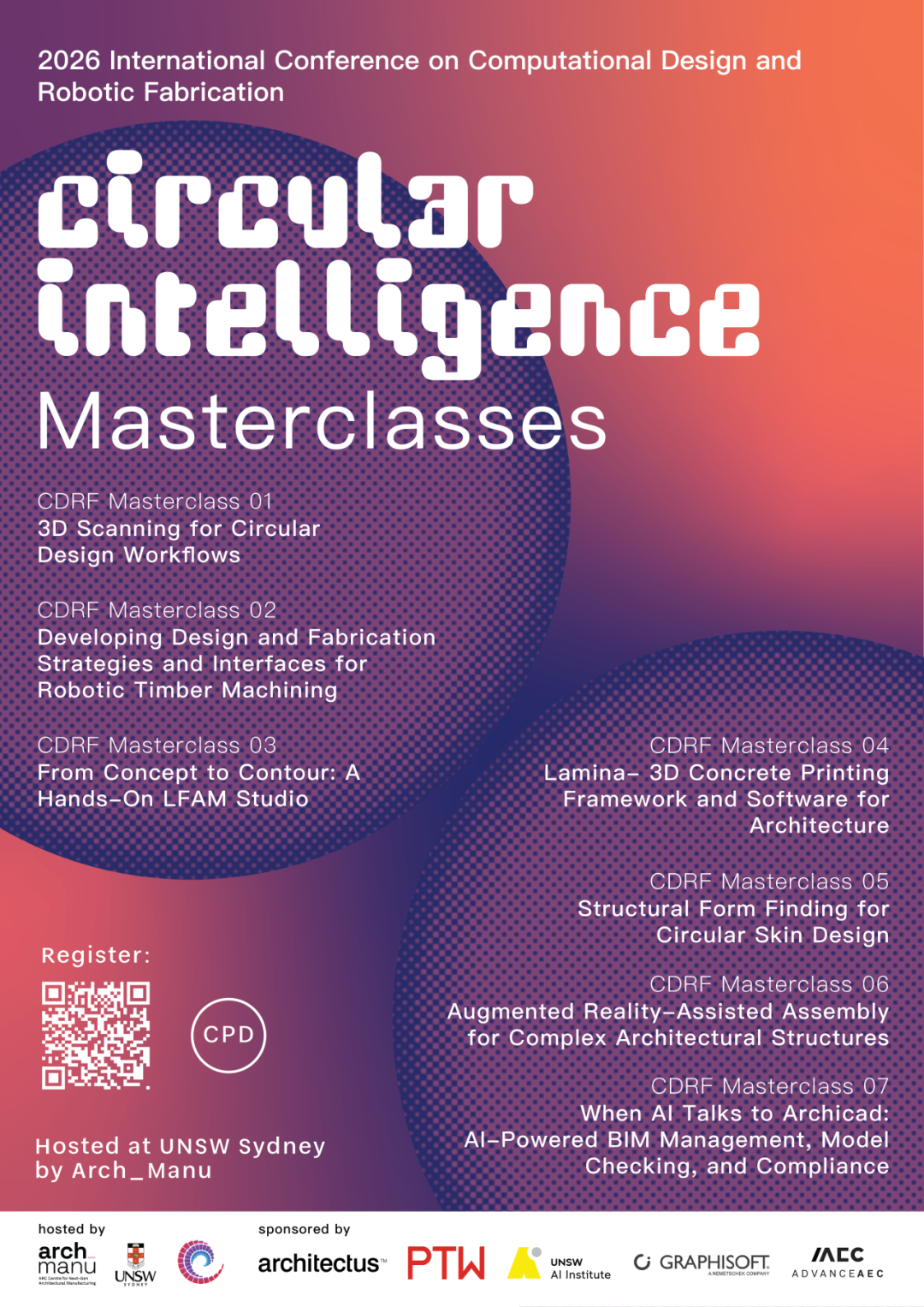
MC01 3D Scanning for Circular Design Workflows
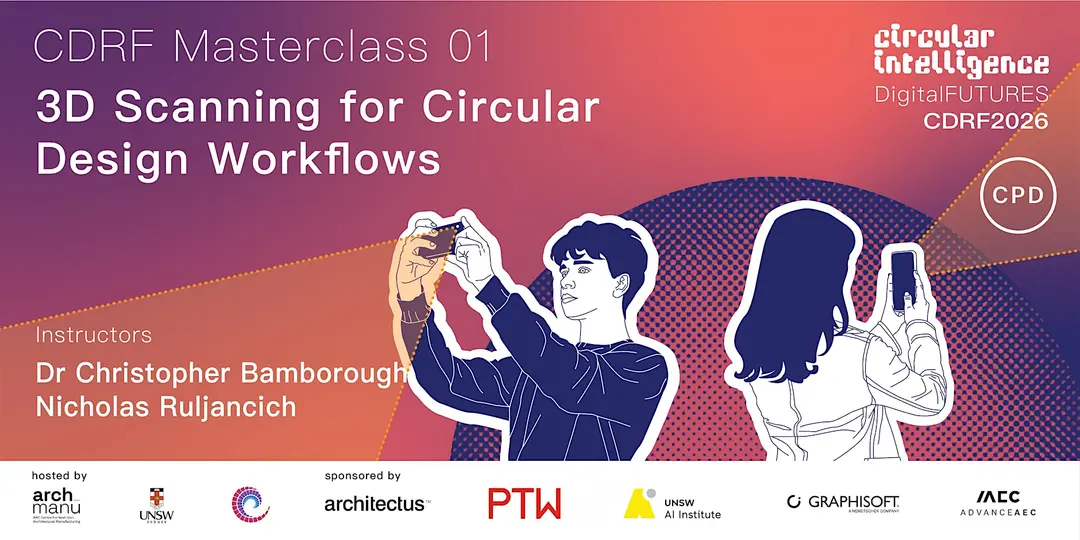
This workshop introduces participants to contemporary 3D scanning techniques and digital workflows within the context of circular design principles and low-carbon architectural practice. The session begins with a presentation exploring the role of 3D scanning in capturing existing conditions, reducing material waste, supporting adaptive reuse, and extending building lifecycles through accurate digital documentation. Participants will then undertake one hour of practical scanning experience using handheld or mobile scanning technologies, followed by a one-hour software session focused on processing, visualising, and interpreting scan data. The workshop demonstrates how digital capture technologies can support resource-efficient decision-making, retrofit strategies, and data-informed approaches to a more circular built environment.
MC02 Developing Design and Fabrication Strategies and Interfaces for Robotic Timber Machining
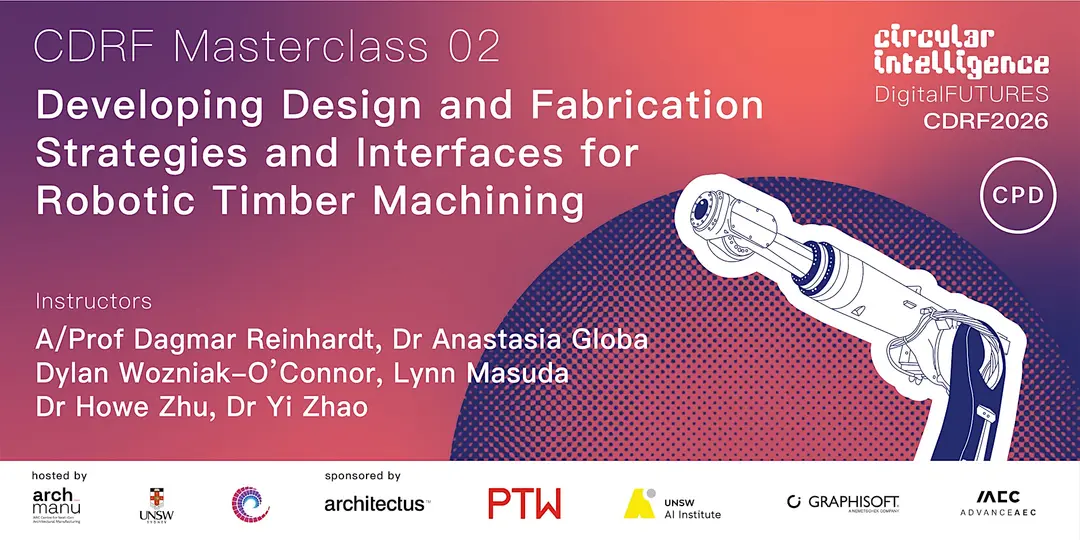
This hands-on workshop explores strategies and interfaces for computational design to robotic timber fabrication through multi-axis cutting, assembly, and robotic control. Participants will engage with advanced robotic fabrication workflows using a KUKA KR120 industrial robot equipped with a high-speed spindle for precision timber cutting, alongside UR5 and UR10 collaborative robots for robotic handling, assembly, and testing. The workshop combines an introduction to robotic timber construction, design-for-disassembly, and modular fabrication strategies with live demonstrations of robotic milling, toolpath generation, and robotic sequencing.
In the interactive session, participants will develop and simulate their own robotic tool paths using a parametric design workflow, before executing selected fabrication and assembly routines on the robots. Through direct interaction with robotic systems, the workshop investigates how robotic fabrication can support precision timber processing, modular construction, reversible joints, and circular material workflows in contemporary architecture and advanced manufacturing.
MC03 From Concept to Contour: A Hands-On LFAM Studio
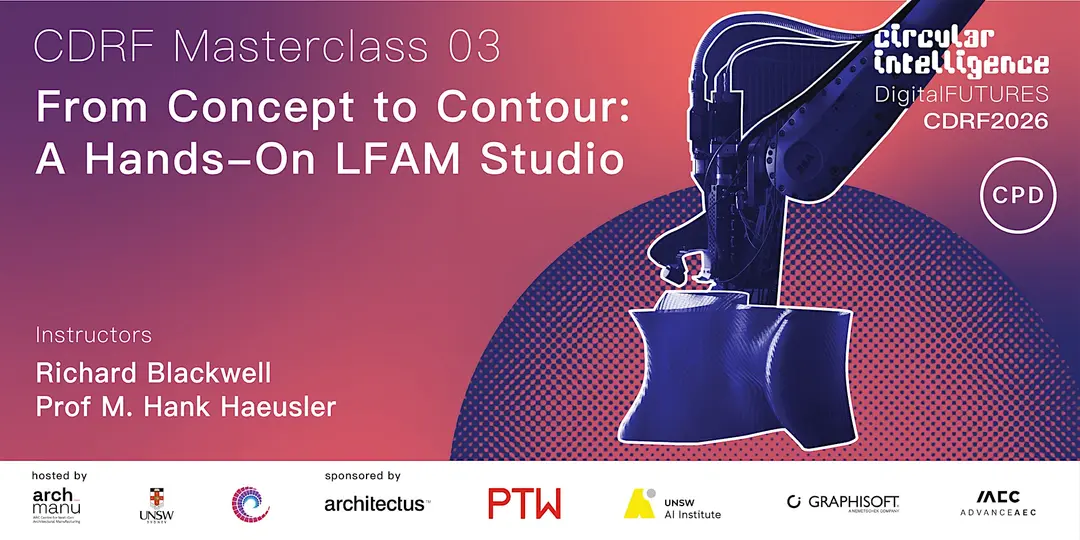
This masterclass offers an applied introduction to Large-Format Additive Manufacturing (LFAM) for the built environment. Participants will first explore the current state of the art through a curated overview of emerging technologies and real-world case studies, with a focus on how complex fabrication challenges were navigated in practice. The session then moves into a hands-on computational workshop, guiding participants through robotic slicing workflows using Rhino and Grasshopper. The final phase transitions to the studio floor for live demonstrations across multiple LFAM systems. Attendees will leave with practical knowledge, reusable digital resources, and direct exposure to architectural-scale robotic 3D printing.
MC04 Lamina — 3D Concrete Printing Framework and Software for Architecture
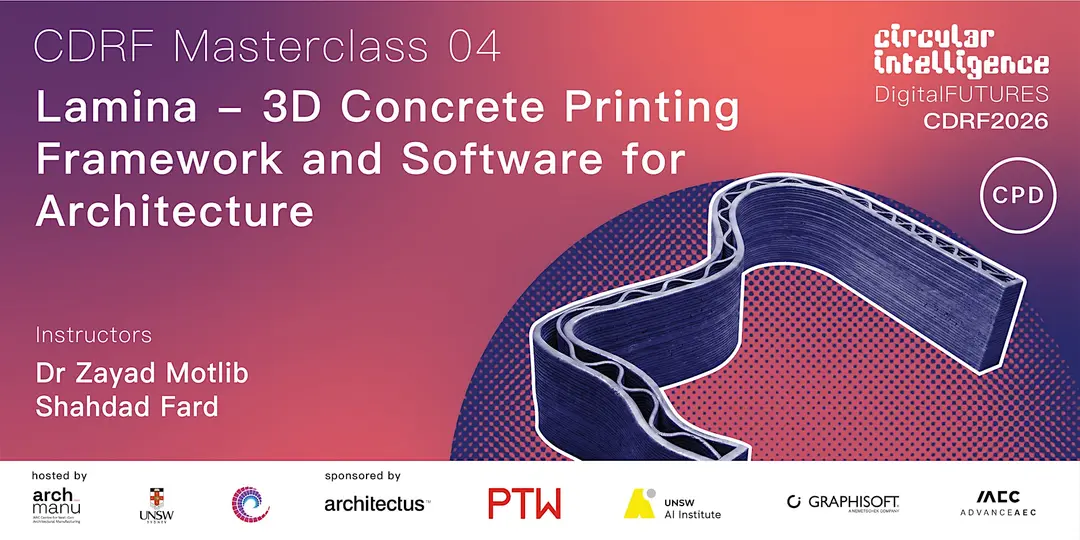
The workshop introduces Lamina, a software platform developed at UNSW, to guide the architects to design for 3D Concrete Printing (3DCP) through three integrated components: the assessor, optimiser, and generator. Participants will engage in a hands-on design process that explores the opportunities and constraints of 3DCP, progressing from evaluating an initial architectural sketch, architectural and structural optimization, to toolpath generation (G-code) and production of optimized and printable 3D models.
Three-Dimensional Concrete Printing (3DCP) is rapidly emerging as a transformative construction technology, yet architectural design workflows often lag behind its technical advancements, limiting its broader adoption. This workshop introduces Lamina, a software platform developed to bridge this gap by guiding architects to design for 3DCP through three integrated components: the assessor, optimiser, and generator. Participants will engage in a hands-on design process that explores the opportunities and constraints of 3DCP, progressing from an initial architectural sketch, optimisation process, segmentation to toolpath generation G-code. The workshop is designed for participants with beginners / intermediate level in Rhino/Grasshopper who are interested in computational design and fabrication, and Concrete 3D printing technolgy.
MC05 Structural Form Finding for Circular Skin Design
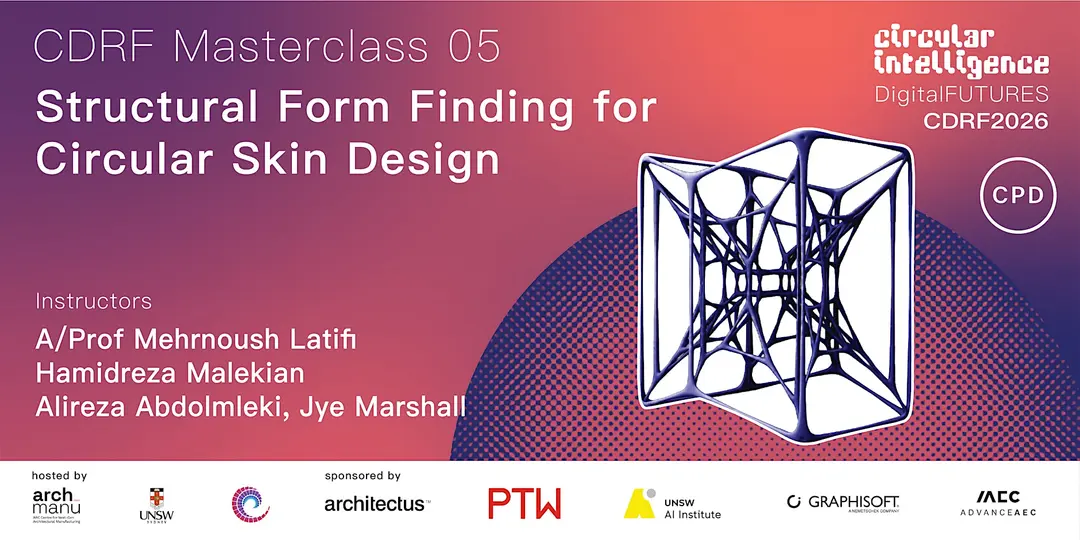
This three-hour masterclass introduces participants to the relationship between structural form, force flow, and equilibrium through Polyhedral Graphic Statics (PGS). The workshop focuses on tensile and fabric-based structures, using polyhedral force geometry as a design method for generating structurally informed forms.
Participants will move through a complete workflow: from understanding the geometric principles of equilibrium, to generating and refining a digital model in Rhino/Grasshopper using PolyFrame 2, and finally to assembling a physical scale model using fabric panels and 3D-printed joints. The aim is not only to teach a computational tool, but to develop structural intuition through the direct comparison between digital prediction and material behaviour.
The workshop is designed for participants with some prior experience in Rhino/Grasshopper who are interested in computational design, form-finding, fabrication, and the physical behaviour of lightweight systems.
MC06 Augmented Reality-Assisted Assembly for Complex Architectural Structures
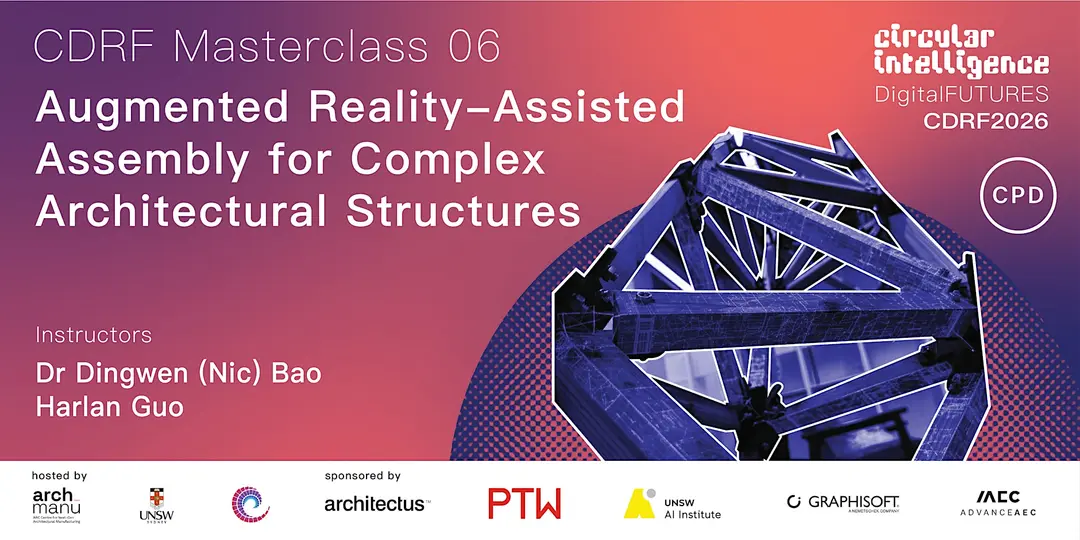
This masterclass introduces augmented reality-assisted assembly as a design-to-construction workflow for complex architectural structures. Participants will explore how digital models, parametric geometry and AR guidance can support accurate, efficient and hands-on assembly processes. Using Rhino, Grasshopper, smartphones and HoloLens devices, the session demonstrates how construction information can be translated from screen-based design into physical assembly tasks. The masterclass focuses on reducing errors, improving spatial coordination, supporting material efficiency and enabling more adaptable construction methods. It is suitable for participants interested in computational design, digital fabrication, architectural technology and emerging workflows for resource-conscious complex structures.
The CDRF2026 program includes keynote presentations, peer-reviewed paper sessions, masterclasses, research discussions, networking events and the closing awards event.
Wednesday 8 July 2026
8.30–9.00am | Masterclasses Registration |
9.00–12.00pm | Masterclasses 1 / 2 / 3 |
12.00–1.30pm | Lunch |
1.30–4.30pm | Masterclasses 4 / 5 / 6 |
4.30–5.30pm | CDRF2026 Registration /Welcome Drinks |
5.30–6.30pm | Opening Ceremony |
6.30–8.00pm | Keynote: Prof Candy Herr |
Thursday 9 July 2026
8.30–9.00am | Registration |
9.00–10.30am | Keynote: Dr Sue Keay |
10.30–12.30pm | Presentation sessions |
12.30–1.30pm | Lunch |
1.30–5.00pm | Presentation sessions |
5.00–5.30pm | Lamina launch |
5.30–6.30pm | Lamina drinks |
6.30–8.00pm | Keynote: Prof Achim Menges |
Friday 10 July 2026
8.30–9.00am | Registration |
9.00–10.30am | Keynote: Kathlyn Loseby |
10.30–12.30pm | Presentation sessions |
12.30–1.30pm | Lunch |
1.30–5.00pm | Presentation sessions |
5.00–5.30pm | Break |
5.30–6.30pm | Closing ceremony |
6.30–8.00pm | Keynote: Prof Philip Yuan |
8.00pm– | Afterparty |
Program subject to final confirmation.
Registration
Registration is now open for the DigitalFUTURES 8th International Conference on Computational Design and Robotic Fabrication.
General RegistrationAUD $300 + GST per person
Student RegistrationAUD $150 + GST per person
Valid student certification is required for student registration.
At least one author of each accepted paper must register and attend the conference in person to present the work.
Committee

Hosted by Arch_Manu ITTC at UNSW Sydney
CDRF2026 is hosted by the ARC Centre for Next-Gen Architectural Manufacturing, Arch_Manu ITTC, at UNSW Sydney. Arch_Manu brings together researchers, industry partners and institutions to advance next-generation architectural manufacturing through computational design, robotics, digital fabrication, advanced materials and future construction systems.
Sponsors
CDRF2026 would like to acknowledge and thank all of our sponsors that made this conference possible.
Acknowledgement of Country
CDRF2026 acknowledges the Bedegal people, the Traditional Custodians of the land on which UNSW Kensington campus is located. We pay our respects to Elders past and present, and extend that respect to Aboriginal and Torres Strait Islander peoples joining the conference.
Committee
Conference Chair:
Prof M. Hank Haeusler, UNSW
Co-Chairs:
Prof Mark Burry, Swinburne University of Technology
Prof Jane Burry, Adelaide University
Prof Blair Kuys, Swinburne University of Technology
Dr. Dingwen 'Nic' Bao, RMIT University
Dr Ivana Kuzmanovska, UNSW
Conference Secretary:
Dr Farnaz Fattahi, UNSW
Master Class Coordinator:
Dr Mehrnoush Latifi Khorasgani, Swinburne University of Technology
Editorial Committee:
Prof. Hank Haeusler, UNSW;
Dr. Dingwen 'Nic' Bao, RMIT University;
Dr Ivana Kuzmanovska, UNSW;
Dr Christopher Bamborough, UNSW;
Dr. Yige Liu, Tongji University;
Prof. Philip Yuan, Tongji University
Contact
For conference enquiries, please contact the CDRF2026 Organising Committee.
Email: archmanu@unsw.edu.au
Location: UNSW Sydney, Australia

DigitalFUTURES
DigitalFUTURES is launched by College of Architecture and Urban Planning(CAUP), Tongji University and Shanghai Digital Architecture Fabrication Technology Center (SFAB) in 2011. International Union of Architects (UIA), Architectural Society of China (ASC), National Engineering Technology Research Center for Prefabrication Construction in Civil Engineering, and The Architectural Society of Shanghai China (ASSC) collaborate with global renowned scholars, architects, designers, enterprises and academic media in this field to establish an online and offline integrated educational platform relying on Architectural DigitalFUTURES. The events are consisting of lectures, conferences, workshops and exhibitions, etc. Nowadays, DigitalFUTURES as a global architecture exchange community, with the platform www.digitalfutures.world, encourages the inheritance and innovation, collaboration and communication of global knowledge in architecture and emphasizes scientific research about digital design theory, technology and artificial intelligence algorithms, robotic fabrication, etc. in the field of architecture and built environment.

NO.1239 Rd. Siping, SHANGHAI


