 ABOUT US
NEWS


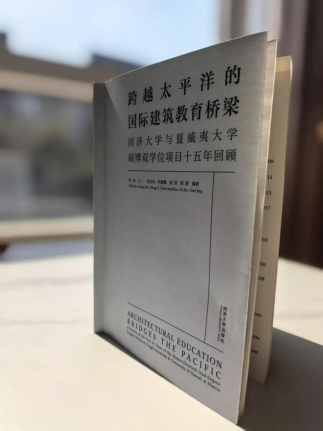
In March 2026, Tongji University Press published the bilingual volume An International Bridge for Architectural Education Across the Pacific: Fifteen Years of the Tongji University–University of Hawai‘i Dual Degree Program. The book commemorates a remarkable journey of academic collaboration and serves as a testament to the enduring commitment of Tongji University’s College of Architecture and Urban Planning (CAUP) to internationalization, educational innovation, and global engagement.
Over the past fifteen years, a visionary partnership has grown into one of the most influential international architectural education programs between China and the United States. Connecting two distinguished institutions across the Pacific Ocean, the dual-degree program has fostered educational exchange, academic excellence, and the cultivation of globally minded architectural professionals.
The story of the program began in 2005, when a delegation led by Professor Wu Zhiqiang, then Dean of the College of Architecture and Urban Planning (CAUP) at Tongji University, visited the University of Hawai‘i at Mānoa. Inspired by shared educational values and complementary academic strengths, the two institutions launched preparations for a joint degree program in 2010 and formally signed an agreement in December 2011. The first cohort of students enrolled in 2012.
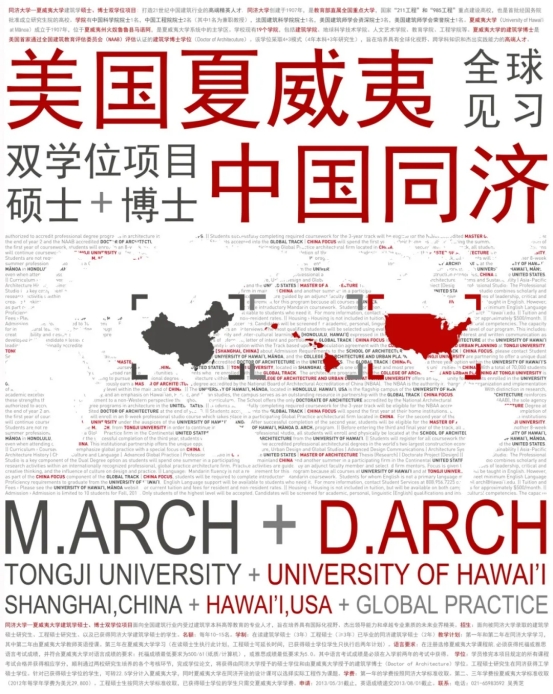
As China’s first architecture dual-degree program recognized by both Chinese and U.S. professional accreditation systems, the Global Track program enables students to earn a Master of Architecture degree from Tongji University and a Doctor of Architecture degree from the University of Hawai‘i. The program has created a unique pathway for cultivating internationally competitive architectural professionals with cross-cultural perspectives and global expertise.
Over the past fifteen years, the partnership has expanded far beyond student exchange. Faculty members from both universities have jointly developed curricula, conducted collaborative teaching and research, and supervised students across borders. The program has also provided students with internship opportunities at leading architectural firms and institutions throughout the Asia-Pacific region and the United States.
To date, the program has admitted 74 students, with 58 successfully earning dual degrees. Graduates now work in universities, design firms, government agencies, and technology companies around the world, contributing to international architectural practice and research.
The publication of the book marks not only a milestone in the history of the Tongji–Hawai‘i partnership, but also a new chapter in Tongji University’s efforts to promote international collaboration and cultivate future leaders in architecture and urban development.

NO.1239 Rd. Siping, SHANGHAI


