 ABOUT US
NEWS


Architectural Theory and History Ⅰ:
Topics of Traditional Chinese Architecture
Brief Introduction
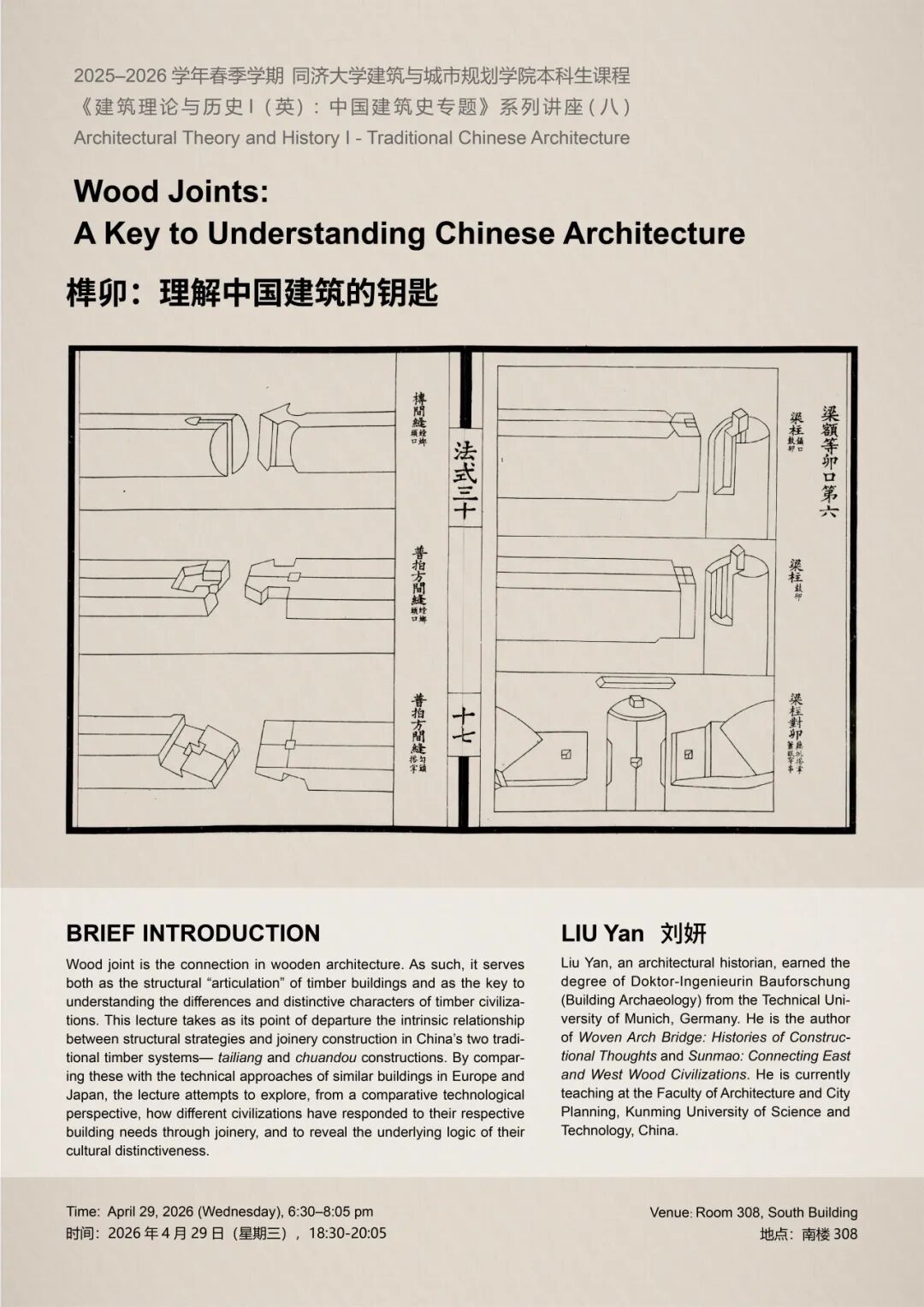
Wood joint is the connection in wooden architecture. As such, it serves both as the structural articulation of timber buildings and as the key to understanding the differences and distinctive characters of timber civilizations. This lecture takes as its point of departure the intrinsic relationship between structural strategies and joinery construction in China's two traditional timber systems— tailiang and chuandou constructions. By comparing these with the technical approaches of similar buildings in Europe and Japan, the lecture attempts to explore, from a comparative technological perspective, how different civilizations have responded to their respective building needs through joinery, and to reveal the underlying logic of their cultural distinctiveness.
Lecturer
LIU Yan
LIU Yan, an architectural historian, earned the degree of Doktor-Ingenieurin Bauforschung (Building Archaeology) from the Technical University of Munich, Germany. He is the author of Woven Arch Bridge: Histories of Constructional Thoughts and Sunmao: Connecting East and West Wood Civilizations. He is currently teaching at the Faculty of Architecture and City Planning, Kunming University of Science and Technology, China.
Time & Venue
Time:
April 29, 2026 (Wednesday)
6:30–8:05 pm
Venue:
Room308, South Building
Reference
Liu, Yan. “Joinery and Structure: Cultural and Technical Comparison between Traditional Wooden Framing Systems in East Asia and Western Europe”. Chinese Annals of History of Science and Technology 6 (1), 089–118 (2022)
Zwerger, Klaus. Wood and Wood Joints: Building Traditions of Europe, Japan and China. Fourth, Revised and Expanded edition. Birkhäuser, 2023.

NO.1239 Rd. Siping, SHANGHAI


