 ABOUT US
NEWS

Call for Students
2026 Tongji CAUP International Summer School
Event Period: July 18th- 26th, 2026
Student Selection: 30 international students worldwide
Host Institution: College of Architecture and Urban Planning - CAUP, Tongji University, Shanghai, P.R.China
Supporting International Organizations: UIA, RIBA
01
THEME
Shanghai LAB: The Re-Figuration on Architecture and Urban Space
SUB-THEME
[1] Re-Figuration of Urban Space
[2] Re-Figuration of Architectural Space
[3] Re-Figuration of Infrastructure
[4] Re-Figuration of Social Communication
[5] Re-Figuration of Artificial Intelligence & Space
[6] Re-Figuration of Future Heritage
02
ACADEMIC CONTEX
In the context of urban regeneration, the process of spatial transformation and its inherent tensions can be academically conceptualized as the Re-Figuration of Space. For architecture and urban environments, this re-figuration involves the restructuring of the city and urban public spaces, the reorganization of architectural functions and spatial configurations, the architectural and urban re-figuration of infrastructure, the transformation of transportation systems, the reconfiguration of social networks and communicative spaces, the spatial production shifts led by artificial intelligence, as well as the redefinition of future architectural and urban cultural heritage and its conservation. The 2026 Tongji CAUP International Summer Workshop draws academic focus from fundamental concepts of time and space, establishing a globalized framework of knowledge and technological perspective. By organizing collaborative workshops involving international faculty and students, it explores the significance and impact of local culture, urban environment, socio-economics, as well as climate change and resilience, on the future of cities and architecture.
03
RESEARCH SITE
The research site of this summer workshop is the Nanjing Road Pedestrian Street in Huangpu District, Shanghai. The study area spans approximately 1.5 kilometers, extending from Xizang Middle Road in the west to the Huangpu River in the east.
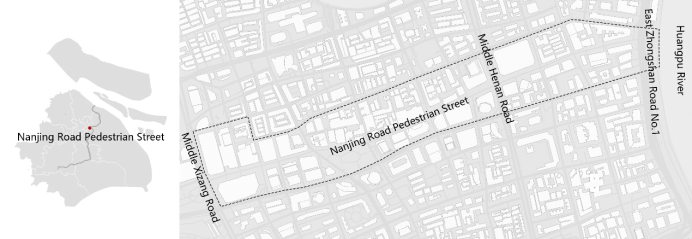
The location of Nanjing Road Pedestrian Street
The Nanjing Road Pedestrian Street is situated in the heart of Shanghai, connecting People's Square to the west and the Bund's architectural ensemble to the east. Since the opening of Shanghai as a commercial port, it has served as a quintessential and continuously evolving core specimen of urban commercial space transformation. Its spatial origins can be traced back to the 1840s, when it emerged as Garden Lane within the British concession, linking the Bund to the racecourse. As the racecourse expanded westward, it gradually evolved into Great Horse Road. In the early 20th century, the successive establishments of four major department stores—Sincere, Wing On, Sun Sun, and Sun—cemented its historical status as the Number One Commercial Street in China. The architectural styles along the street, characterized by a fusion of Chinese and Western elements and a juxtaposition of old and new, have formed a distinctive streetscape and a vessel of urban memory.
As a core historical district in Shanghai, Nanjing Road has been in a constant state of flux regarding its architectural forms and spatial configurations. This dynamic evolution encompasses the preservation and restoration of historical buildings, comprehensive adjustments to commercial业态, the inauguration of a 24-hour pedestrian street from Xizang Middle Road to Henan Middle Road in 1999, and the pedestrianization of the eastern extension section in 2020. Over its century-long trajectory, Nanjing Road has consistently responded to the evolving context of urban development, advancing a multi-layered, systemic spatial re-figuration across urban, architectural, and infrastructural scales.
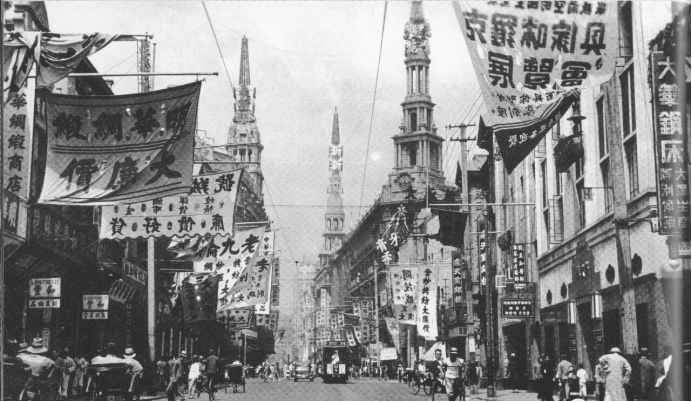
Nanjing Road in the 1930s and 1940s
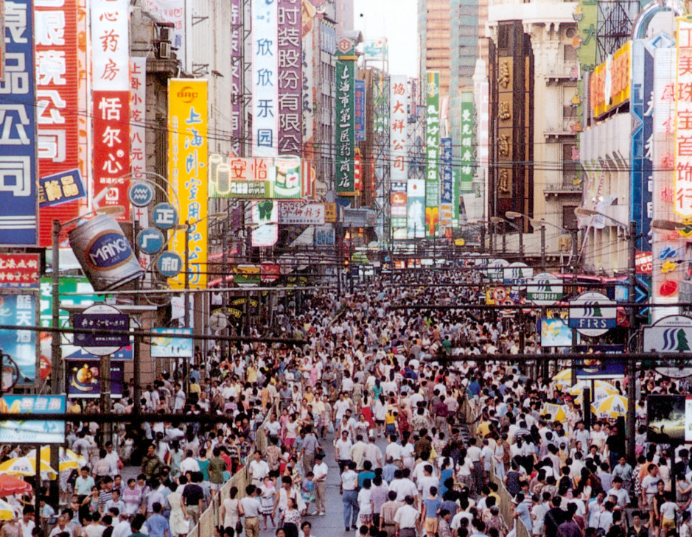
Nanjing Road in the 1990s
However, within the current context of urban development, Nanjing Road Pedestrian Street confronts a series of spatial structural dilemmas: commercial homogenization leading to the convergence of retail interfaces, the underutilization of historical and cultural resources in scenographic narration, and a pronounced spatial disconnection between the main thoroughfare and its backstreet areas. Consequently, the district finds itself ensnared in a paradox of spatial efficiency—characterized by high footfall yet low retention. This international summer camp will take Nanjing Road Pedestrian Street as the primary spatial object of study, focusing on the core theme of Re-figuration of Space. Through sustained, multi-dimensional workshops and discussions, it aims to analyze the structural issues inherent in existing urban spaces and explore potential pathways for their spatial re-figuration within the contemporary urban context.
04
INVITATION AND APPLICATION
The Tongji CAUP Summer School will continue the previous practice, with a combination of global open call and special invitation. The invited institutions are the top national and regional architectural planning and design colleges in the world. The program invites students from foreign institutions and domestic institutions. The accommodation in Shanghai for all students will be covered by the 2026 ISS. Camp participants should communicate in English.
报名起止日期
ENROLMENT DATE
From today to May 5th, 2026
THE MATERIALS SUPPOSED TO SUBMIT
1.
Application Form (Please scan the following QR code to download)

THE QR CODE OF APPLICATION FORM
2.
Portfolio including two pieces of works(The resolution of each picture is 300dpi)
ENROLMENT EMAIL
tjcaup_summer2026@163.com
Applicants will be selected on the basis of merit and will be judged by a panel of experts. The date of releasing formal invitation: May 20th, 2026.
2026 Tongji CAUP Summer School Committee
Tongji University
Shanghai, 2026-04-07
Reconnecting and Revitalizing 2025 TONGJI CAUP SUMMER SCHOOL
http://www.tongji-caup.org

NO.1239 Rd. Siping, SHANGHAI


