 ABOUT US
NEWS


Architectural Theory and History Ⅰ:
Topics of Traditional Chinese Architecture
Ethnic Architecture in the Three Parallel Rivers Region of Yunnan Province
Brief Introduction
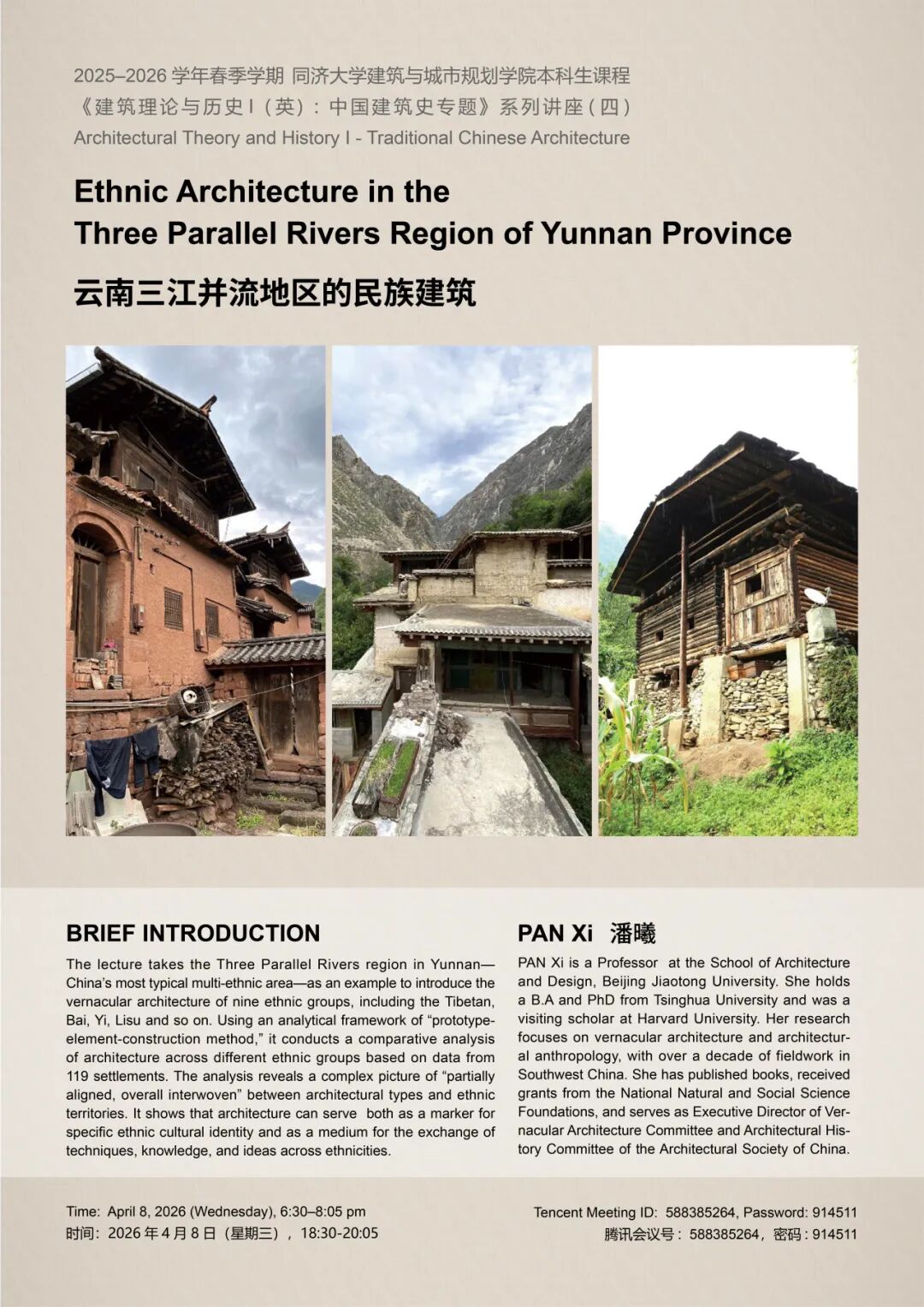
The lecture takes the Three Parallel Rivers region in Yunnan—China’s most typical multi-ethnic area—as an example to introduce the vernacular architecture of nine ethnic groups, including the Tibetan, Bai, Yi, Lisu and so on. Using an analytical framework of “prototype-element-construction method,” it conducts a comparative analysis of architecture across different ethnic groups based on data from 119 settlements. The analysis reveals a complex picture of “partially aligned, overall interwoven” between architectural types and ethnic territories. It shows that architecture can serve both as a marker for specific ethnic cultural identity and as a medium for the exchange of techniques, knowledge, and ideas across ethnicities.
Lecturer
PAN Xi
PAN Xi is a Professor at the School of Architecture and Design, Beijing Jiaotong University. She holds a B.A and PhD from Tsinghua University and was a visiting scholar at Harvard University. Her research focuses on vernacular architecture and architectural anthropology, with over a decade of fieldwork in Southwest China. She has published books, received grants from the National Natural and Social Science Foundations, and serves as Executive Director of Vernacular Architecture Committee and Architectural History Committee of the Architectural Society of China.
Time & Venue
Time:
April 8, 2026 (Wednesday)
6:30–8:05 pm
Venue:
Tencent Meeting ID: 588385264
Password: 914511
Reference
Vellinga, M., 2011. The end of the vernacular: anthropology and the architecture of the other. Etnofoor 23, 171–192.
Fei, X., 1999. The Pattern of Diversity in Unity of the Chinese Nation. Central Minzu University Press, Beijing.
Pan, X., Lin, X., 2025. Research on the Genealogy of Vernacular Architecture in Northwest Yunnan. China Architecture & Building Press, Beijing.

NO.1239 Rd. Siping, SHANGHAI


