 ABOUT US
NEWS

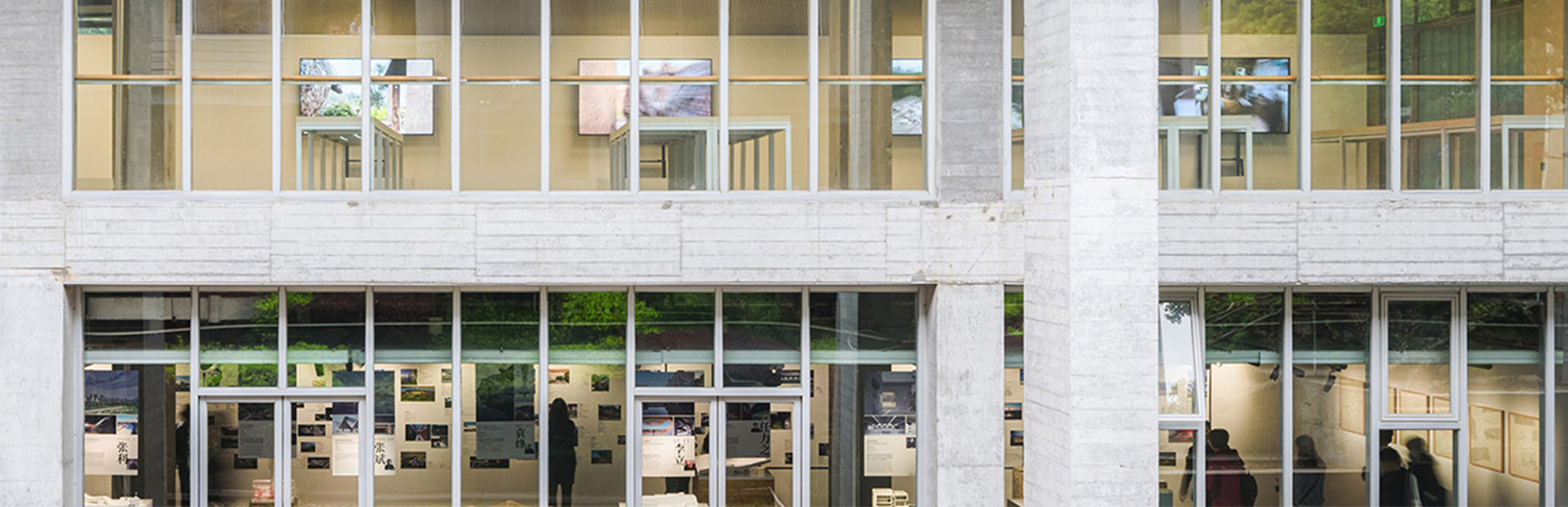
CAUP Tongji University Innovative Experimental Class
Fall 2025 Architecture Design Course Works Exhibition
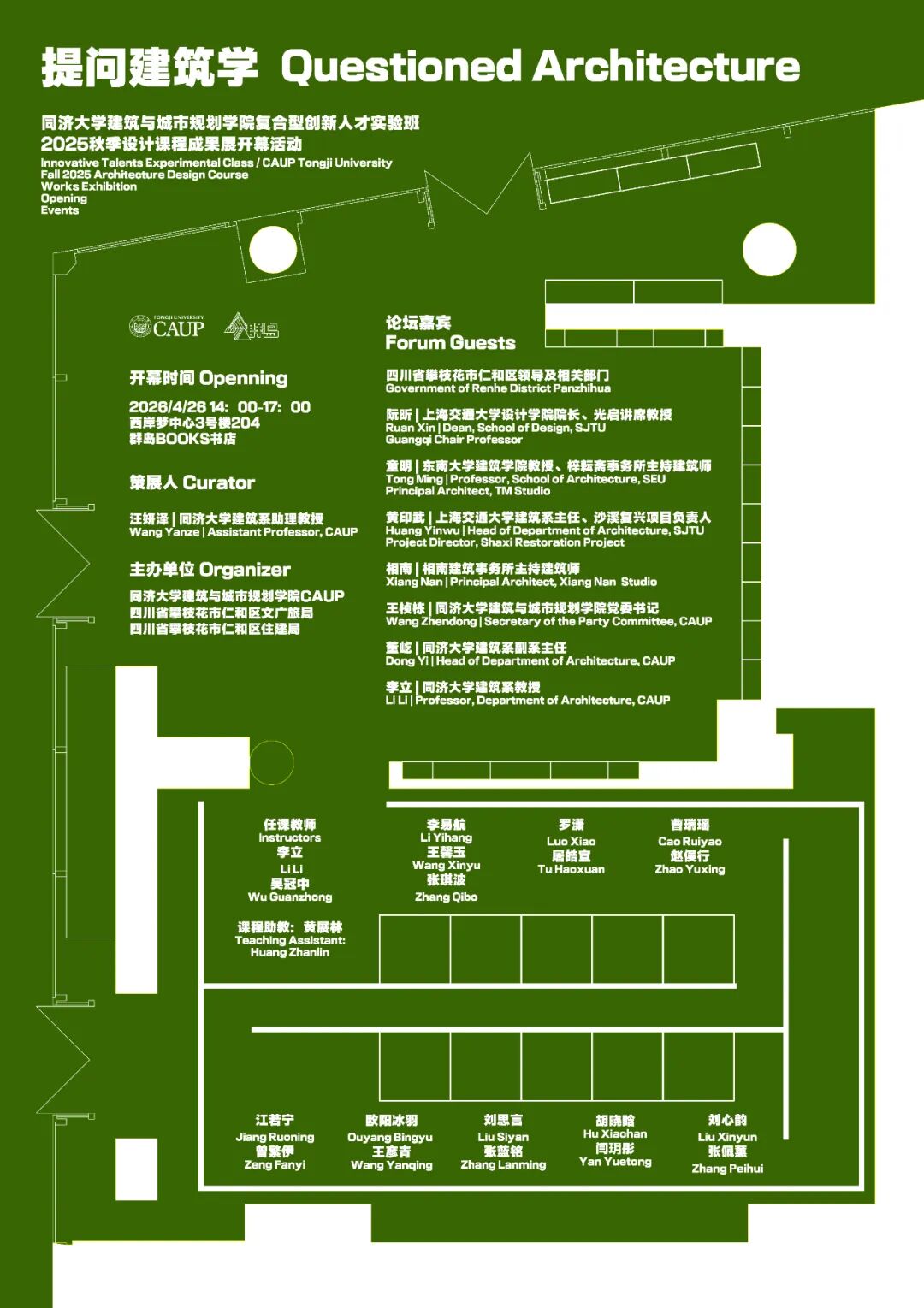
Questioned Architecture
In the age of AI breaking technical barriers and China’s slowed urbanization, urban and rural development has shifted to renewal. The ability to identify problems has thus become crucial for architects. Against this background, CAUP Tongji University Innovative Experimental Class, set “Questioning Architecture” as the theme for the 4th-year autumn design studio in 2024 and 2025. Adopting a Problem–Orientation–Concept–Operation framework, the course takes problem-finding as the core driver, guiding students’ logical thinking and spatial operations precisely.
In 2025, the course took Chengkun Railway’s industrial heritage as its theme, focusing on the abandoned Lazha Station in Renhe District and its surrounding context: natural landscapes, villages and industrial zones. Through field research, each group defined problems, set design directions, and selected sites within a 1-kilometer north-south range. Students conducted research and case analysis to develop solutions, put forward design concepts, and finalized them through spatial design.
Over the 8-week course, 8 groups completed creative regeneration designs for Lazha Station from different perspectives, offering 8 approaches for the revitalization of Chengkun Railway’s industrial heritage: Leverage existing railway training industry to develop research and education, driving integrated development of industrial heritage and rural settlements; Use wind (a unique feature of Jinsha River Canyon) as a medium to shape the experience of Chengkun Railway; Transform industrial heritage into landscape infrastructure and create innovative railway-derived spatial experience products; Take Lazha Station as an experimental model to explore a revitalization pattern for the entire abandoned Chengkun Railway; Interpret the integration of man-made and natural features through the intersection of multiple site elements; Treat the abandoned station and surrounding nature as exhibits, adopting light-touch intervention for heritage reuse; Clarify the link between infrastructure and Lazha’s rise and fall, reviving infrastructure by reconstructing spatial order; Focus on railway-village symbiosis, activating station renewal through scene innovation.
Introduction
The Chengkun Railway is one of the world’s most difficult trunk railways, with extremely complex terrain and geology, and the highest bridge-tunnel density. It stretches from the Sichuan Basin across the Hengduan Mountains and Daliang Mountains to the Yunnan-Guizhou Plateau, with an altitude drop of over 2,000 meters. It crosses major rivers 98 times. Tunnels and bridges account for 41.6% of the total length, a world record then.
From 1958 to 1970, 300,000 soldiers and civilians spent 12 years building the Chengkun Railway, at the cost of two lives per kilometer on average. As a strategic southwest corridor linking Sichuan and Yunnan, it boosted the Third Front Construction, strengthened national defense, ended the railway-free history in ethnic areas, promoted unity and changed the fate of 20 million people. In 1984, it was listed as one of the three great miracles of human conquest of nature in the 20th century, together with Apollo moon landing and the first Soviet satellite
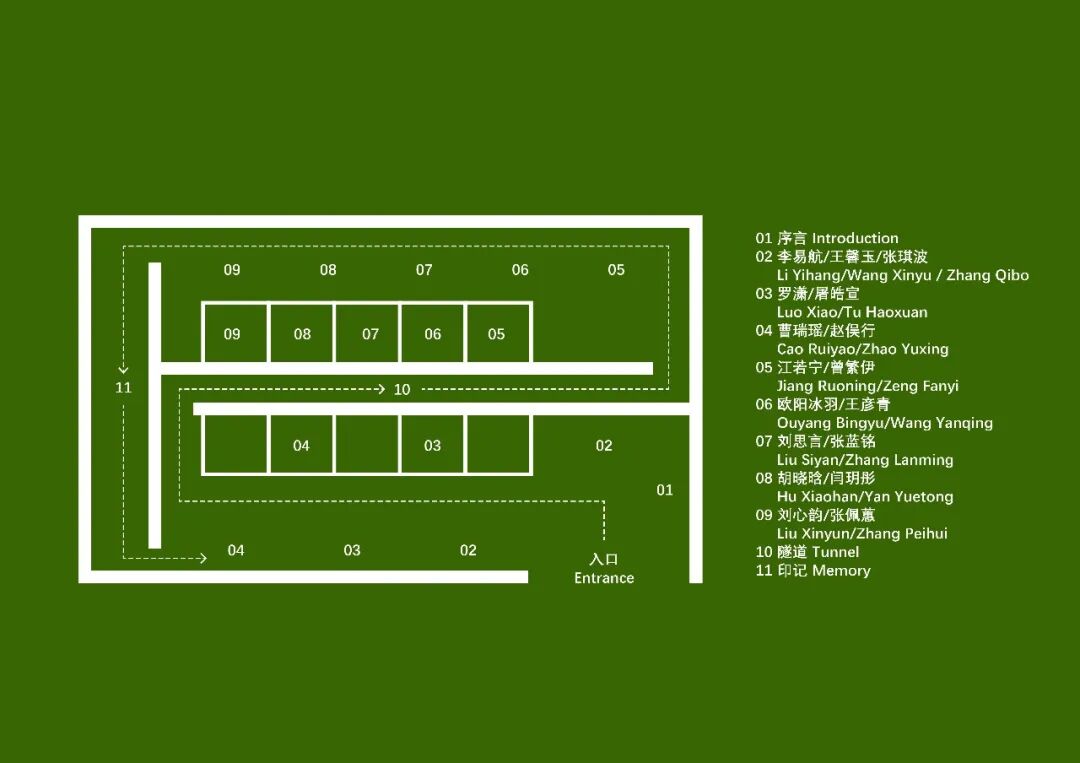
The Tunnel Space, 10-meter-long, 0.7-meter-wide black curtain passage, divides the course achievements into two different zones. With mixed sounds of moving trains as background audio, it creates an experience featuring the characteristics of Chengkun Railway tunnels.
The exhibition space is enclosed with green canvas. Design works are collaged and hung in forms of trace paper, color prints and sketches. Just like the engineers who designed the Chengkun Railway half a century ago, students from the CAUP activate and renew the red industrial heritage through design and creativity
Information
Venue: Archipelago Books丨204, NO 3, West Bund GATE M
Duration: April 26 – May 5, 2026
Opening Hours: Monday – Sunday 10:00 – 22:00
Instructors: Li Li, Wu Guanzhong
Teaching Assistant: Huang Zhanlin
Curator: Wang Yanze
Participants:
Cao Ruiyao, Hu Xiaohan, Jiang Ruoning, Li Yihang, Liu Siyan, Liu Xinyun, Luo Xiao, Ouyang Bingyu, Tu Haoxuan, Wang Xinyu, Wang Yanqing, Yan Yuetong, Zeng Fanyi, Zhang Lanming, Zhang Peihui, Zhang Qibo, Zhao Yuxing
Organizers:
College of Architecture and Urban Planning (CAUP), Tongji University
Culture and Tourism Bureau of Renhe District
Housing and Urban-Rural Development Bureau of Renhe District
Exhibition Support: Archipelago

NO.1239 Rd. Siping, SHANGHAI


