 ABOUT US
NEWS

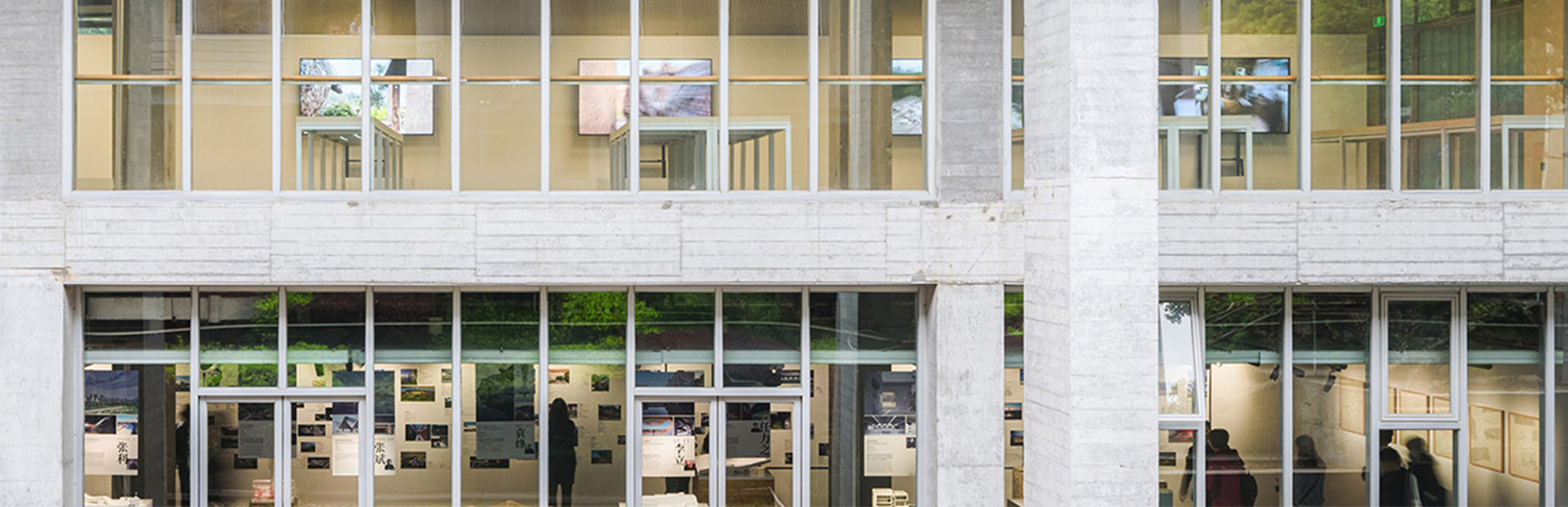
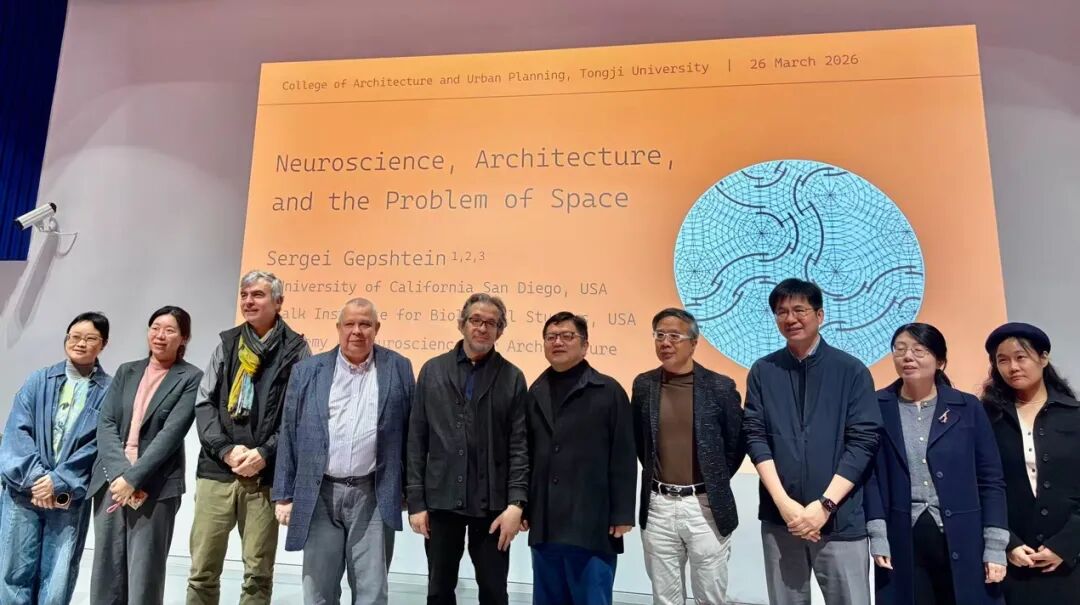
On the morning of March 26, Sergei Gepshtein, Professor of Cognitive Science at the University of California San Diego and President of the Academy of Neuroscience for Architecture (ANFA), delivered an academic lecture entitled Neuroscience, Architecture, and the Problem of Space at the Bell Hall Auditorium, Building B, College of Architecture and Urban Planning (CAUP), Tongji University.
The lecture intricately examined cutting-edge topics such as spatial perception, the invisible boundaries of experienced space, and the intersection of neuroscience and architectural design, drawing a substantial audience of faculty and students. The subsequent discourse was highly spirited, leveraging the core inquiry of spatial experience to engender a series of profound, cross-disciplinary academic deliberations.

Lecture
Associate Professor Jie Yin moderated the lecture from CAUP, Tongji University. Professor Philip F. Yuan (Dean of CAUP), Professor Costas Terzidis from the College of Design and Innovation, Professor Sergey Saveliev (Theoretical Physicist and Visiting Scholar from Loughborough University), along with faculty members from CAUP including Professor Leiqing Xu (Department of Architecture), Associate Professors Xiaoqing Xu, Zheng Chen, and Yujia Zhai (Department of Landscape Architecture), and Associate Professor Yunyun Li from the School of Physics Science and Engineering, attended the lecture and participated in the discussion session.
Professor Sergei Gepshtein, possessing a protracted commitment to investigating the fundamental mechanisms of perception and action, has recently conducted a series of interdisciplinary experiments probing how organisms organize spatial information, thereby articulating profound scientific insights into architectural spatial experience. Professor Gepshtein initially posited that the space experienced by human subjects within the built environment is not structured according to the distance and coordinate metrics used in physics, but rather through the concrete possibilities of perception and action. He argued that a prolonged reliance on absolute, objective coordinate systems in professional training has engendered a professional deformation, rendering architects largely insensitive to alternative spatial conceptualizations in their design praxis.
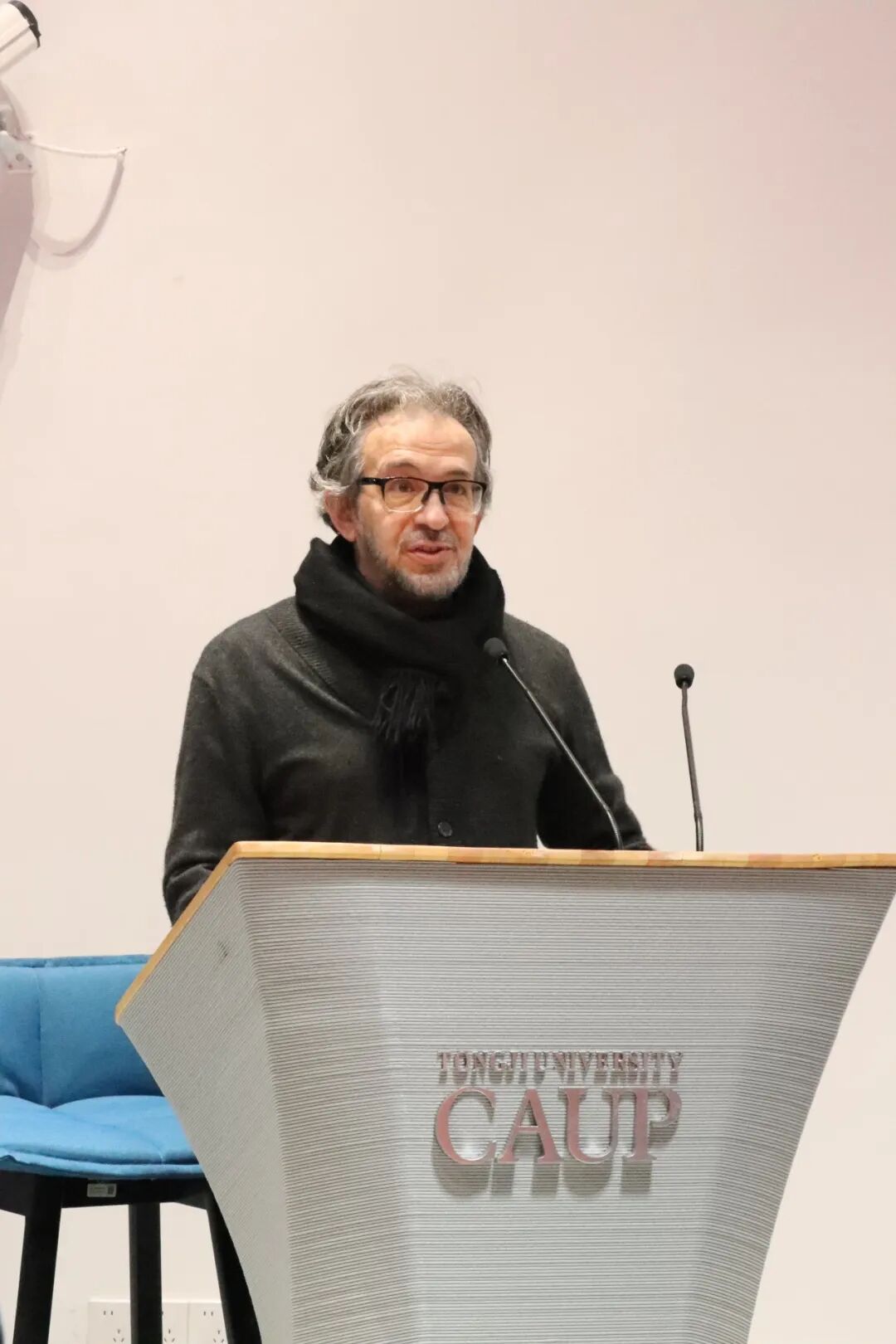

Expanding upon this premise, Professor Gepshtein introduced two complementary conceptions of the spatial field in science: Ernst Mach’s internal field, rooted in the nervous system, and James Gibson’s “external field,” emerging through the relation between the perceiver and the environment. Utilizing illustrative instances of visual illusions and dynamic optical arrays, he elucidated that space encompasses not merely fixed physical perimeters but also invisible boundaries in experienced space. These boundaries, while imperceptible through direct sensory apprehension, precipitate markedly disparate experiences contingent upon human locomotion and positional variance; fundamentally, they constitute experiential structures that manifest concomitantly with action.
Ultimately, Professor Gepshtein delineated cross-disciplinary research initiatives that translate these theoretical paradigms into architectural spatial practice. By appropriating large-scale industrial robots traditionally employed in automotive manufacturing, the research apparatus features synchronized, reciprocating kinematics between a robot-mounted projector and a corresponding screen. This configuration facilitates a quantifiable, replicable macro-spatial experience, effectively transposing laboratory-based planar stimulus methodologies into tangible spatial environments. Such research renders the purported invisible boundaries in experienced space measurable and predictive, thereby bestowing architects with a novel paradigm for proactively optimizing design formulation.
Dialogue
During the interactive dialogue, the convened scholars engaged in rigorous discussions on a range of frontier topics. These encompassed perceptual discrepancies and the interactivity of multi-agent entities (including humans and robotic systems) within collective spatial typologies, the contemporary scientific substantiation of classical architectural treatises such as Christopher Alexander's A Pattern Language, and the ontological reconciliation between absolute coordinate systems and phenomenological space from the vantage point of theoretical physics. Professor Gepshtein argued that methodologies derived from physics and cognitive science possess the latent capacity to transmute the characteristically speculative spatial experiences of architecture into definitive, objective evidence, anticipating augmented interdisciplinary collaboration in prospective endeavors.
This lecture constitutes a paramount installment of the International CAUP Open Lecture (iCAUPOL) series, inaugurated by the College of Architecture and Urban Planning at Tongji University. Its successful execution not only dismantled entrenched disciplinary demarcations—fostering profound intellectual confluence among architecture, urban planning, neuroscience, theoretical physics, and design disciplines—but also offered immensely heuristic trajectories for deploying scientific instruments to catalyze high-caliber architectural design paradigms of the future.
About iCAUPOL
iCAUPOL, an acronym for the International CAUP Open Lecture, represents a distinguished international lecture series organized by the College of Architecture and Urban Planning (CAUP) at Tongji University. The series is dedicated to transcending geographical, disciplinary, and academic confines. Through the engagement of globally eminent scholars, it propels the advancement of built environment science, explores the frontiers of scholarly knowledge, and cultivates a consensus on the latest scientific and technological progress within the field.

NO.1239 Rd. Siping, SHANGHAI


