 ABOUT US
NEWS

Lecture Introduction
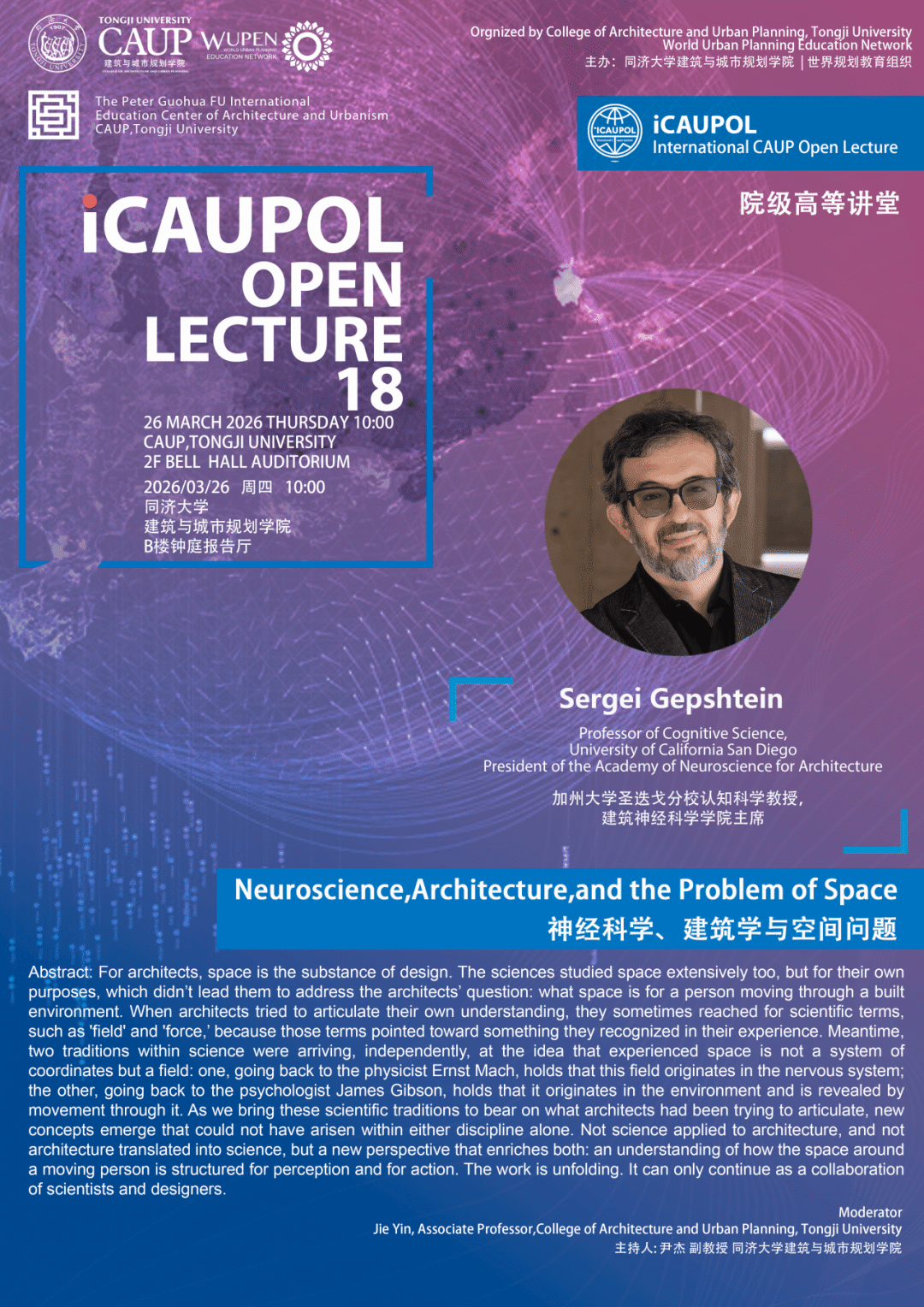
For architects, space is the substance of design. The sciences studied space extensively too, but for their own purposes, which didn’t lead them to address the architects’ question: what space is for a person moving through a built environment. When architects tried to articulate their own understanding, they sometimes reached for scientific terms, such as 'field' and 'force,’ because those terms pointed toward something they recognized in their experience. Meantime, two traditions within science were arriving, independently, at the idea that experienced space is not a system of coordinates but a field: one, going back to the physicist Ernst Mach, holds that this field originates in the nervous system; the other, going back to the psychologist James Gibson, holds that it originates in the environment and is revealed by movement through it. As we bring these scientific traditions to bear on what architects had been trying to articulate, new concepts emerge that could not have arisen within either discipline alone. Not science applied to architecture, and not architecture translated into science, but a new perspective that enriches both: an understanding of how the space around a moving person is structured for perception and for action. The work is unfolding. It can only continue as a collaboration of scientists and designers.
Lecturer
Sergei Gepshtein
Professor of Cognitive Science
University of California San Diego
President of the Academy of Neuroscience for Architecture
Sergei Gepshtein, PhD, is a scientist studying the principles of perception and action, with particular emphasis on how organisms organize spatial information to guide behavior in complex environments. He is Professor of Cognitive Science at the University of California San Diego and President of the Academy of Neuroscience for Architecture. He has served as principal investigator on projects funded by the National Institutes of Health, the National Science Foundation, the Kavli Foundation, and the Swartz Foundation, among others, conducted at the Salk Institute for Biological Studies, the University of Southern California, and UC San Diego. Integrating experimental, computational, and theoretical approaches, his work encompasses naturalistic settings, large-scale behavioral data, and multi-agent modeling. He develops interdisciplinary programs and international collaborations connecting neuroscience with architecture and design.
Moderator
Assoc. Prof. Jie Yin
College of Architecture and Urban Planning, Tongji University
Time
26 March, 2026, Thursday, 10:00
Venue
Bell Hall Auditorium, 2F, Bldg B,
CAUP, Tongji University

NO.1239 Rd. Siping, SHANGHAI


