 ABOUT US
NEWS

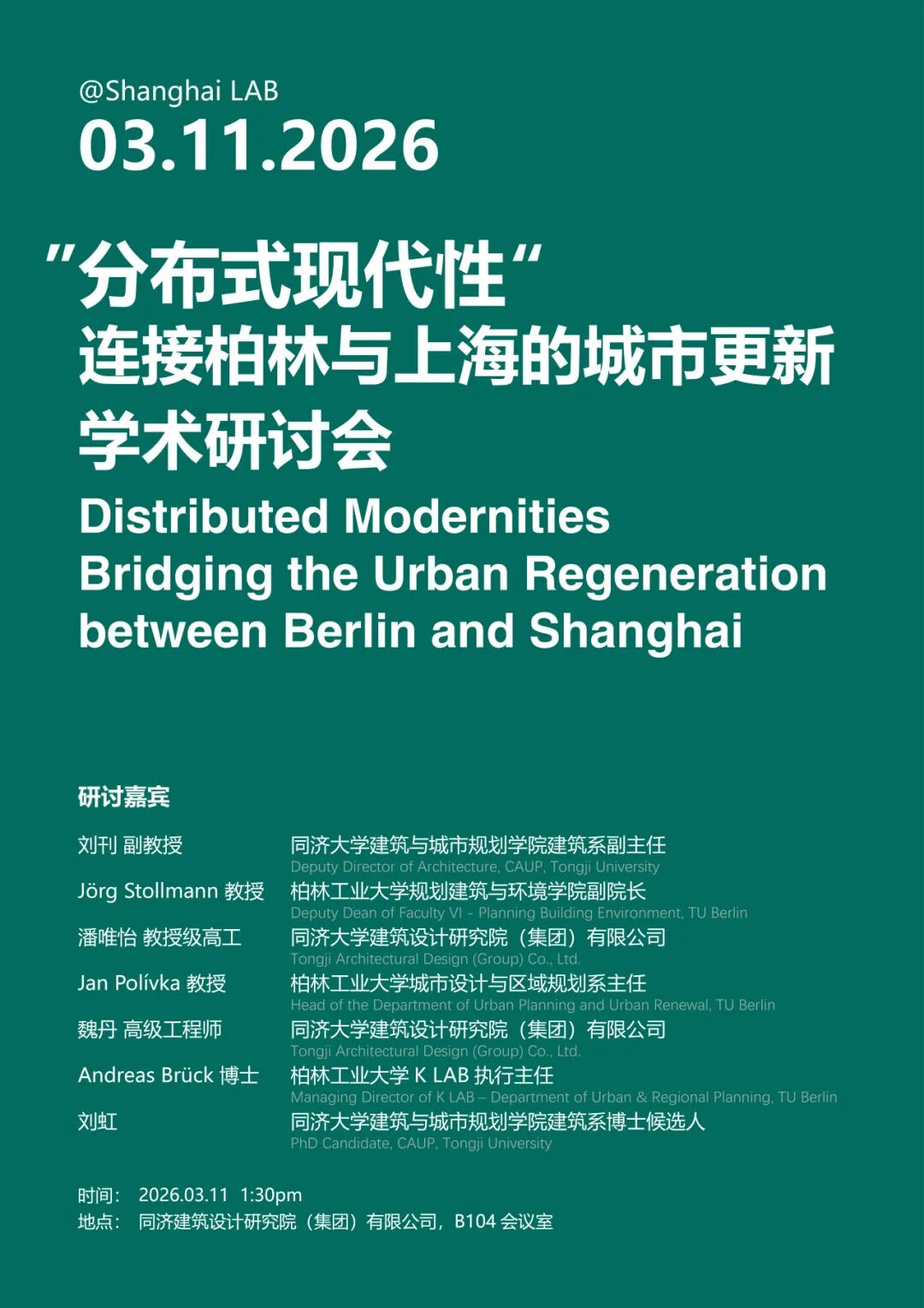
Distributed Modernities:Bridging the Urban Regeneration between Berlin and Shanghai
Time: 1:30 PM, March 11, 2026
Venue: Room B104, Tongji Architectural Design (Group) Co., Ltd.
Distributed Modernities is a core concept in architectural history and theory used to interpret pluralistic modernisms. It posits that modern architecture did not emerge from a single center, but through a multi-centric or even networked evolution. Modern architecture developed across different regions, while distinct from one another, carries diverse connotations of modernity. In contemporary architectural practice, the significance of distributed modernities has become increasingly prominent. It implies that architects, while equipped with globalized knowledge and technical vision, are increasingly focused on local culture, urban environments, socio-economics, as well as issues such as climate change and resilience. This dual focus empowers design with broader creativity, enabling contemporary architecture to maintain local identity and cultural recognition within a global context.
Berlin and Shanghai have traversed distinctly different paths in the development of modern architecture. Facing urban regeneration, their problem-solving approaches and underlying mechanisms reveal profound differences. After nearly forty years of rapid construction and development, the architectural and urban challenges Shanghai currently faces may appear superficially similar to certain stages Berlin experienced over the past half-century. However, a closer examination reveals that the essence of these problems and their constraining conditions are substantially different. Reflecting on Berlin’s urban process, an increasing number of architectural renovation topics point toward issues of urban strategy and spatial systems: from the 1957 International Building Exhibition (Interbau), which had a far-reaching impact on modern architecture and urban reconstruction; to the 1987 International Building Exhibition (IBA), which profoundly shaped urban renewal and urban philosophy; from the urban design of Potsdamer Platz after German reunification, to the Berlin Central Station, a multi-dimensional transportation hub designed by gmp Architects; and from the renovation of the Kulturforum to the series of landmark renewal practices including the Museum Island, the Neue Nationalgalerie, and the Humboldt Forum. The spatial boundaries between the city, architecture, and infrastructure are dissolving and being reconstructed. These practices reflect how to confront and resolve deep-seated spatial issues within complex built environments. Such experiences hold significant theoretical value and academic relevance for Shanghai’s exploration and reflection on urban regeneration methodologies.
We look forward to this academic symposium establishing a bridge for dialogue on urban regeneration between Berlin and Shanghai through the interaction of theory and practice. This event is also dedicated to the 20th anniversary of the academic exchange of the Urban Design Dual Degree Program between CAUP, Tongji University and TU Berlin. May this partnership serve as a vital link to galvanize the emerging forces that will shape the future of architecture and urbanism. May this bond serve as a catalyst to galvanize new forces in the future fields of architecture and urbanism.
Discussion Guests
●
LIU Kan
Associate Professor; Deputy-Director of Architecture Department, CAUP, Tongji University
●
Jörg Stollmann
Professor; Deputy Dean of Faculty VI - Planning Building Environment, Technische Universität Berlin
●
PAN Weiyi
Professor of Engineering, Tongji Architectural Design (Group) Co., Ltd.
●
Jan Polívka
Professor; Head of the Department of Urban Planning and Urban Renewal, Technische Universität Berlin
●
WEI Dan
Senior Engineer, Tongji Architectural Design (Group) Co., Ltd.
●
Andreas Brück
Doctor; Managing Director of K LAB – Department of Urban & Regional Planning, Technische Universität Berlin
●
LIU Hong
PhD Candidate, CAUP, Tongji University
This symposium is supported by the National Key R&D Program of China during the 14th Five-Year Plan Period (2023YFC3804100), titled Key Technologies for Building-City Integration and Three-Dimensional Development under the Carbon Peaking and Carbon Neutrality Target.

NO.1239 Rd. Siping, SHANGHAI


