 ABOUT US
NEWS

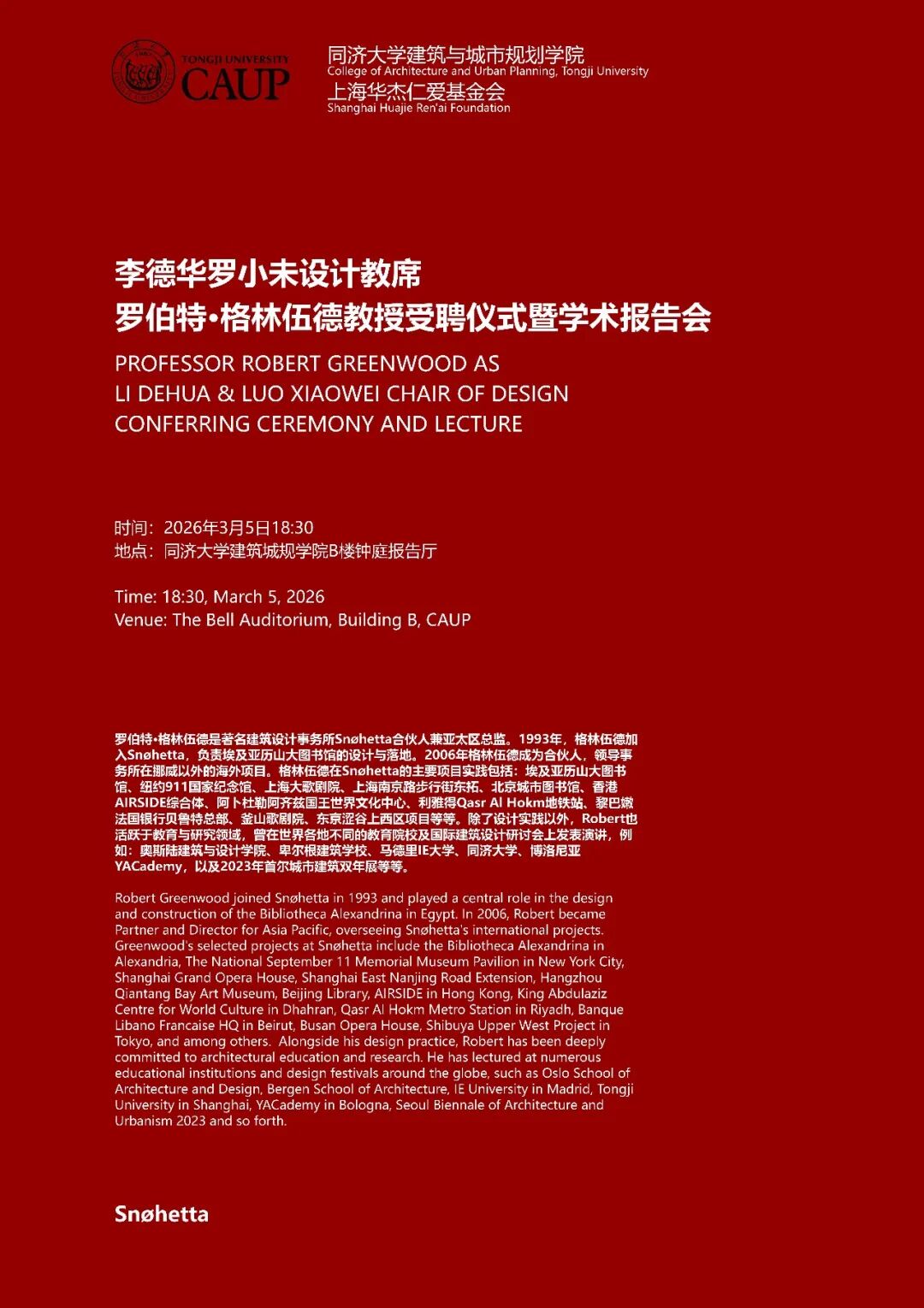
In the spring semester of 2026, Tongji University will award the Li Dehua & Luo Xiaowei Design Chair to Professor Robert Greenwood. The conferring ceremony and lecture, titled Architecture: the Art of Prepositions, will be held at 18:30 on March 5, 2026, in the Bell Auditorium of the College of Architecture and Urban Planning.
Time: 18:30, March 5, 2026
Venue: The Bell Auditorium, Building B, CAUP

Robert Greenwood, Partner and Director for Asia Pacific at Snøhetta
Robert Greenwood joined Snøhetta in 1993 and played a central role in the design and construction of the Bibliotheca Alexandrina in Egypt. In 2006, Robert became Partner and Director for Asia Pacific, overseeing Snøhetta's international projects. Greenwood's selected projects at Snøhetta include the Bibliotheca Alexandrina in Alexandria, The National September 11 Memorial Museum Pavilion in New York City, Shanghai Grand Opera House, Shanghai East Nanjing Road Extension, Hangzhou Qiantang Bay Art Museum, Beijing Library, AIRSIDE in Hong Kong, King Abdulaziz Centre for World Culture in Dhahran, Qasr Al Hokm Metro Station in Riyadh, Banque Libano Francaise HQ in Beirut, Busan Opera House, Shibuya Upper West Project in Tokyo, and among others. Alongside his design practice, Robert has been deeply committed to architectural education and research. He has lectured at numerous educational institutions and design festivals around the globe, such as Oslo School of Architecture and Design, Bergen School of Architecture, IE University in Madrid, Tongji University in Shanghai, YACademy in Bologna, Seoul Biennale of Architecture and Urbanism 2023 and so forth.
Robert Greenwood is Partner and Director for Asia Pacific at Snøhetta. The College of Architecture and Urban Planning has appointed Cheng Gong (Studio Director China at Snøhetta) and Martin Gran (Managing Director at Snøhetta Foundation) as Design Instructors. Led by Robert Greenwood, the teaching team will conduct postgraduate design studios in the 2026 spring semester under the theme “Sensing Space”.
Under the title Sensing Space, the studio seeks to cultivate embodied spatial literacy while linking architectural education to issues of educational equity, access, and cultural continuity. This semester-long course approaches space as something we sense and negotiate with our bodies—not merely something we draw. Integrating the Sensing Space educational program with Snøhetta's design methodology, the studio challenges students to work on a single site and develop a three-part program. The overarching goal is to explore how architecture can strengthen learning, culture, and community.

NO.1239 Rd. Siping, SHANGHAI


