 ABOUT US
NEWS

Designing Living History
This course aimed to help students understand the role of architecture and design to commemorate, celebrate and validate important historical moments, concepts, individuals and their actions, reasserting the power of the discipline in actively upholding historical awareness. Ole Bouman 01 Course Introduction
According to the Austrian architect Adolf Loos, the most honest manifestation of architecture was the monument and the tomb. It has been a statement that for more than 100 years have occupied architects and critics, provoking them to consider the role of architecture as an important medium of history and culture.
In reverse, one could say, that for centuries for an honest manifestion of the tomb and the monument, people relied on architecture to create and send the desired message about past events or value systems.
In a world which increasingly becomes aware of the necessity of dialogue and a shared future for all, the traditions of highlighting specific values over others, and prioritizing specific groups or individuals over others, has been challenged by alternative ways to remember history and learn from it.
This course addressed this contemporary dynamic, and explored a variety of options by which architecture and design can vindicate its importance of carrying on and transcending history.
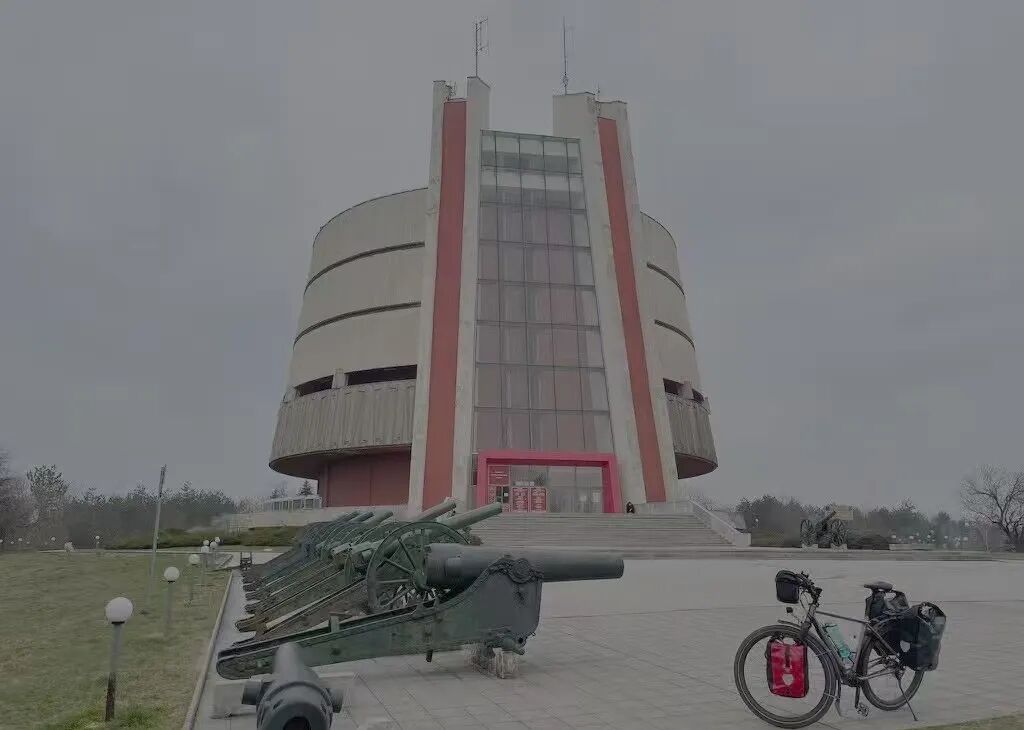
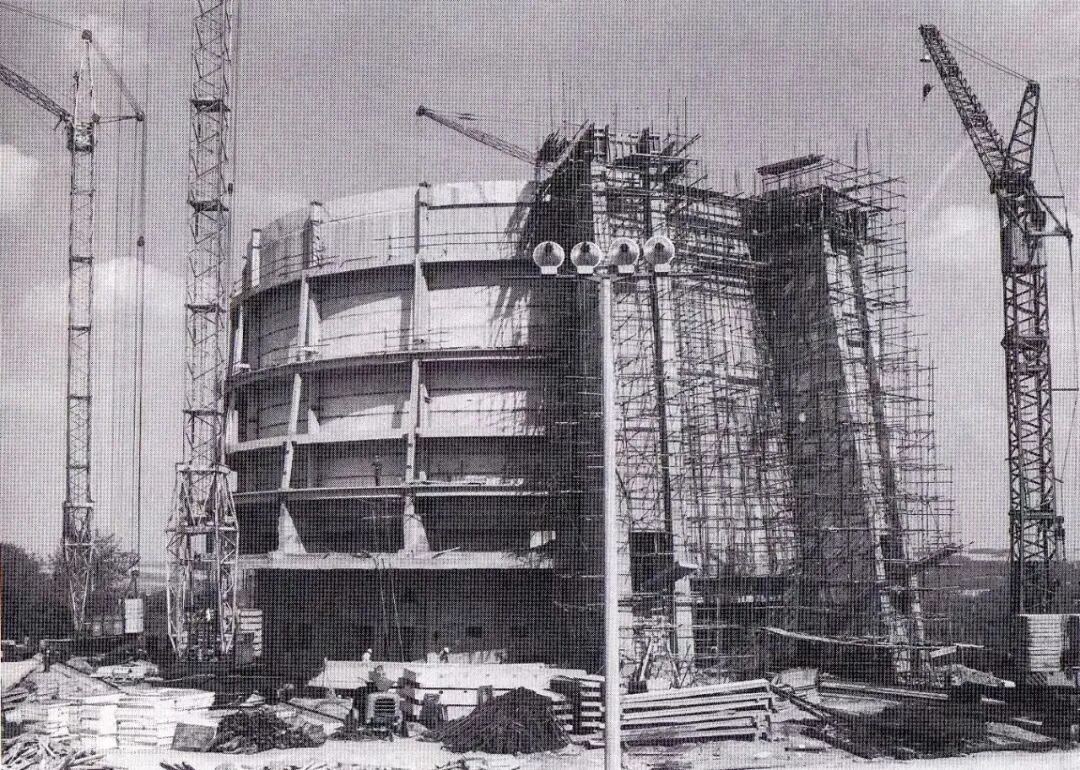
Pleven panorama (Bulgaria), commemorating the Siege of Plevna (1877/78) between Russia and the Ottoman Empire.
02 Course Background
“ When I bicycled from Amsterdam to Shanghai in 2024, a few elements held the entire endeavor together: the beauty of nature, the physical effort of crossing a continent, and, of course, the desire to come closer to and more deeply understand the East. I was looking for a New Silk on that Old Road.
But on a daily basis, mile by mile, the most persistent force feeding my curiosity was the way I came face to face with world history unfolding—the way thousands of years can still be felt in the here and now.
There were traces of history everywhere. Some were anonymous, without recognizable authorship: sediments of centuries of cultural customs and human activity. In contrast, others were highly explicit—monuments recalling stylistic periods, crucial episodes, if not critical moments in history. Turning points that people chose to remember as sources of legitimacy, purpose, and moral order.
Not a day passed without me stopping, holding my bike, and contemplating such a statement, executed in stone, bronze, or other respectable materials. And almost always, architecture played a decisive role in securing and amplifying the message: an elevation, an avenue, a driveway; contrasts between light and shadow; a sudden vista; a frame; a carefully directed gaze.
Clearly, from crossing the limes just outside Amsterdam—once the border of the Roman Empire—to the prominent entrance gate of Tongji University in Shanghai, it was architecture expressing power and values, sentiment and nostalgia. Writing this, my thoughts are drawn back to the Lion’s Mound at Waterloo, the statue of a seated Yaşar Kemal gazing over the Sea of Marmara, the Azadi Tower in Tehran , and the Nine-Tiered Pagoda at the caves of Dunhuang.
Sometimes these monuments were still endowed with deep respect; sometimes they were barely maintained, clear cases of neglect. Yet even then, the power of architecture seemed to delay—or even thwart—oblivion. All of these monuments demonstrated architecture’s capacity to commemorate, celebrate, and validate values through design. This power must have been what led Adolf Loos, in his famous essay Architektur, to identify the monument and the grave as the only instances in which architecture could truly be art.
In the fall of 2025, I taught a Tongji design studio that took this observation as its point of departure, challenging architecture students to explore their discipline’s potential to be an art by asking them to design a monument. At a time when architecture is under severe pressure—through the marginalization of the architect in an increasingly rationalized building process, and through the algorithmic reproduction of meaning enabled by AI—I wanted students to reflect on what remains of this age-old respect for architecture. A respect that once defined it as the mother of all arts, endowed with the symbolic power to serve as a metaphor for order, structure, and meaning.
The studio was intended to give students the space to maneuver, to navigate their own faith in architecture, by allowing it to embody what they felt closest to their hearts. In short: to design a monument of their own choosing.
Looking back on an intense sixteen weeks of speculative design, I was struck by what they produced—projects that spoke of their respective cultures, their generation, their search for purpose, and their profound social concerns about the era we are living in.”
——Ole Bouman
Swipe to see more
Some monuments recorded in “Journey to the East” project by Ole Bouman
03 Course Project Review
#01 Wang Yida
Monument for the victims of the Japanese air raids of Chongqing
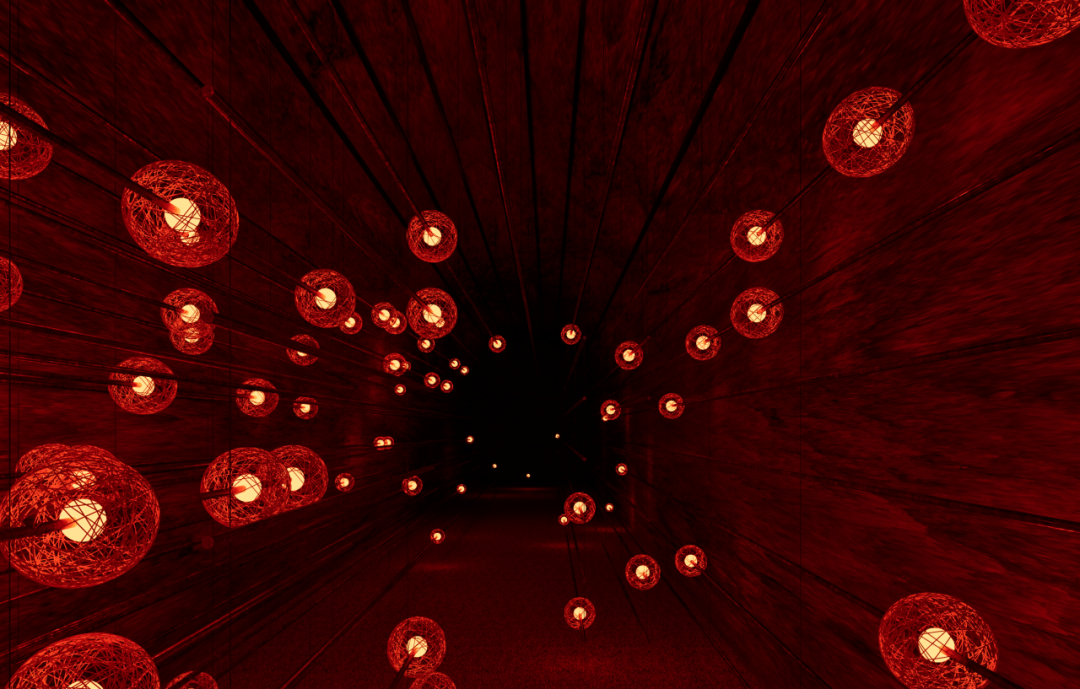
Where Red Lanterns Breathe in the Dark is a memorial project inserted into existing air-raid shelters in Chongqing. The project takes these shelters as the spatial carrier of memory and integrates the commemorative experience into the city’s nightscape and everyday urban life, allowing memory to exist within spaces that are still actively used.
The design uses the red lantern as its key element. During the war, red lanterns functioned as air-raid warning signals. In this project, the red lantern refers to death, blood, and the situation of people during the Chongqing Bombing. By transforming a familiar cultural object into a warning and mourning signal, the design introduces a layered and restrained spatial language.
The monument is designed within the linear and enclosed structure of air-raid shelters. A crowded and winding pathway reconstructs physical pressure and restricted movement. Lanterns wrapped with red thread form a dense spatial field, while flickering light embedded inside simulates heartbeat and breathing. As visitors move deeper into the space, the number of lanterns gradually decreases and the environment becomes darker, establishing a spatial rhythm that corresponds to disappearance, survival, and the passage of time.
Through movement, light, and scale, the memorial emphasizes bodily experience rather than visual spectacle. The project is organized as a phased system, progressing from small pop-up exhibitions to parasitic memory nodes within reused shelters, and eventually to complete monuments. Supported by long-term mechanisms and public participation, the memorial operates as an expandable system that allows memory to continue and remain present within the city.
#02 Zhang Jianing
Monument for the Lost Memories
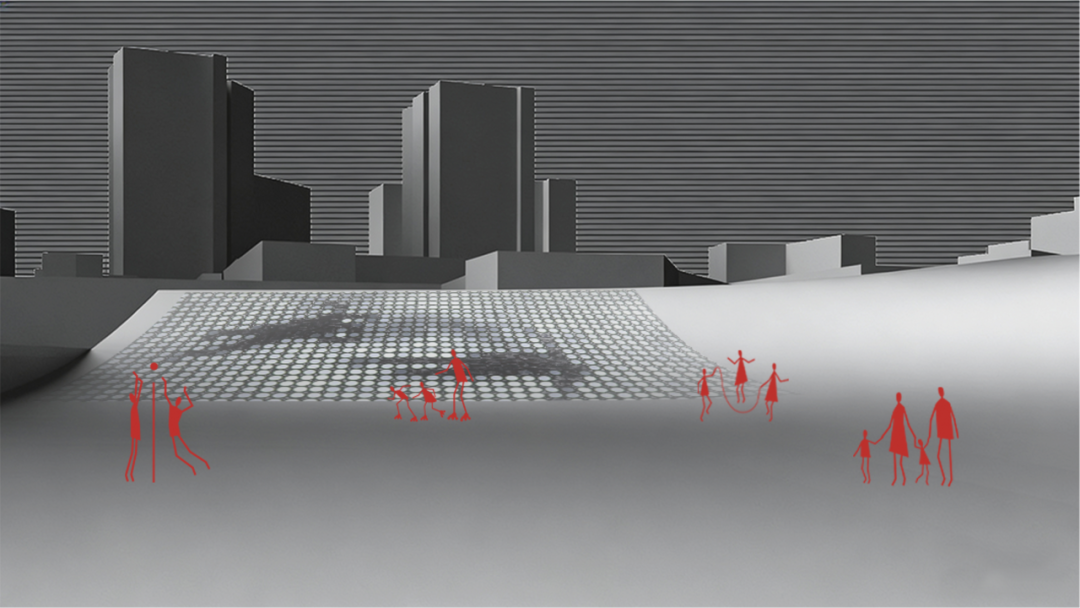
Shanghai’s rapid urban redevelopment is eroding its layered social landscapes—the intricate weave of public, semi-public, and private spaces that fostered unique community cohesion and informal interaction. This represents not merely architectural loss but the erasure of collective memory and social fabric. In response, the proposed monument is conceived as a living Spatial Book. Its primary purpose is twofold: to bear witness by making the invisible past visible, and to cultivate community by acting as a new civic heart. Strategically sited on the Old City’s edge, its form—crafted from warm white terrazzo—metaphorically resembles a giant page being turned, directly connecting to Shanghai’s architectural heritage. The design operates on a clear day-night rhythm. By day, it functions as managed civic infrastructure for community events, meetings, and access to a shared memory archive. By night, it transforms into an open, unprogrammed public space for gathering and reflection. A key interactive element is an integrated LED slope. Here, citizen-submitted images and videos of urban life are displayed as low-resolution, pixelated silhouettes, curated by public vote. This approach fosters deep engagement by encouraging interpretation, ensuring the monument remains a dynamic, participatory platform rather than a static memorial.
#03 Lu Yifan
Monument for Shared Griefs
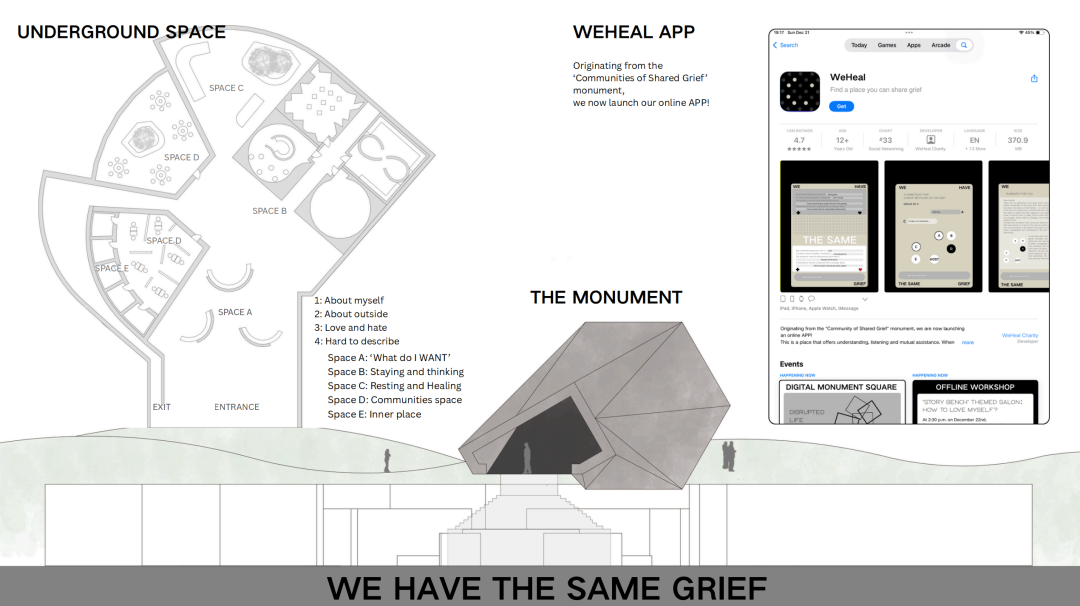
Many people experience misunderstood pains that affect their lives to varying degrees. Engaging in a prolonged struggle with one's inner suffering is dangerous—it leads to a decline in well-being, with emotion fluctuating, and subsequently impacts mental health. Therefore, intervention through group-based relief methods is necessary. Certain events leave deep psychological wounds in the hearts of survivors or their loved ones. Driven by intangible catalysts, strangers who share similar experiences come together through collective pain, forming mutual support groups known as. They begin to unite and seek ways to help each other navigate their sorrow. The Expected Effect I hope this monument can serve as a sanctuary for those carrying hardship and sorrow, offering psychological healing. Furthermore, I hope it can enable visitors to potentially form ‘Communities of Shared Grief’, where they can establish links with similar people, and achieve a healing effect.
#04 Huang Yingying
Monument for Truth
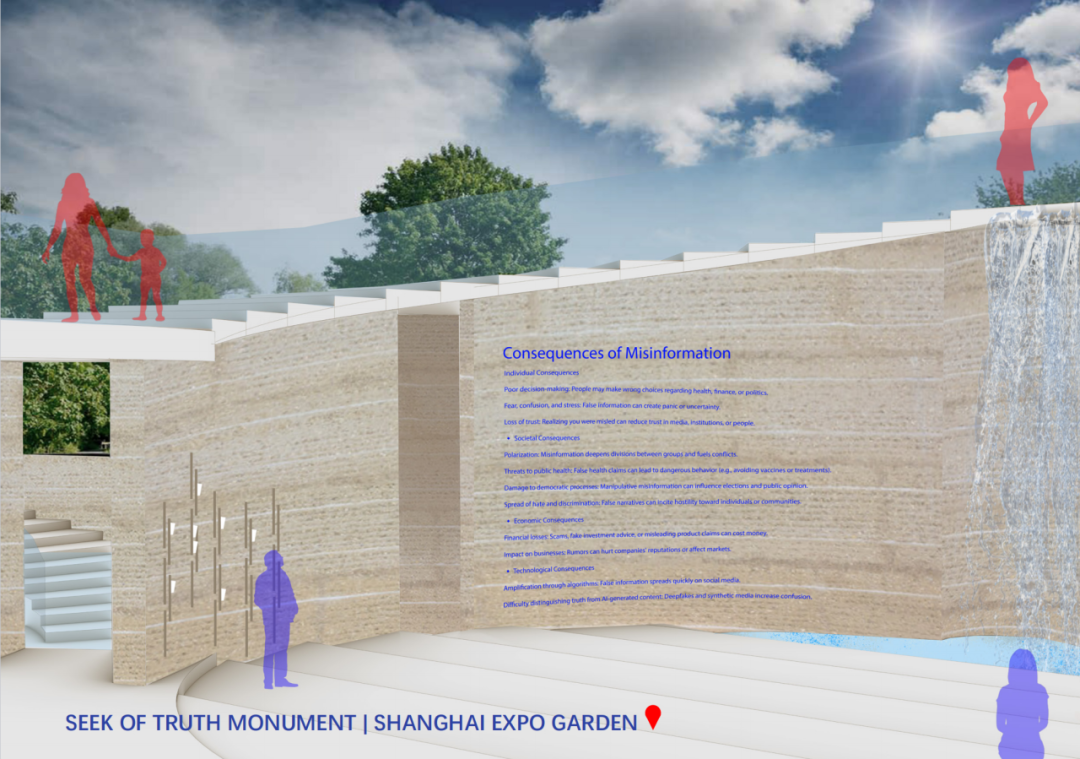
The Seek of Truth Monument is intended to help people reconnect with one another. Its purpose is to challenge and break through well-established social thought patterns, while further strengthening the belief in the goodness inherent in human nature. Through the five fears of humanity, five fundamental and widely recognized themes are exemplarily represented within the monument. These themes originated in times of crisis and have become deeply rooted in collective memory. As humans tend to remember negative information more strongly, the monument deliberately addresses these fears to question and ultimately refute them.
#05 Naïs Ranson
Monument for Failure
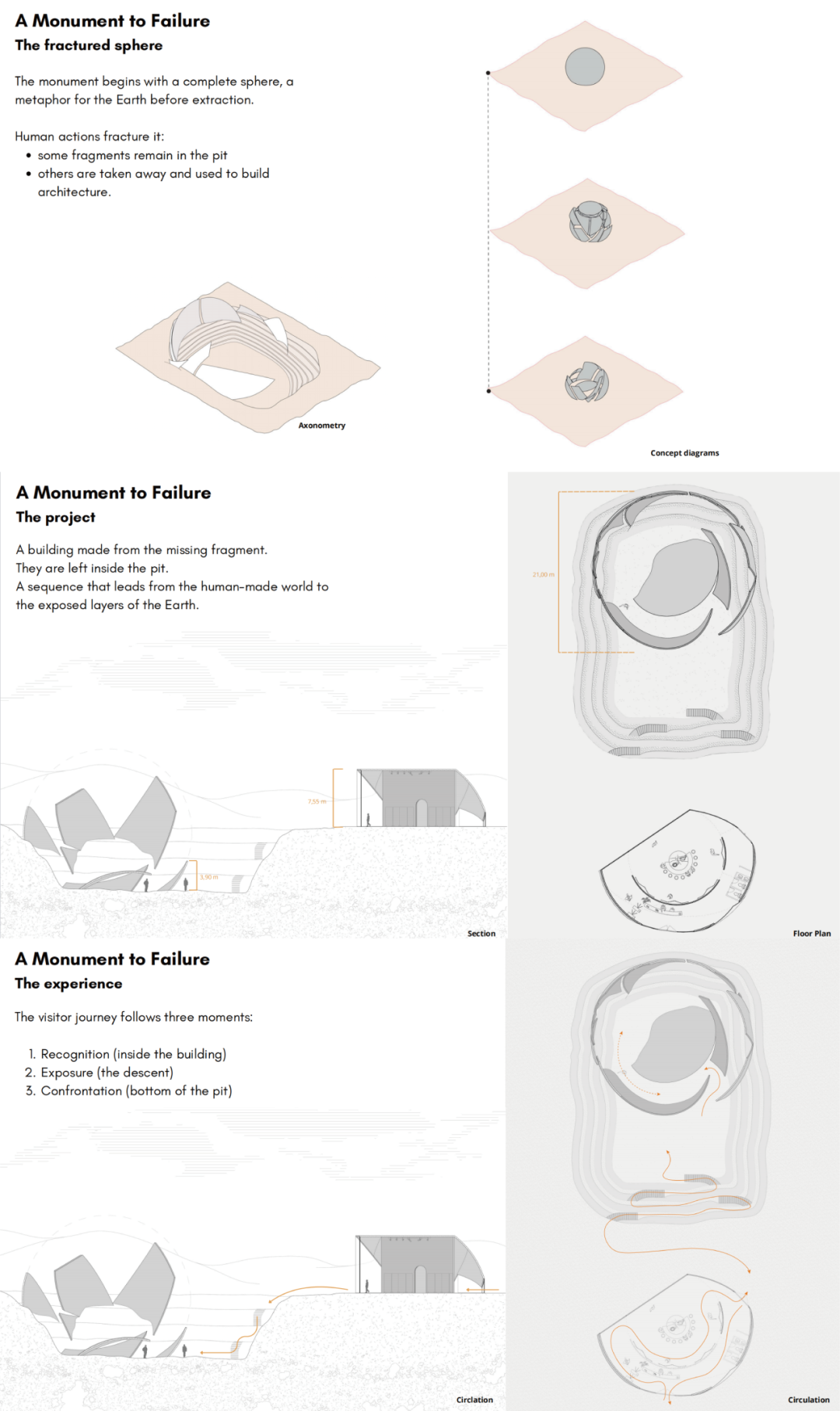
« A monument to failure » is a monument located in the abandoned mining landscape of Rio Tinto, in Spain. The proposal addresses failure not as an accident, but as a lasting condition produced by extractive human activities. Rather than repairing or concealing the site, the project seeks to expose and make visible what remains after exploitation. The intervention is based on the metaphor of a complete sphere, representing the Earth, broken apart by human action. Fragments remain embedded within the mining pit, while others are reassembled into a visitor structure positioned on its edge. Through a carefully descent and pilgrimage-like approach, the project confronts visitors with the physical, spatial and material consequences of irreversible transformation.
#06 Jesus Ramos
(Jesus Emiliano Ramos Palomino)
Monument for Disappeared People
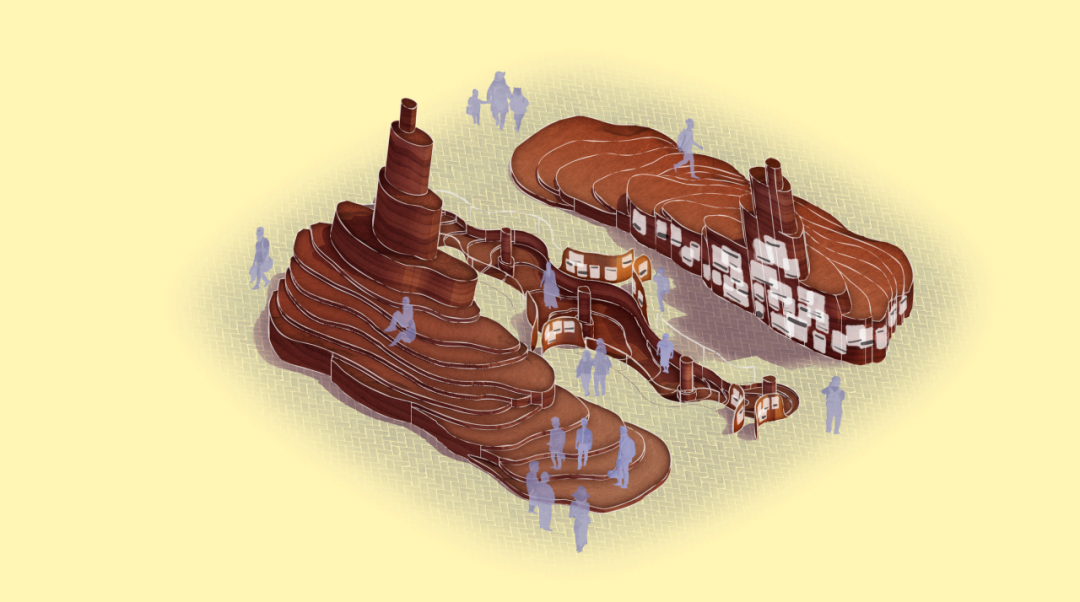
In Latin America, Mexico has the highest and growing number of missing persons, with more than 116,000 cases registered in 2024; Colombia exceeds 83,000, Guatemala has 45,000, Argentina has 30,000, Peru has 8,000. Other countries such as Honduras and El Salvador also face a high number of disappearances.
The cases of enforced disappearance operate as a method of terror within communities and territories marked by economic interests and resource extraction, spreading fear to disperse social movements, eliminating members or leaders of collectives, and silencing those who seek to denounce corruption and organized crime. Groups of relatives arise, called searchers or search collectives, which organize themselves to track clandestine graves, report cases and demand justice. Imbalance triggers a reaction to the situation, a solemn act of both the land and the surface. The land rises as it can no longer bear to hide more of the disappeared within it, making itself physically and symbolically present in the urban landscape. Meanwhile, the surface turns out to be an open breach for those who are missing, expressing the wound of having someone disappeared, and yearning for the day this gap be filled again. The use of rammed earth as a material, evokes the land itself and is a cheap material, aiming to avoid impacting the client´s budget, conceived as a commission by a social collective or group searching for the disappeared.
#07 Joshua Richardson
Monument for Refugee
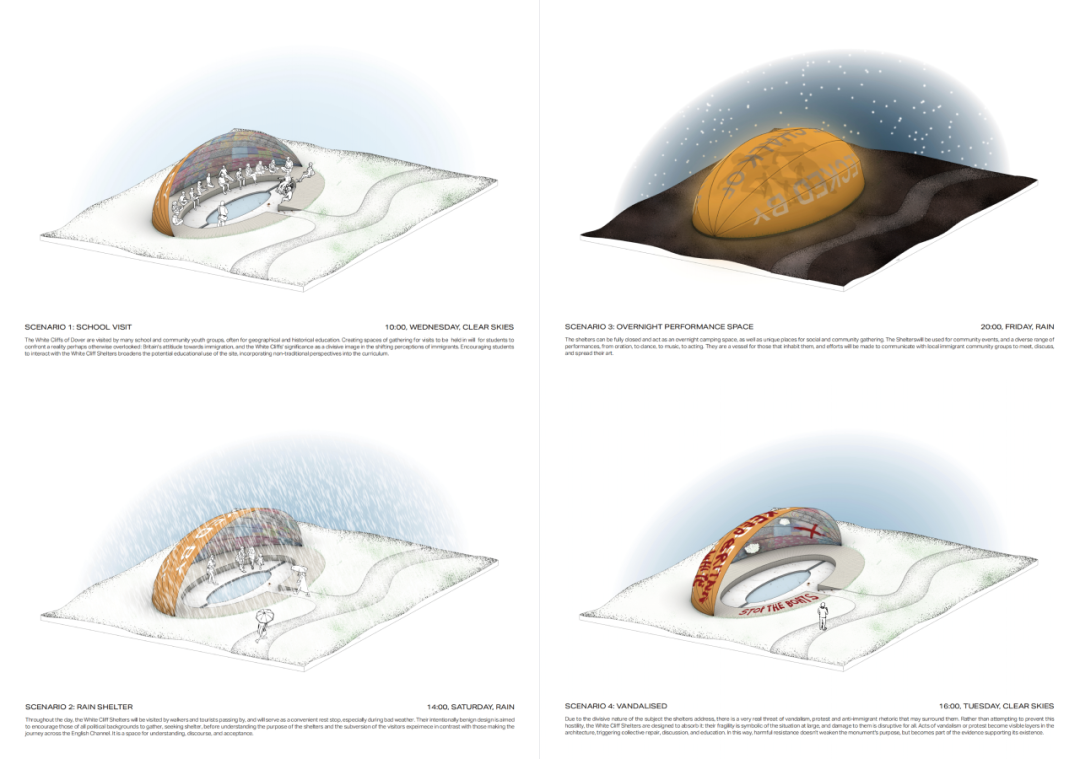
In the last ten years, thousands of migrants have reached the UK in small boats, crossing the English Channel from France. Often arriving at night, squeezed into vessels designed to accommodate four or five and braving dangerously cold and choppy waters, dozens of people arrive on Britain’s south coast, the final leg of a dangerous and often traumatic journey they’ve made to leave their home. And yet when they arrive, many are met with racism, abuse and an intolerant system.
This work aims to generate compassionate discourse around the attitudes towards immigrants in Britain. Based at the White Cliffs of Dover, an historic symbol of Britain’s relationship with the world, the installation of a series of shelters aims to bring together people from across the political spectrum and work in collaboration with immigrants and refugees to create a space for sharing, listening and contemplating.

NO.1239 Rd. Siping, SHANGHAI


