 ABOUT US
NEWS

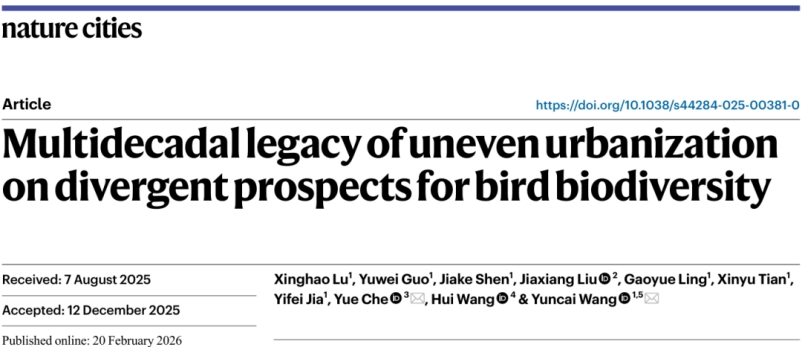
On February 21, 2026, a groundbreaking study titled Multidecadal legacy of uneven urbanization on divergent prospects for bird biodiversity by Professor Wang Yuncai's team from Tongji University's College of Architecture and Urban Planning was published online in Nature Cities. This research sheds light on the enduring effects of historical urbanization on avian biodiversity, providing crucial scientific foundations for proactive urban conservation planning and sustainable governance.
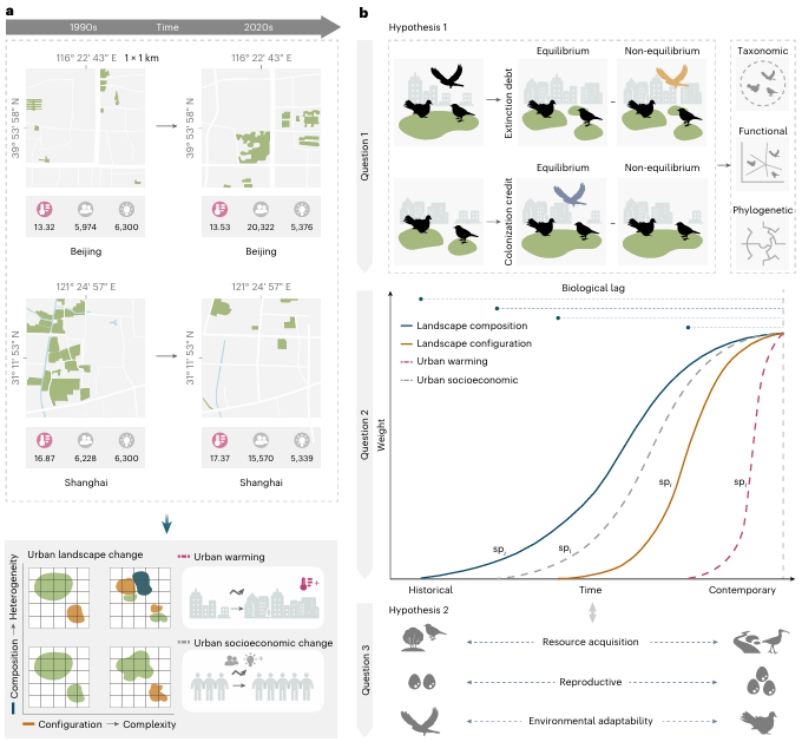
Urbanization is a key driver of biodiversity change, yet the legacy effects of past urban planning and development on current biodiversity remain poorly understood. The study employs equilibrium and non-equilibrium modeling to quantify the lagged impacts of China's urban environmental characteristics over the past 31 years on bird distribution. It reveals widespread extinction debts and colonization credits across taxonomic, functional, and phylogenetic diversity due to uneven urbanization, indicating delayed losses and gains in biodiversity as species-urban environment relationships stabilize.
Historical vegetation and socio-economic factors are identified as long-term determinants of bird spatial distribution patterns. Multi-model validations further demonstrate species-specific lagged responses to urban environmental factors, linked to life-history traits.
This research underscores the profound and delayed impacts of long-term urbanization on biodiversity. It highlights the potential for effective conservation and restoration measures to mitigate risks associated with delayed species loss. The established methodological framework offers valuable insights for biodiversity-friendly urban planning and pioneers new approaches for predictive urban biodiversity conservation strategies.
The study was supported by the National Natural Science Foundation of China (No.52238003).

NO.1239 Rd. Siping, SHANGHAI


