 ABOUT US

NEWS

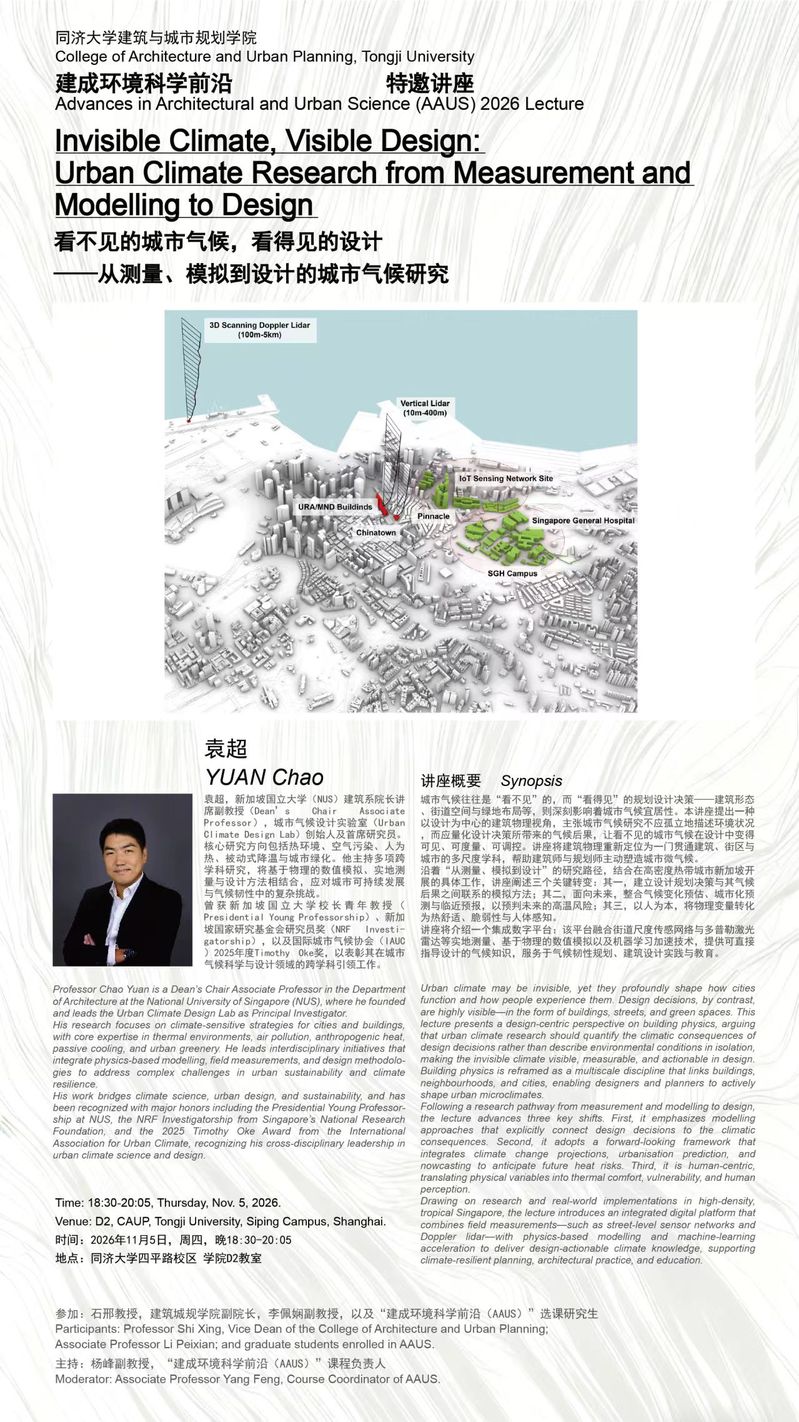
Invisible Climate, Visible Design:
Urban Climate Research from Measurement and Modelling to Design
YUAN Chao
Professor Chao Yuan is a Dean's Chair Associate Professor in the Department of Architecture at the National University of Singapore (NUS), where he founded and leads the Urban Climate Design Lab as Principal Investigator.
His research focuses on climate-sensitive strategies for cities and buildings, with core expertise in thermal environments, air pollution, anthropogenic heat, passive cooling, and urban greenery. He leads interdisciplinary initiatives that integrate physics-based modelling, field measurements, and design methodologies to address complex challenges in urban sustainability and climate resilience.
His work bridges climate science, urban design, and sustainability, and has been recognized with major honors including the Presidential Young Professorship at NUS, the NRF Investigatorship from Singapore's National Research Foundation, and the 2025 Timothy Oke Award from the International Association for Urban Climate, recognizing his cross-disciplinary leadership in urban climate science and design.
Synopsis
Urban climate may be invisible, yet they profoundly shape how cities function and how people experience them. Design decisions, by contrast, are highly visible—in the form of buildings, streets, and green spaces. This lecture presents a design-centric perspective on building physics, arguing that urban climate research should quantify the climatic consequences of design decisions rather than describe environmental conditions in isolation, making the invisible climate visible, measurable, and actionable in design. Building physics is reframed as a multiscale discipline that links buildings, neighbourhoods, and cities, enabling designers and planners to actively shape urban microclimates.
Following a research pathway from measurement and modelling to design, the lecture advances three key shifts. First, it emphasizes modelling approaches that explicitly connect design decisions to the climatic consequences. Second, it adopts a forward-looking framework that integrates climate change projections, urbanisation prediction, and nowcasting to anticipate future heat risks. Third, it is human-centric, translating physical variables into thermal comfort, vulnerability, and human perception.
Drawing on research and real-world implementations in high-density, tropical Singapore, the lecture introduces an integrated digital platform that combines field measurements—such as street-level sensor networks and Doppler lidar—with physics-based modelling and machine-learning acceleration to deliver design-actionable climate knowledge, supporting climate-resilient planning, architectural practice, and education.
Time: 18:30-20:05, Thursday, Nov. 5, 2026.
Venue: D2, CAUP, Tongji University, Siping Campus, Shanghai.
Participants: Professor Shi Xing, Vice Dean of the College of Architecture and Urban Planning, Associate Professor Li Peixian; and graduate students enrolled in AAUS.
Moderator: Associate Professor Yang Feng, Course Coordinator of AAUS.

NO.1239 Rd. Siping, SHANGHAI


