 ABOUT US

NEWS

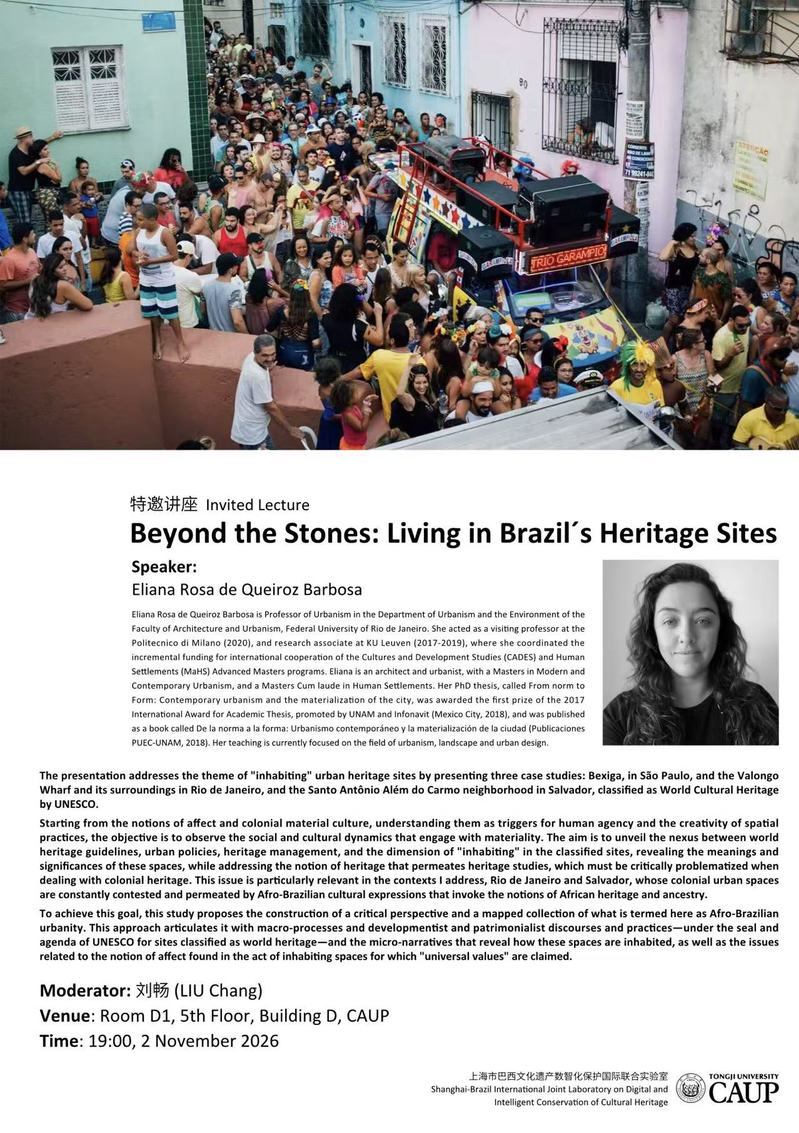
Beyond the Stones: Living in Brazil's Heritage Sites
Speaker:
Eliana Rosa de Queiroz Barbosa
Eliana Rosa de Queiroz Barbosa is Professor of Urbanism in the Department of Urbanism and the Environment of the Faculty of Architecture and Urbanism, Federal University of Rio de Janeiro. She acted as a visiting professor at the Politecnico di Milano (2020), and research associate at KU Leuven (2017-2019), where she coordinated the incremental funding for international cooperation of the Cultures and Development Studies (CADES) and Human Settlements (MaHS) Advanced Masters programs. Eliana is an architect and urbanist, with a Masters in Modern and Contemporary Urbanism, and a Masters Cum laude in Human Settlements. Her PhD thesis, called From norm to Form: Contemporary urbanism and the materialization of the city, was awarded the first prize of the 2017 International Award for Academic Thesis, promoted by UNAM and Infonavit (Mexico City, 2018), and was published as a book called De la norma a la forma: Urbanismo contemporáneo y la materialización de la ciudad (Publicaciones PUEC-UNAM, 2018). Her teaching is currently focused on the field of urbanism, landscape and urban design.
The presentation addresses the theme of inhabiting urban heritage sites by presenting three case studies: Bexiga, in São Paulo, and the Valongo Wharf and its surroundings in Rio de Janeiro, and the Santo Antônio Além do Carmo neighborhood in Salvador, classified as World Cultural Heritage by UNESCO.
Starting from the notions of affect and colonial material culture, understanding them as triggers for human agency and the creativity of spatial practices, the objective is to observe the social and cultural dynamics that engage with materiality. The aim is to unveil the nexus between world heritage guidelines, urban policies, heritage management, and the dimension of inhabiting in the classified sites, revealing the meanings and significances of these spaces, while addressing the notion of heritage that permeates heritage studies, which must be critically problematized when dealing with colonial heritage. This issue is particularly relevant in the contexts I address, Rio de Janeiro and Salvador, whose colonial urban spaces are constantly contested and permeated by Afro-Brazilian cultural expressions that invoke the notions of African heritage and ancestry.
To achieve this goal, this study proposes the construction of a critical perspective and a mapped collection of what is termed here as Afro-Brazilian urbanity. This approach articulates it with macro-processes and developmentist and patrimonialist discourses and practices—under the seal and agenda of UNESCO for sites classified as world heritage—and the micro-narratives that reveal how these spaces are inhabited, as well as the issues related to the notion of affect found in the act of inhabiting spaces for which universal values are claimed.
Moderator: LIU Chang
Venue: Room D1, 5th Floor, Building D, CAUP
Time: 19:00, 2 November 2026

NO.1239 Rd. Siping, SHANGHAI


