学院介绍
学院介绍
新闻中心



提问建筑学
Questioned Architecture
同济大学建筑城规学院复合型创新人才实验班
2025秋季成昆铁路工业遗产复兴课程设计成果展
CAUP Tongji University Innovative Experimental Class
Fall 2025 Architecture Design Course Works Exhibition
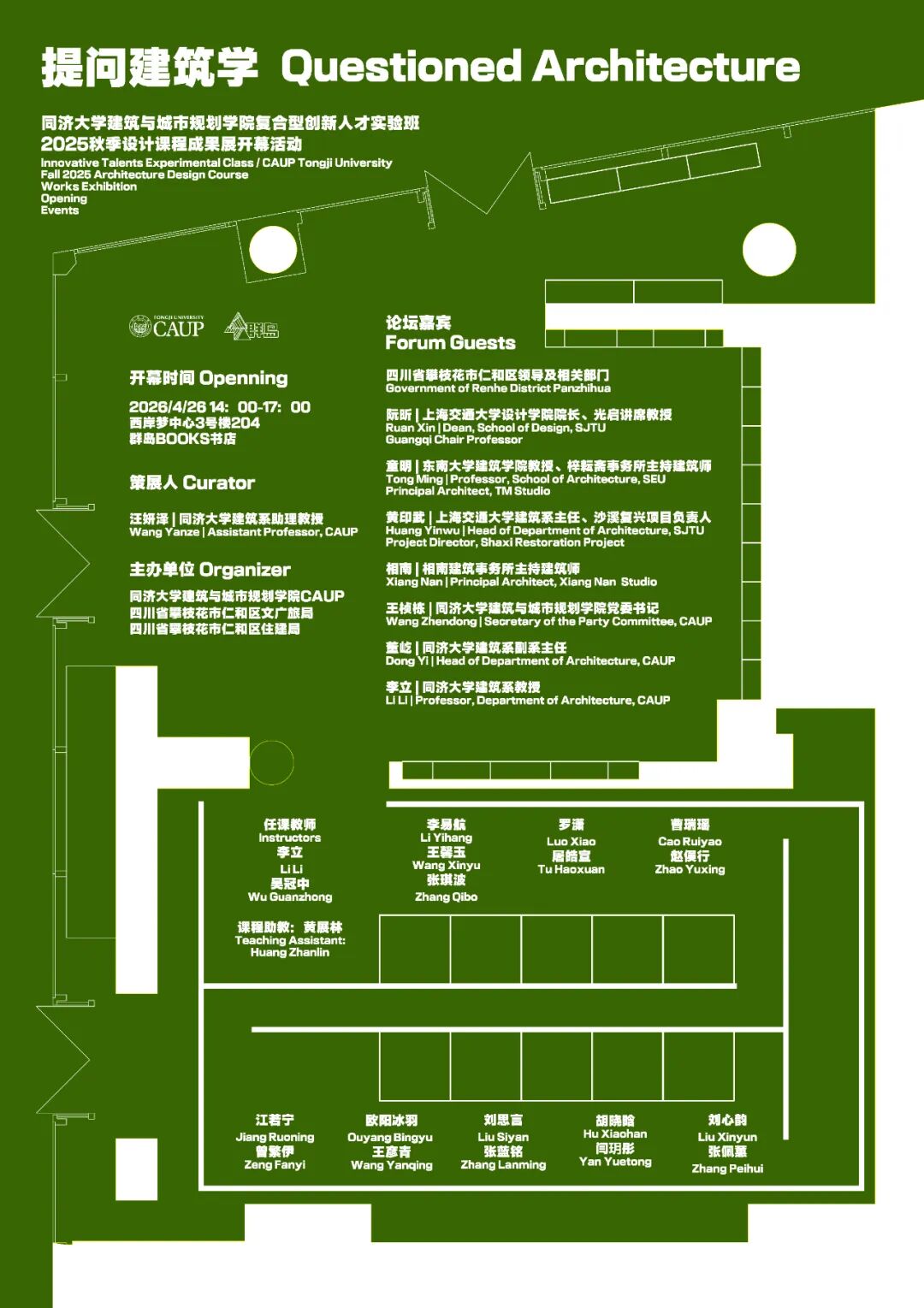
提问建筑学
Questioned Architecture
当下时代的许多技术门槛逐渐被AI突破,加之中国城市化进程放缓,城市和乡村进入存量更新时代,发现问题的能力对建筑师的工作变得尤为关键。因此,同济大学建筑城规学院复合型创新人才实验班,在2024和2025年两届四年级秋季设计课程均以“提问建筑学”为课程主题,教学模式以“问题、方向、概念、操作”为步骤推进,要求学生将问题作为设计思考的核心驱动力,精确指导每步的逻辑梳理和空间操作。
In the age of AI breaking technical barriers and China’s slowed urbanization, urban and rural development has shifted to renewal. The ability to identify problems has thus become crucial for architects. Against this background, CAUP Tongji University Innovative Experimental Class, set “Questioning Architecture” as the theme for the 4th-year autumn design studio in 2024 and 2025. Adopting a Problem–Orientation–Concept–Operation framework, the course takes problem-finding as the core driver, guiding students’ logical thinking and spatial operations precisely.
2025年课程以成昆铁路工业遗产为设计对象,选择已停运的攀枝花仁和区拉鮓火车站及其周边附属的自然、村落、厂区等多种环境因素为场地,每组同学通过现场调研发现问题,依据其提出的问题选择设计研究方向,在南北一公里范围内自主选址,围绕问题进行相关领域研究、案例学习,找到问题的解决办法进而提出自己的设计概念,最终通过空间操作精准地构筑概念、解决问题。
In 2025, the course took Chengkun Railway’s industrial heritage as its theme, focusing on the abandoned Lazha Station in Renhe District and its surrounding context: natural landscapes, villages and industrial zones. Through field research, each group defined problems, set design directions, and selected sites within a 1-kilometer north-south range. Students conducted research and case analysis to develop solutions, put forward design concepts, and finalized them through spatial design.
通过8周的设计课程,8组同学从不同研究方向出发,完成了各自对拉鲊站更新利用的创意设计,为成昆铁路工业遗产的活化提供了8种不同的解题思路:依托现有铁路实训产业,培育研学业态,带动工业遗产与乡村聚落共同发展;关注金沙江峡谷中特殊的风环境,以风为媒介塑造成昆铁路的体验感知;将工业遗产转化为景观基础设施,基于铁路创新衍生空间体验产品;以拉鲊站作为建设实验样本,为整条废弃成昆线找到铁路复兴的经验模式;借力多种场地元素的交叉点,诠释成昆铁路人工与自然复合叠加的差异特征;将废弃车站及周边自然转化为展品本身,以轻介入方式利用工业遗产;梳理基础设施与拉鲊兴衰的脉络关系,以空间秩序的再造激发基础设施的复兴;关注铁路与村落的共生互动关系,以场景创新激活废弃铁路站房的更新重塑。
Over the 8-week course, 8 groups completed creative regeneration designs for Lazha Station from different perspectives, offering 8 approaches for the revitalization of Chengkun Railway’s industrial heritage: Leverage existing railway training industry to develop research and education, driving integrated development of industrial heritage and rural settlements; Use wind (a unique feature of Jinsha River Canyon) as a medium to shape the experience of Chengkun Railway; Transform industrial heritage into landscape infrastructure and create innovative railway-derived spatial experience products; Take Lazha Station as an experimental model to explore a revitalization pattern for the entire abandoned Chengkun Railway; Interpret the integration of man-made and natural features through the intersection of multiple site elements; Treat the abandoned station and surrounding nature as exhibits, adopting light-touch intervention for heritage reuse; Clarify the link between infrastructure and Lazha’s rise and fall, reviving infrastructure by reconstructing spatial order; Focus on railway-village symbiosis, activating station renewal through scene innovation.
(上下滑动浏览图片)
(上下滑动浏览图片)
展览介绍
Introduction
成昆铁路是世界铁路建设史上地形地质最复杂、工程难度最高、桥隧密度最大的干线铁路之一。从四川盆地穿越横断山脉、大小凉山至云贵高原,海拔落差超2000 米,跨越大渡河、金沙江、龙川江等主要河流98 次,隧道桥梁占线路总长度的41.6%,为当时世界之最。
The Chengkun Railway is one of the world’s most difficult trunk railways, with extremely complex terrain and geology, and the highest bridge-tunnel density. It stretches from the Sichuan Basin across the Hengduan Mountains and Daliang Mountains to the Yunnan-Guizhou Plateau, with an altitude drop of over 2,000 meters. It crosses major rivers 98 times. Tunnels and bridges account for 41.6% of the total length, a world record then.
1958年至1970年,30万军民以平均每公里2人牺牲的付出,历时12 年成昆铁路建成通车。成昆铁路打通了西南战略大通道,连接川滇,带动攀西地区的三线建设,巩固国防;同时,结束了少数民族地区无铁路历史,促进民族团结,改变2000 万人命运。1984 年成昆铁路与阿波罗登月、苏联第一颗卫星并列为20 世纪人类征服自然三大奇迹。
From 1958 to 1970, 300,000 soldiers and civilians spent 12 years building the Chengkun Railway, at the cost of two lives per kilometer on average. As a strategic southwest corridor linking Sichuan and Yunnan, it boosted the Third Front Construction, strengthened national defense, ended the railway-free history in ethnic areas, promoted unity and changed the fate of 20 million people. In 1984, it was listed as one of the three great miracles of human conquest of nature in the 20th century, together with Apollo moon landing and the first Soviet satellite
(上下滑动浏览图片)
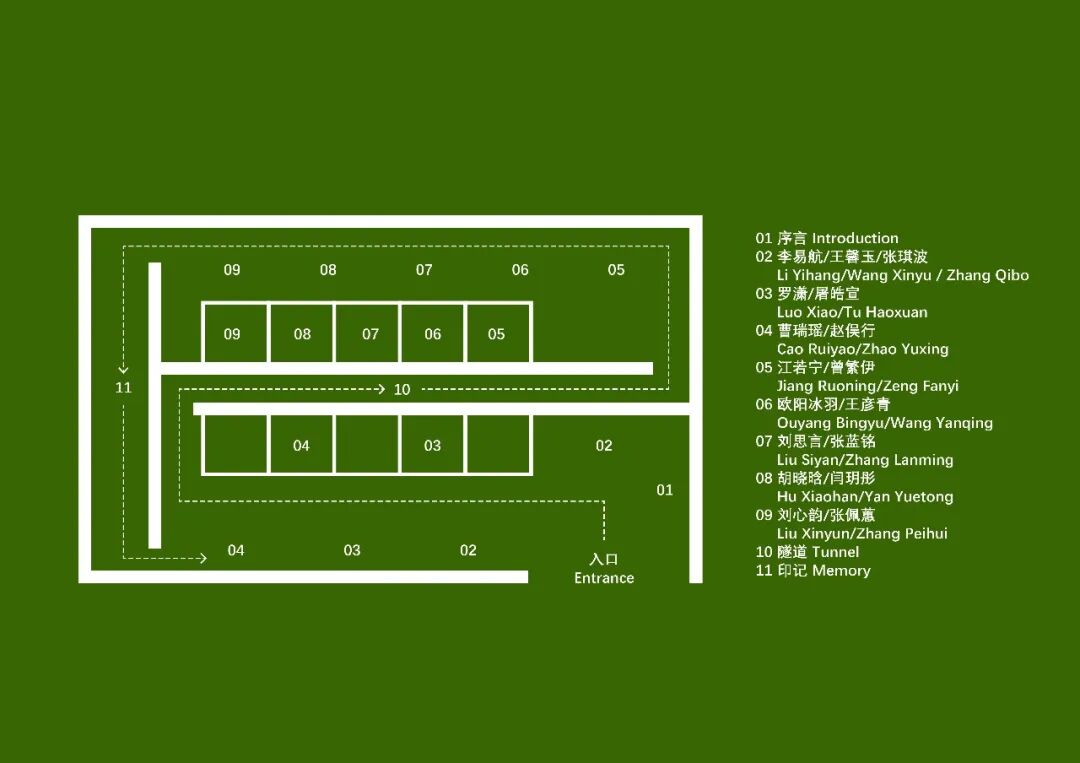
隧道-展览通过一条10米长、0.7米宽的黑色布帘通道,将课程成果分为左右两个展区,并使用火车行驶中混合的声音作为背景音,营造成昆铁路隧道特征的感官体验。
The Tunnel Space, 10-meter-long, 0.7-meter-wide black curtain passage, divides the course achievements into two different zones. With mixed sounds of moving trains as background audio, it creates an experience featuring the characteristics of Chengkun Railway tunnels.
帆布-展陈空间选用军绿色帆布围合构成,设计成果以硫酸纸、彩图、草图等图纸形式拼贴悬挂布置,如半个世纪前设计铸造成昆铁路的工程师前辈,CAUP实验班同学用设计和创意,激活更新红色工业遗产。
The exhibition space is enclosed with green canvas. Design works are collaged and hung in forms of trace paper, color prints and sketches. Just like the engineers who designed the Chengkun Railway half a century ago, students from the CAUP activate and renew the red industrial heritage through design and creativity
展览信息
Information
地点:群岛BOOKS丨西岸梦中心3号楼二层204
Venue: Archipelago Books丨204, NO 3, West Bund GATE M
展期:2026/04/26-2026/05/05
Duration: April 26 – May 5, 2026
开放时间:周一至周日 10:00-22:00
Opening Hours: Monday – Sunday 10:00 – 22:00
任课教师:李立 吴冠中
Instructors: Li Li, Wu Guanzhong
课程助教:黄展林
Teaching Assistant: Huang Zhanlin
策展人:汪妍泽
Curator: Wang Yanze
参展人:
曹瑞瑶 胡晓晗 江若宁 李易航 刘思言 刘心韵 罗潇 欧阳冰羽 屠皓宣 王馨玉 王彦青 闫玥彤 曾繁伊 张蓝铭 张佩蕙 张琪波 赵俣行
Participants:
Cao Ruiyao, Hu Xiaohan, Jiang Ruoning, Li Yihang, Liu Siyan, Liu Xinyun, Luo Xiao, Ouyang Bingyu, Tu Haoxuan, Wang Xinyu, Wang Yanqing, Yan Yuetong, Zeng Fanyi, Zhang Lanming, Zhang Peihui, Zhang Qibo, Zhao Yuxing
主办单位:
同济大学建筑与城市规划学院CAUP
四川省攀枝花市仁和区文广旅局
四川省攀枝花市仁和区住建局
Organizers:
College of Architecture and Urban Planning (CAUP), Tongji University
Culture and Tourism Bureau of Renhe District
Housing and Urban-Rural Development Bureau of Renhe District
展览支持:群岛
Exhibition Support: Archipelago
展览开幕式
Opening Ceremony
开幕式:2026/04/26
Opening Ceremony: April 26, 2026
开幕导览:2026/04/26 14:30-15:30
Exhibition Tour: April 26, 2026 14:30 – 15:30
开幕论坛:教学实验/工业遗产/校地联动
Forum: Architecture Education / Industrial Heritage / Collaboration
论坛嘉宾:
Forum Guests:
四川省攀枝花市仁和区政府领导及相关部门负责人
People’s Government of Renhe District, Panzhihua City, Sichuan Province
特邀嘉宾:
阮昕 | 上海交通大学设计学院院长、光启讲席教授
Ruan Xin | Dean, School of Design, Shanghai Jiao Tong University;Guangqi Chair Professor
童明 | 东南大学建筑学院教授、上海梓耘斋建筑工作室主持建筑师
Tong Ming | Professor, School of Architecture, Southeast University;Principal Architect, TM Studio
黄印武 | 上海交通大学建筑系主任、沙溪复兴工程瑞士项目负责人
Huang Yinwu | Head of Department of Architecture, Shanghai Jiao Tong University;Project Director, Shaxi Restoration Project
相南 | 相南建筑事务所主持建筑师
Xiang Nan | Principal Architect, Xiang Nan Architecture Studio
王桢栋 | 同济大学建筑与城市规划学院党委书记
Wang Zhendong | Secretary of the Party Committee, College of Architecture and Urban Planning, Tongji University
董屹 | 同济大学建筑与城市规划学院建筑系副系主任
Dong Yi | Head of Department of Architecture, Tongji University CAUP
李立 | 同济大学建筑与城市规划学院建筑系教授
Li Li | Professor, Department of Architecture, Tongji University CAUP
汪妍泽 | 同济大学建筑与城市规划学院建筑系助理教授
Wang Yanze | Assistant Professor, Department of Architecture, Tongji University CAUP
吴冠中丨同济大学建筑与城市规划学院建筑系客座导师
Wu Guanzhong | Guest Tutor, Department of Architecture, Tongji University CAUP