学院介绍
学院介绍
新闻中心



2026同济大学CAUP
国际设计夏令营
招募通知
Call for Students丨2026 Tongji CAUP International Summer School
计划活动时间:2026年7月18-26日
Event Period: July 18th- 26th, 2026
选拔国际学生:全球学生30人
Student Selection: 30 international students worldwide
活动主办单位:中国上海,同济大学建筑与城市规划学院
Host Institution: College of Architecture and Urban Planning - CAUP, Tongji University, Shanghai, P.R.China
支撑国际组织:UIA,RIBA
Supporting International Organizations: UIA, RIBA
1、夏令营主题 | THEME
上海实验室:重构建筑与城市空间
Shanghai LAB: The Re-Figuration on Architecture and Urban Space
夏令营分议题| SUB-THEME
[1] 重构城市空间Re-Figuration of Urban Space
[2] 重构建筑空间Re-Figuration of Architectural Space
[3] 重构基础设施Re-Figuration of Infrastructure
[4] 重构社会网络Re-Figuration of Social Communication
[5] 重构数智空间Re-Figuration of Artificial Intelligence & Space
[6] 重构未来遗产Re-Figuration of Future Heritage
2、学术背景| ACADEMIC CONTEXT
城市更新背景下,空间变革的过程及其内在张力可从学术概念上视为“空间的重构”。对建筑和城市空间而言,空间重构涉及对城市和城市公共间重构、建筑功能与空间组织的重构、基础设施的建筑化与城市化的重构、交通系统的重构、社会网络和交往空间的重构、人工智能引领的空间生产变革,以及重构未来的建筑与城市文化遗产和保护等。2026 CAUP暑期国际夏令营从基本性的时空概念引发学术关切,搭建全球化的知识背景与技术视野,通过组织国际师生研习,探讨地方文化、城市环境、社会经济,以及气候变化与韧性等对未来城市与建筑的价值和意义。
In the context of urban regeneration, the process of spatial transformation and its inherent tensions can be academically conceptualized as the Re-Figuration of Space. For architecture and urban environments, this re-figuration involves the restructuring of the city and urban public spaces, the reorganization of architectural functions and spatial configurations, the architectural and urban re-figuration of infrastructure, the transformation of transportation systems, the reconfiguration of social networks and communicative spaces, the spatial production shifts led by artificial intelligence, as well as the redefinition of future architectural and urban cultural heritage and its conservation. The 2026 Tongji CAUP International Summer Workshop draws academic focus from fundamental concepts of time and space, establishing a globalized framework of knowledge and technological perspective. By organizing collaborative workshops involving international faculty and students, it explores the significance and impact of local culture, urban environment, socio-economics, as well as climate change and resilience, on the future of cities and architecture.
3、研究场地 | RESEARCH SITE
本次夏令营研究场地为上海市黄浦区南京路步行街,研究范围西起西藏中路,东至黄浦江,总长约1.5公里。
The research site of this summer workshop is the Nanjing Road Pedestrian Street in Huangpu District, Shanghai. The study area spans approximately 1.5 kilometers, extending from Xizang Middle Road in the west to the Huangpu River in the east.
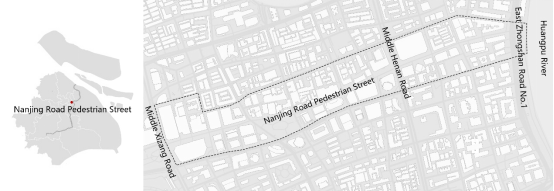
南京路步行街区位
The location of Nanjing Road Pedestrian Street
南京路步行街地处上海市中心,西接人民广场,东临外滩万国建筑群,是上海开埠以来城市商业空间演变中兼具典型性与连续性的核心样本。其空间形态可追溯至19世纪40年代英租界内由外滩通往跑马场的“花园弄”,后随跑马场西拓逐步演变为“大马路”。20世纪初,先施、永安、新新、大新四大百货公司相继落成,奠定了其“中华第一商业街”的历史地位。沿街建筑中西融合、新旧并置,构成了独特的街道界面与城市记忆载体。
The Nanjing Road Pedestrian Street is situated in the heart of Shanghai, connecting People's Square to the west and the Bund's architectural ensemble to the east. Since the opening of Shanghai as a commercial port, it has served as a quintessential and continuously evolving core specimen of urban commercial space transformation. Its spatial origins can be traced back to the 1840s, when it emerged as Garden Lane within the British concession, linking the Bund to the racecourse. As the racecourse expanded westward, it gradually evolved into Great Horse Road. In the early 20th century, the successive establishments of four major department stores—Sincere, Wing On, Sun Sun, and Sun—cemented its historical status as the Number One Commercial Street in China. The architectural styles along the street, characterized by a fusion of Chinese and Western elements and a juxtaposition of old and new, have formed a distinctive streetscape and a vessel of urban memory.
作为上海核心历史街区,南京路始终处于建筑形态与空间组构的动态演变之中。从历史建筑的保护修缮,到商业业态的综合调整;从1999年西藏中路至河南中路段辟为全天候步行街,到2020年东拓段的步行化改造完成,南京路在其百余年的时空演进中,持续回应城市发展语境,推进城市、建筑、基础设施等多层级的系统性空间重构。
As a core historical district in Shanghai, Nanjing Road has been in a constant state of flux regarding its architectural forms and spatial configurations. This dynamic evolution encompasses the preservation and restoration of historical buildings, comprehensive adjustments to commercial业态, the inauguration of a 24-hour pedestrian street from Xizang Middle Road to Henan Middle Road in 1999, and the pedestrianization of the eastern extension section in 2020. Over its century-long trajectory, Nanjing Road has consistently responded to the evolving context of urban development, advancing a multi-layered, systemic spatial re-figuration across urban, architectural, and infrastructural scales.
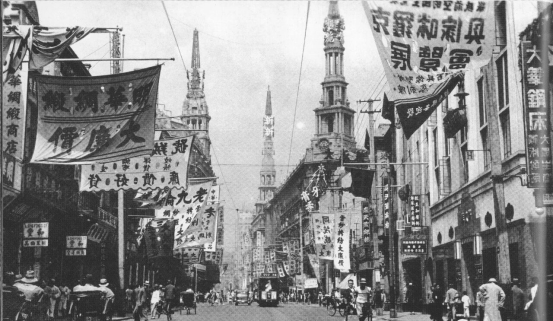
20世纪30、40年代的南京路
Nanjing Road in the 1930s and 1940s
图片来源:上海市黄浦区档案局
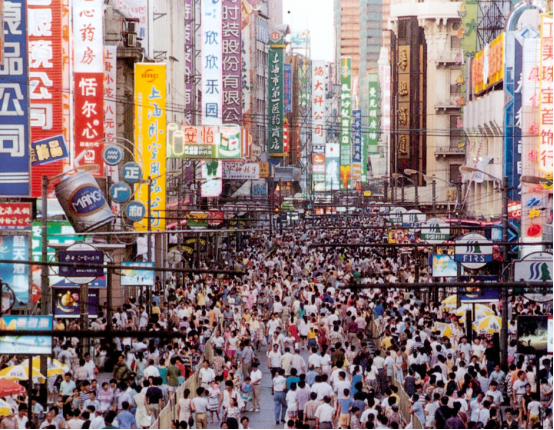
20世纪90年代的南京路
Nanjing Road in the 1990s
图片来源:上海市黄浦区档案局
然而,在当下城市发展语境中,南京路步行街面临多重空间结构困境:业态同质化导致商业界面趋同、历史文化资源尚未有效转化为场景叙事、主街与背街存在显著的空间割裂,由此街区陷入“高流量、低留量”的空间效能悖论。本次国际夏令营将以南京路步行街为空间本体研究对象,聚焦“空间的重构”这一核心议题,通过持续性、多维度的研习与讨论,剖析既有城市空间的结构性问题,探索其在当代城市语境下空间重构的可能路径。
However, within the current context of urban development, Nanjing Road Pedestrian Street confronts a series of spatial structural dilemmas: commercial homogenization leading to the convergence of retail interfaces, the underutilization of historical and cultural resources in scenographic narration, and a pronounced spatial disconnection between the main thoroughfare and its backstreet areas. Consequently, the district finds itself ensnared in a paradox of spatial efficiency—characterized by high footfall yet low retention. This international summer camp will take Nanjing Road Pedestrian Street as the primary spatial object of study, focusing on the core theme of Re-figuration of Space. Through sustained, multi-dimensional workshops and discussions, it aims to analyze the structural issues inherent in existing urban spaces and explore potential pathways for their spatial re-figuration within the contemporary urban context.
4、征集方式 | INVITATION AND APPLICATION
本次夏令营将延续以往惯例,全球公开征集与特邀相结合。所邀请的院校为全球国家和区域顶尖的建筑规划设计类院校。计划邀请国外院校学生,国内院校学生。在上海期间的住宿费用将有工作营承担。参加学生必须用英语交流。
The Tongji CAUP Summer School will continue the previous practice, with a combination of global open call and special invitation. The invited institutions are the top national and regional architectural planning and design colleges in the world. The program invites students from foreign institutions and domestic institutions. The accommodation in Shanghai for all students will be covered by the 2026 ISS. Participating students must communicate in English.
5、报名起止日期 | ENROLMENT DATE
即日起 - 2026年5月5日
From today to May 5th, 2026
6、提交材料 | THE MATERIALS SUPPOSED TO SUBMIT
(1)申请表(请扫二维码下载)
Application Form (Please scan the following QR code to download)
(2)设计作品两幅(每张图片精度300dpi)
Portfolio including two pieces of works (The resolution of each picture is 300dpi)

报名表下载二维码
THE QR CODE OF APPLICATION FORM
7、报名邮箱 | ENROLMENT EMAIL
tjcaup_summer2026@163.com
报名者将择优入选,由专家组裁定入选资格。组委会将在2026年5月20日前给入选者发出邀请通知。
Applicants will be selected on the basis of merit and will be judged by a panel of experts. The date of releasing formal invitation: May 20th, 2026.
2026 Tongji CAUP Summer School Committee
Tongji University
Shanghai, 2026-04-07
Reconnecting and Revitalizing 2025 TONGJI CAUP SUMMER SCHOOL
http://www.tongji-caup.org