学院介绍
学院介绍
新闻中心



2026 王维仁建筑研究/设计展 上海 同济
2026 Works by WANG Weijen Architecture
Shanghai Tongji
在中国快速变迁的城乡环境中,建筑如何彰显空间的场所特性与人文精神?面对大体量、多功能、高密度的需求,建筑如何调控尺度,建立单体与群体的关系,以及建筑景观与自然环境的互动?
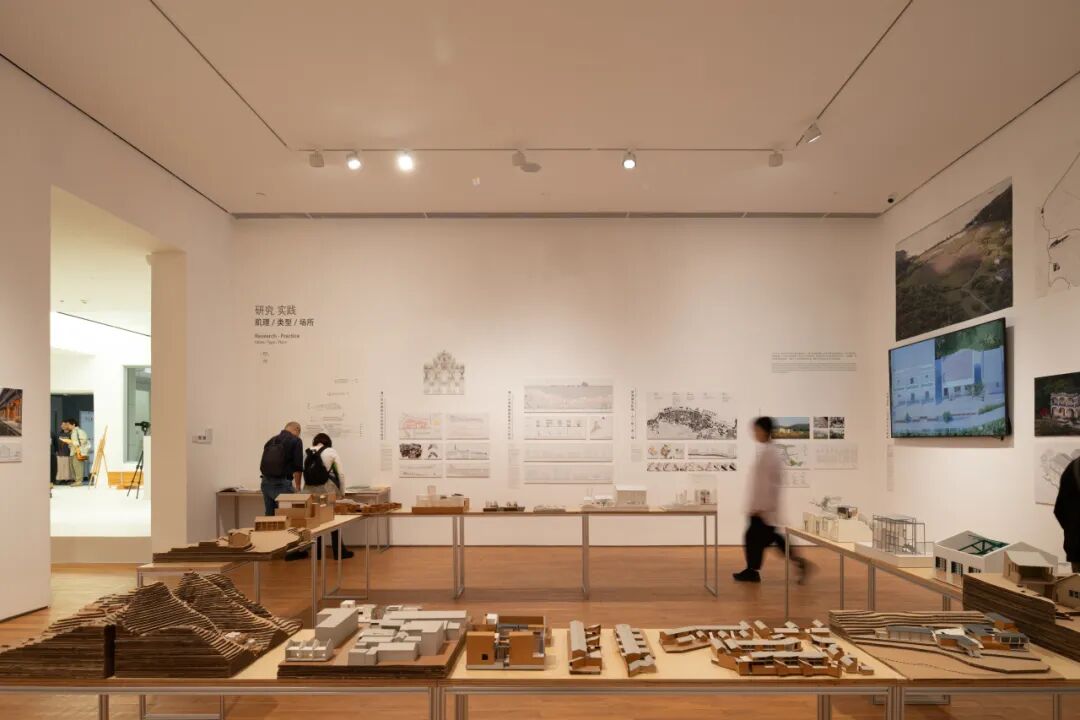
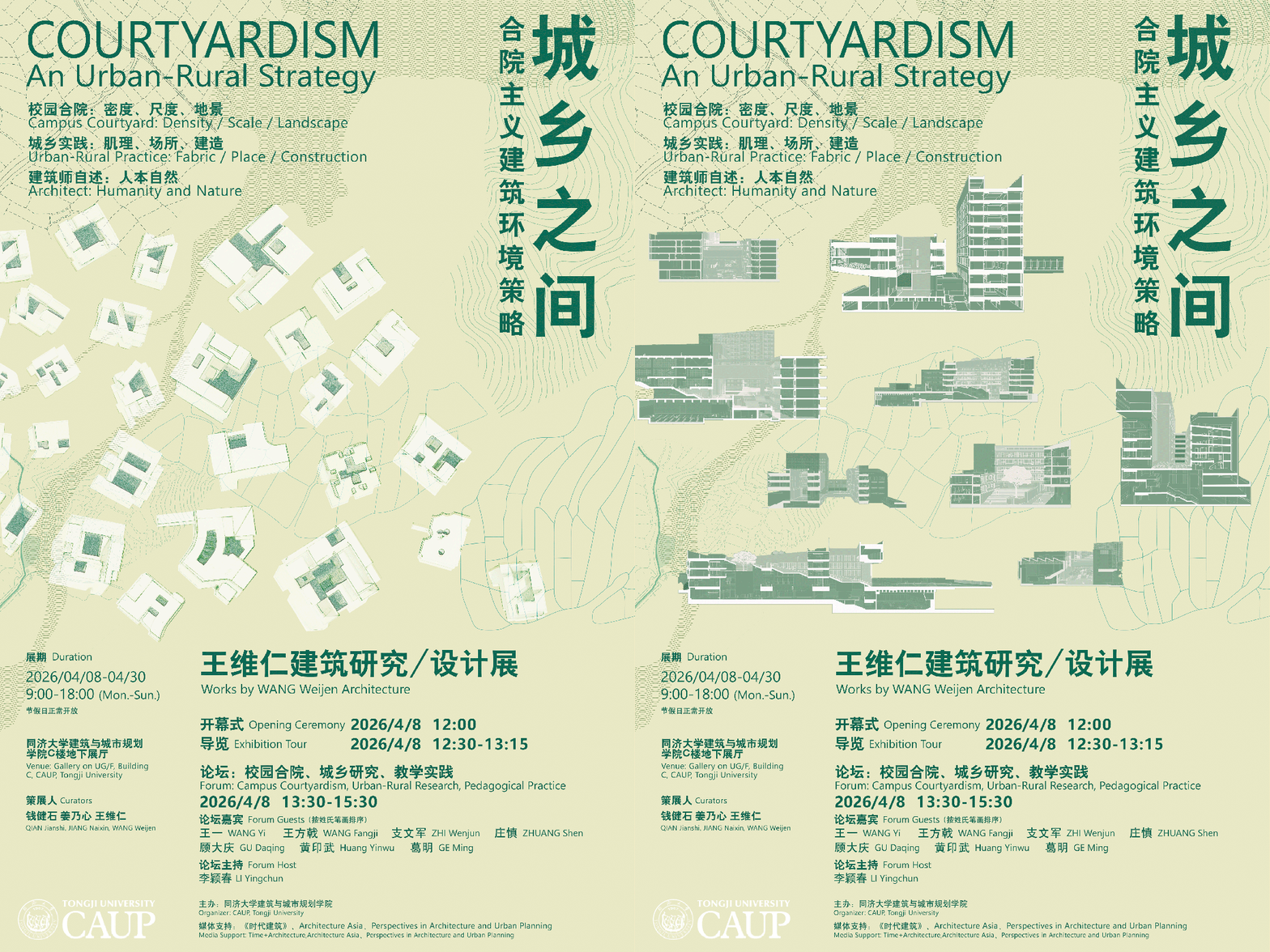
2026年4月8日,“城乡之间:合院主义建筑环境策略——王维仁建筑研究/设计展”将于上海同济大学建筑与城市规划学院正式开幕。 从多重视角呈现王维仁建筑设计研究室近二十年来,以合院主义为建筑环境策略所展开的城乡实践。除了城乡校园与社区建筑的设计实践,展览也梳理了研究室在城乡环境中持续的田野式调查与研究,体现建筑师对人本尺度、生态自然与社区场所的坚持,以及游走于城乡之间的工作日常。
In China’s rapidly changing urban and rural environment, how can architecture reveal the spatial genius loci and humanistic spirit? Faced with demands for large scale, mixed functions, and high density, how can architecture regulate scale, establish relationships between individual buildings and the collective, and foster interaction between built form and the natural environment?
On April 8, 2026, Between Urban and Rural: Courtyard Urbanism as an Architectural Environmental Strategy – Wang Weijen Architecture Research/Design Exhibition will officially open at the College of Architecture and Urban Planning, Tongji University in Shanghai. From multiple perspectives, the exhibition presents nearly two decades of urban and rural practice by Wang Weijen Architecture, grounded in courtyard urbanism as an architectural environmental strategy. In addition to design practices for urban-rural campuses and community buildings, the exhibition also features the research studio’s ongoing field-based investigations and studies in urban and rural contexts, highlighting the architect’s commitment to human scale, ecological nature, and community place, as well as the everyday work of navigating between city and countryside.
展览介绍 Introduction
本次展览以“校园合院:密度、尺度、地景”“城乡实践:肌理、场所、建造”与“建筑师自述:人本与自然”三部分展开。
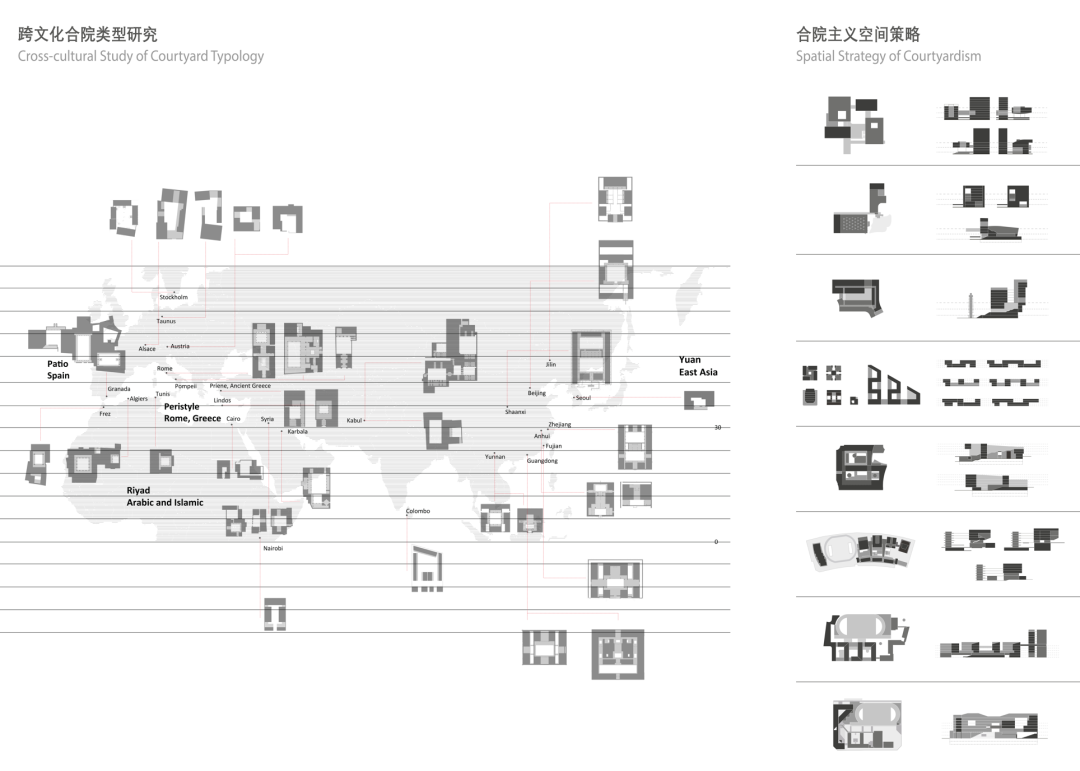
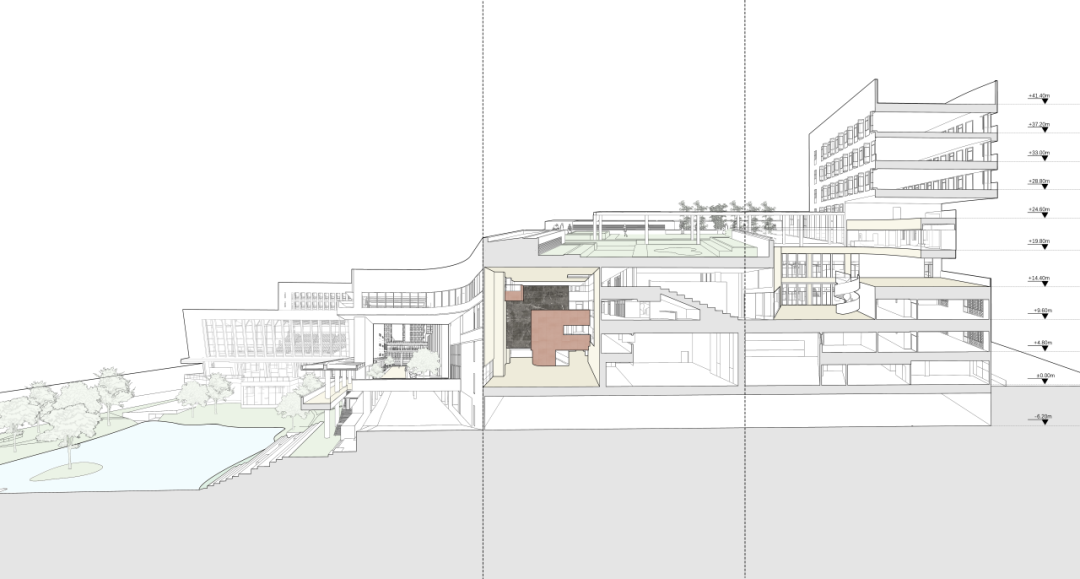
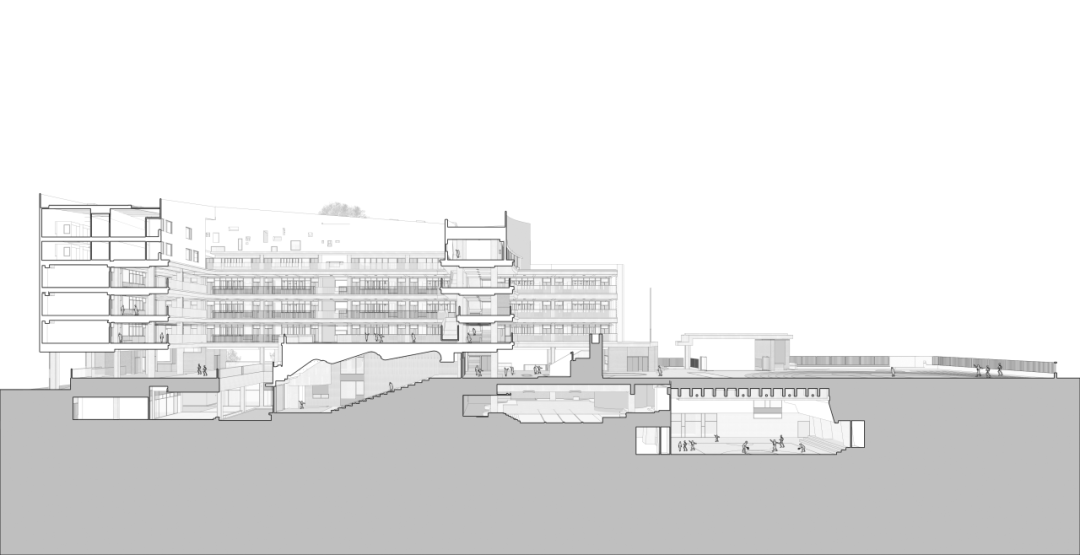
“校园合院”探讨合院主义作为跨文化空间原型:合院,在当代高密度城市,如何发展为一种多层立体城市空间系统,协调建筑的空间尺度与自然景观。透过研究室近年完成的校园设计包括香港中文大学(深圳),深圳石厦小学、明德高中、福海中学、福田外国语学校以及松阳丽水学院,展览进一步探讨合院主义作为一种类型学的剖面设计方法,如何通过叠加与交错、围合与连接,序列与过渡、大树与水塘,形成有效的空间策略,维系建筑的人本和生态环境的可持续。
“城乡实践”呈现研究室在城乡环境中的研究与设计实践。从澳门的茨林围、内港骑楼到香港的城市肌理研究,再到北京胡同、浙江松阳、河南王屋山、香港谷埔村等多个地域的建筑保育再利用与设计改造,以及香港菜园村的重建与社区营造,思考在城乡环境变迁下,城市与乡村、建筑与景观、湿地与聚落、高层与低层、保育与创新的二元辩证与共生关系。
“建筑师自述”以影片的方式呈现王维仁从个人成长与教育背景,到思想与行动的发展轨迹,展现其持续地对人的关注与对自然的观察,以合院主义作为方法的持续探索,以及在教师、学者、建筑师、策展人等多重身份下的工作日常。
本次上海展为“王维仁建筑研究/设计展”继香港艺穗会 (2025.5-6)、港中大(深圳)(2025.11-2026.3)之后的第三次展出。
This exhibition is organised in three parts, with the thematic discussions on Campus Courtyard, Urban-Rural Practice and Architect respectively.
Campus Courtyard: Density / Scale / Landscape
This section explores Courtyardism as a cross-cultural prototype which can be developed into a multi-layered three-dimensional system of architectural urbanism, coordinating scale while accommodating nature in contemporary high-density cities. Through a series of campus designs including The Chinese University of Hong Kong, Shenzhen, four schools in Shenzhen, and the Lishui University in Songyang, the exhibition explores how Courtyardism as typology can be developed into a sectional design method, through overlapping and interweaving, enclosure and connecting, sequence and transition, trees and ponds, establishing an effective spatial strategy for sustaining architectural and natural environments.
Urban-Rural Research: Fabric / Place / Construction
This section presents the studio's extensive research and built projects in diverse urban and rural contexts. From studies of Macao's Tsz Lam Wai and Hong Kong's urban fabric to the adaptive reuse and design transformations in Beijing's hutongs, villages in Zhejiang and Henan, the Hakka settlement of Kuk Po Village in Hong Kong, and the reconstruction of Choi Yuen Village, the exhibition highlights the dialectical and symbiotic relationships between city and village, architecture and landscapes, settlement and wetland, high and low density, conservation and innovation, amidst vast urban-rural transformations.
Architect: Humanity and Nature
Finally, a short film presents the personal and intellectual trajectory of WANG Weijen. It traces the development of his ideas and actions, from his upbringing and education to his consistent focus on people and observation of nature. This narrative reveals his continuous exploration of Courtyardism as a method and offers a glimpse into his daily work across the multiple roles of teacher, scholar, architect, and curator.
This Shanghai exhibition marks the third iteration of the Wang Weijen Architecture Research/Design Exhibition, following its previous shows in Hong Kong (May-June 2025) and Shenzhen (November 2025-March 2026).
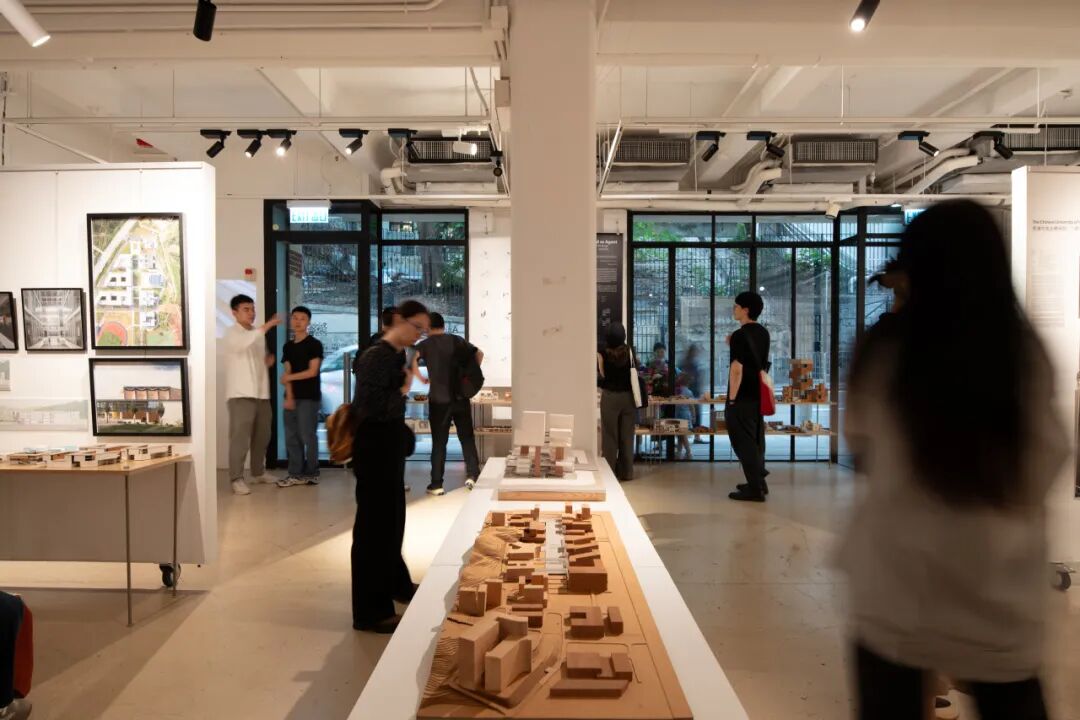
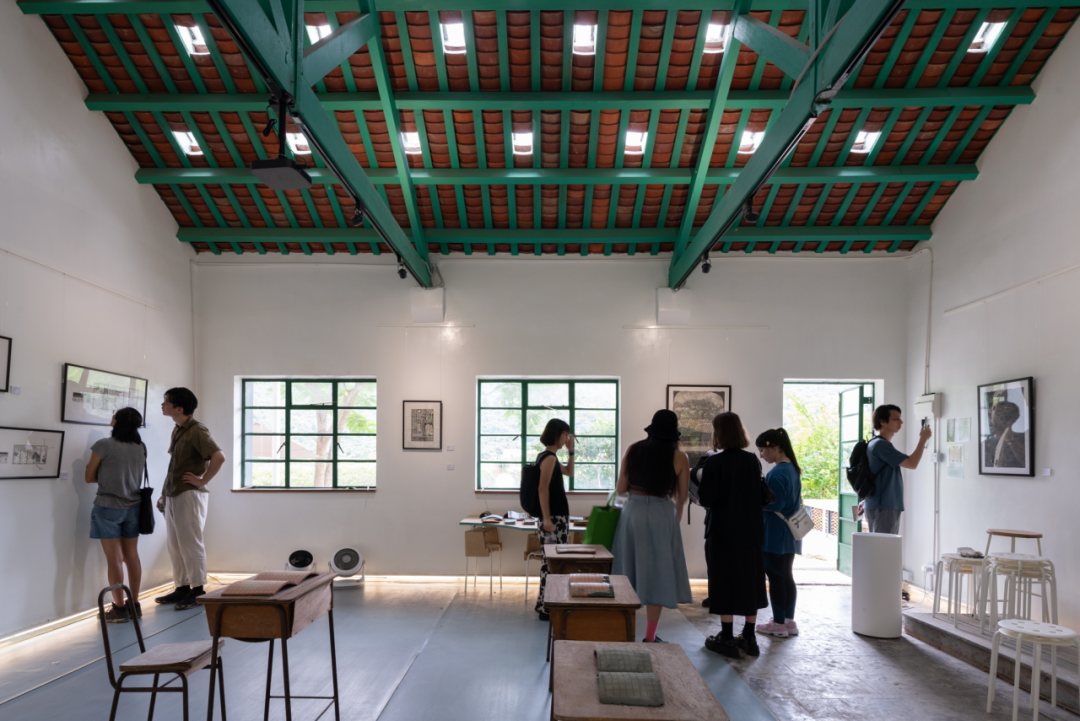
香港,中环艺穗会展览及论坛(2025.5-6)
<< 左右滑动可浏览多图 >>
深圳,香港中文大学深圳校区美术馆展览及论坛(2025.11-2026.3)
展览信息 Information
城乡之间:合院主义建筑环境策略
Courtyardism: an urban-rural strategy
地点:同济大学建筑与城市规划学院C楼地下展厅
Venue: Gallery on UG/F, Building C, CAUP, Tongji University
展期:2026/04/08-04/30
Duration: April 8 – April 30, 2026
开放时间:周一至周日9:00—18:00
Opening Hours: Monday to Sunday, 9:00–18:00
策展人:钱健石、姜乃心、王维仁
Curators: QIAN Jianshi, JIANG Naixin, WANG Weijen
主办单位:同济大学建筑与城市规划学院
Organizer: College of Architecture and Urban Planning, Tongji University
媒体支持:《时代建筑》、Architecture Asia、Perspectives in Architecture and Urban Planning
Media Support: Time+Architecture, Architecture Asia、Perspectives in Architecture and Urban Planning
开幕式:2026/04/08 12:00
Opening Ceremony: April 8, 2026, 12:00
开幕导览:2026/04/08 12:30—13:15
Exhibition Tour: April 8, 2026, 12:30–13:15
开幕论坛:校园合院/城乡研究/教学实践
2026/04/08 13:30-15:30
Forum: Campus Courtyard / Urban-Rural Research / Teaching Practice
April 8, 2026, 13:30–15:30
论坛嘉宾(按姓氏笔画排序):
Forum Guests:
王一 同济大学建筑与城市规划学院副教授、建筑系主任
Wang Yi: Associate Professor and Head of the Department of Architecture, College of Architecture and Urban Planning, Tongji University
王方戟 同济大学建筑与城市规划学院教授,上海博风建筑设计咨询有限公司主持建筑师
Wang Fangji: Professor, College of Architecture and Urban Planning, Tongji University; Principal Architect, Shanghai Bofeng Architectural Design Consulting Co., Ltd.
支文军 同济大学建筑与城市规划学院教授、《时代建筑》主编
Zhi Wenjun: Professor, College of Architecture and Urban Planning, Tongji University; Editor-in-Chief, Time+Architecture
庄慎 上海交通大学设计学院教授、未来空间研究中心主任,阿科米星建筑设计事务所主持建筑师
Zhuang Shen: Professor, School of Design, Shanghai Jiao Tong University; Director, Future Space Research Center; Principal Architect, Atelier Archmixing
顾大庆 东南大学建筑国际化示范学院教授
Gu Daqing: Professor, Internationalization Demonstration School of Architecture, Southeast University
黄印武 上海交通大学设计学院副教授、建筑系主任
Huang Yinwu: Associate Professor and Head of the Department of Architecture, School of Design, Shanghai Jiao Tong University
葛明 东南大学建筑学院教授
Ge Ming: Professor, School of Architecture, Southeast University
学术主持:
Academic Host:
李颖春 同济大学建筑与城市规划学院副教授
Li Yingchun: Associate Professor, College of Architecture and Urban Planning, Tongji University
2026年3月27日至4月10日樱花节期间,校外人士进校参加活动需凭邀请函,请电邮联系王小姐:15316168057@163.com。
院级高等讲堂
College-Level Distinguished Lecture
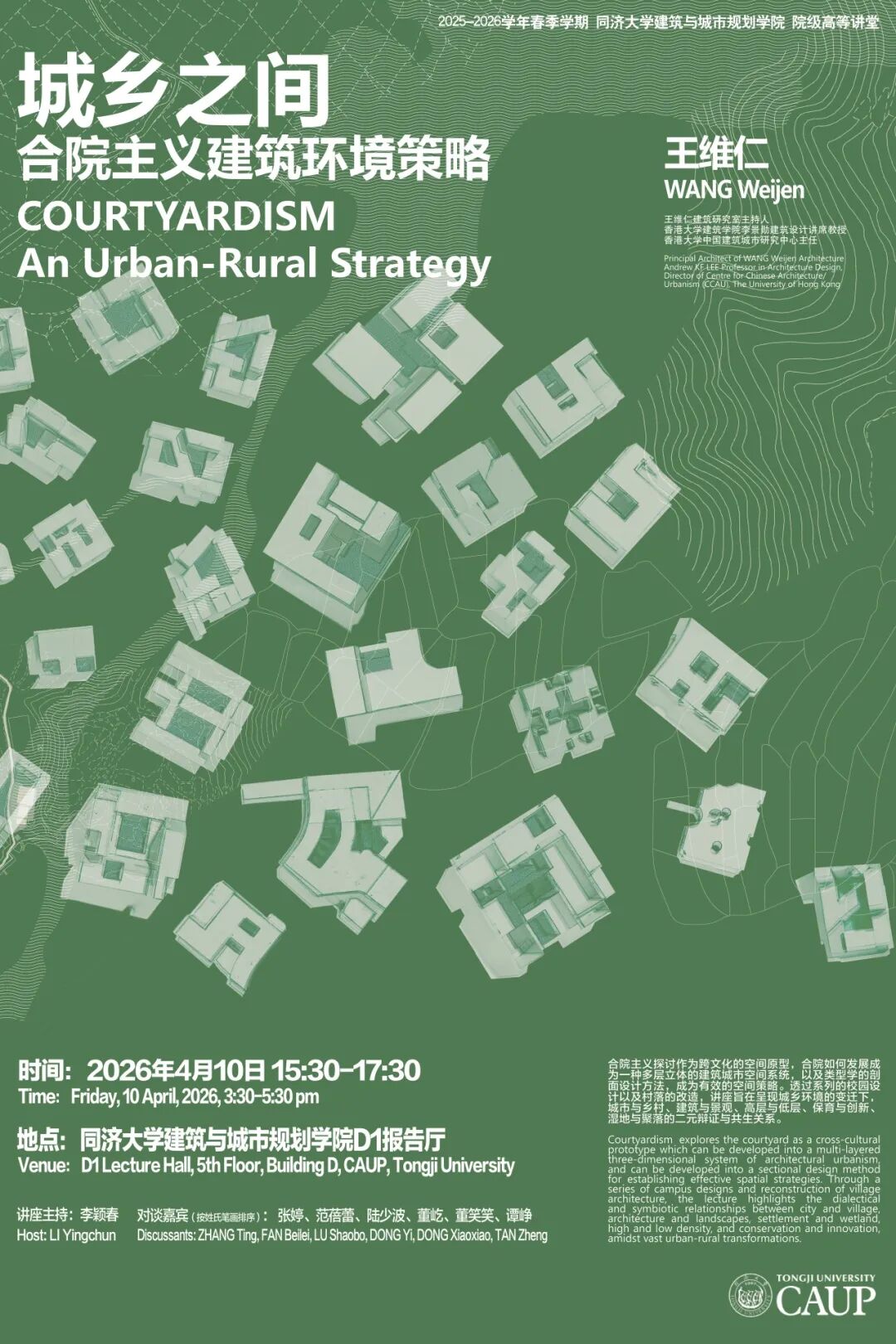
时间:2026年4月10日 15:30-17:30
Time: Friday, April 10, 2026, 3:30-5:30 pm
地点:同济大学建筑与城市规划学院D1报告厅
Venue: D1 Lecture Hall, 5th Floor, Building D, CAUP, Tongji University
讲座主持:李颖春
Host: LI Yingchun
对谈嘉宾(按姓氏笔画排序):张婷、范蓓蕾、陆少波、董屹、董笑笑、谭峥
Discussants: ZHANG Ting, FAN Beilei, LU Shaobo, DONG Yi, DONG Xiaoxiao, TAN Zheng
合院主义探讨作为跨文化空间原型,合院如何发展成为一种多层立体的建筑城市空间系统,以及类型学的剖面设计方法,成为有效的空间策略。透过系列的校园设计以及村落的改造,讲座旨在呈现城乡环境的变迁下,城市与乡村、建筑与景观、高层与低层、保育与创新、湿地与聚落的二元辩证与共生关系。
Courtyardiism explores the courtyard as a cross-cultural prototype which can be developed into a multi-layered three-dimensional system of architectural urbanism, and can be developed into a sectional design method for establishing effective spatial strategies. Through a series of campus designs and reconstruction of village architecture, the lecture highlights the dialectical and symbiotic relationships between city and village, architecture and landscapes, settlement and wetland, high and low density, and conservation and innovation, amidst vast urban-rural transformations.
2026年3月27日至4月10日樱花节期间,校外人士进校参加活动需凭邀请函,请电邮联系王小姐:15316168057@163.com。
王维仁
WANG Weijen
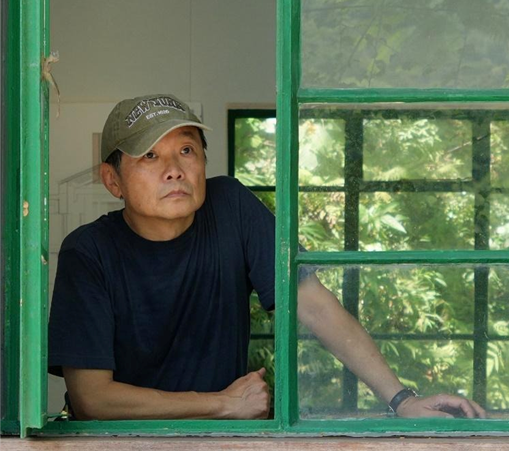
香港大学建筑学院李景勋建筑设计讲席教授,王维仁建筑设计研究室主持人及中国建筑城市研究中心主任。强调建筑与自然和文化地景的结合,其设计与研究关注高密度城市、乡村保育与可持续环境。曾任香港大学建筑系系主任、2023年任伯克利加州大学弗里曼讲座教授、2018年威尼斯建筑双年展香港馆策展人、2007年香港深圳城市建筑双城双年展策展人。
王维仁建筑设计研究室成立于旧金山,1994年迁到香港。设计着重类型学、城市肌理、公共空间,以及它们和人文与自然的互动,项目涵盖校园、社区及城乡文化建筑,作品曾获包括香港建筑师学会、香港城市设计学会、美国建筑师学会、AR公共奖、WA中国建筑奖等奖项,并被收录于肯尼思·弗兰普顿2020年再版的《现代建筑:一部批判的历史》。
WANG Weijen is the Andrew KF LEE Professor in Architecture Design at The University of Hong Kong and Principal Architect of WANG Weijen Architecture and Director of Centre for Chinese Architecture/Urbanism (CCAU). Integrating architecture with landscape and community, his practice responds to high-density urban context, rural conservation, and sustainable environments. Previously served as Head of the Department of Architecture, he was the 2023 Howard Freeman Visiting Professor at UC Berkeley, curator of 2018 Venice Architecture Biennale for HK Exhibition and 2007 Hong Kong Biennale of Architecture and Urbanism.
WANG Weijen Architecture started in San Francisco and moved to Hong Kong in 1994. Their projects address typology, urban fabric, public spaces, and their interaction with humanity and nature, covering campuses, community and culture buildings. Their works have received awards from HKIA, HKIUD, AIA Hong Kong, AR, WA, and were reviewed by Kenneth Frampton in Modern Architecture: A Critical History (2020).
“40年前在台湾澎湖的小渔村,我开始了建筑学习生涯的第一栋四合院测绘:一个四、五米见方框出的蓝天,石材铺地、青瓦檐口和白墙上移动的光影。之后的这些年,我们测绘、修建了更多的四合院,从北京胡同到浙江或香港的山村。我们一直拿四合院作为一个空间衡量的标准,关于尺度、自然、建筑与地景的关系。将合院作为一种理想的历史原型,面对高密度大尺度的城市,我们研究室总是想在大尺度的建筑里,重建这种合宜的尺度关系,保持建筑与自然关系的空间状态。”
Forty years ago, in a small fishing village in Penghu, Taiwan, I began my architectural education by surveying my first siheyuan (a traditional courtyard house): a four-by-five-meter square framing the blue sky, with the play of light and shadow moving across its stone paving, green-tiled eaves, and white walls. In the years since, we have surveyed and renovated more courtyard houses, from the hutongs of Beijing to the mountain villages of Zhejiang and Hong Kong. We have always used the courtyard as a spatial benchmark for the relationships between scale, nature, architecture, and landscape. Treating the courtyard house as an ideal historical prototype, our studio has always sought to rebuild this appropriate sense of scale within the large-scale buildings of high-density cities, preserving a spatial condition that maintains the relationship between architecture and nature.
王维仁,2025
WANG Weijen
<< 左右滑动可浏览多图 >>
跨文化的合院类型与合院空间策略 @王维仁建筑设计研究室
Cross-cultural typology of “courtyard”and courtyard as spatial strrategy, WANG Weijen Architecture
代表作品 Selected Works
香港中文大学(深圳)
The Chinese University of Hong Kong, Shenzhen
<< 左右滑动可浏览多图 >>
港中大(深圳)的设计强调校园环境与周边山水的联系,重视群组和单体建筑的协调,利用高低组合不同形式的开放院落,建立人文尺度与自然生态的校园环境。
The planning and design of CUHK-Shenzhen campus enhance its connection with surrounding landscape, as well as the coordination of parts with the whole for building clusters.
香港中文大学(深圳)附属明德高级中学
The Chinese University of Hong Kong, Shenzhen Affiliated Mingde High School
<< 左右滑动可浏览多图 >>
明德中学在平面和竖向剖面之间形成多元的交流平台,形成南北的空间张力与三维序列的线性院落空间。
Mingde Middle School creates diverse communication platforms between plan and vertical section, generating north-south spatial tension and linear courtyard spaces in a three-dimensional sequence.
石厦小学
Shixia Primary School
<< 左右滑动可浏览多图 >>
石厦小学的设计希望在多层高密度的条件下,维系一个合宜的空间尺度,调控建筑与自然的交错,让学生与院落、大树与草地一起成长。
By arranging courtyard spaces three-dimensionally, the design of Shixia Primary School interweaves architecture with landscape in the high-density urban condition, moderates scale for the multi-leveled campus.
谷埔愿景:点线面针灸式策略
Kuk Po Vision: :Point-Line-Network Acupuncture Strategy
<< 左右滑动可浏览多图 >>
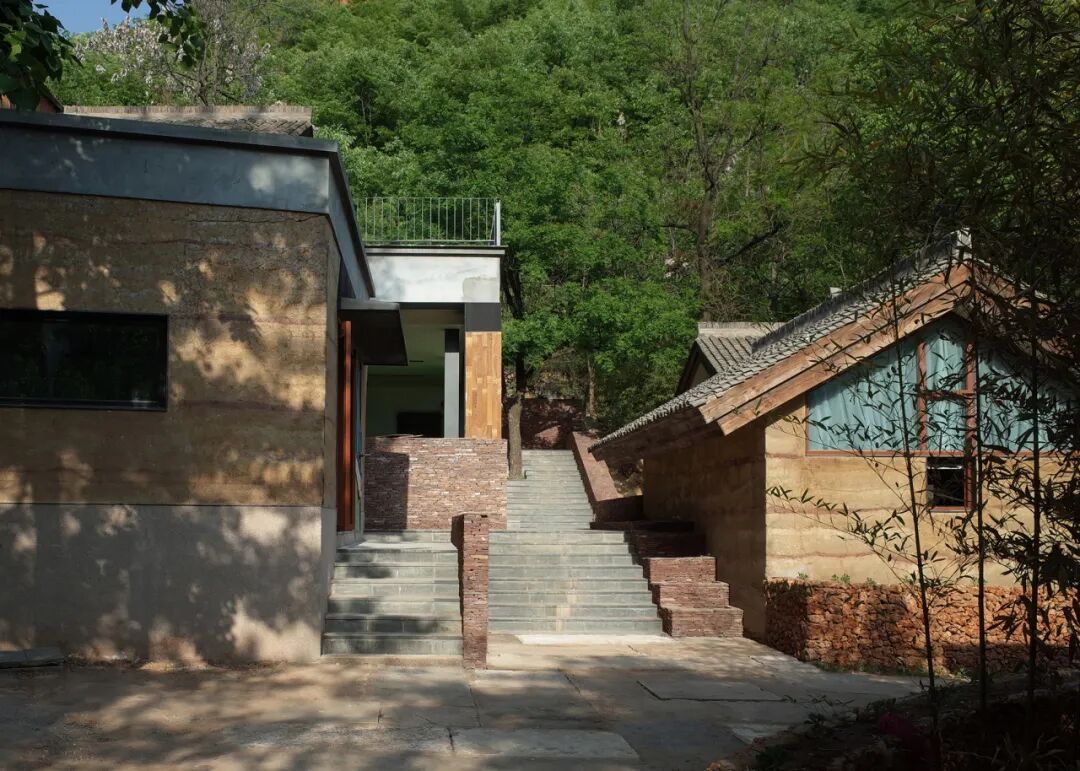
谷埔位于香港边界的沙头角地区,保存了大面积的红树林湿地与传统客家聚落。研究以“谷埔愿景”为期许,透过启才学校的展览、带动谷埔客厅的修复、启才学校广场的营造、艺术谷埔的活动、生态厕所的兴建,与废墟花园的改造,启动建筑的活化与景观环境的改善。
Situated amidst the rural landscapes of Hong Kong's Sha Tau Kok, Kuk Po preserves a large area of mangrove wetlands and traditional Hakka settlements. Built upon a shared theme “Kuk Po Vision”, the study demonstrates various design interventions for Kuk Po including the establishment of Kai Choi School Plaza, the renovation of Kuk Po Common, the construction of Eco-toilet, and the reconstruction of Ruin Garden.
小有洞天:小有河精品民宿
Valley Retreat: Xiaoyou Dongtian
<< 左右滑动可浏览多图 >>
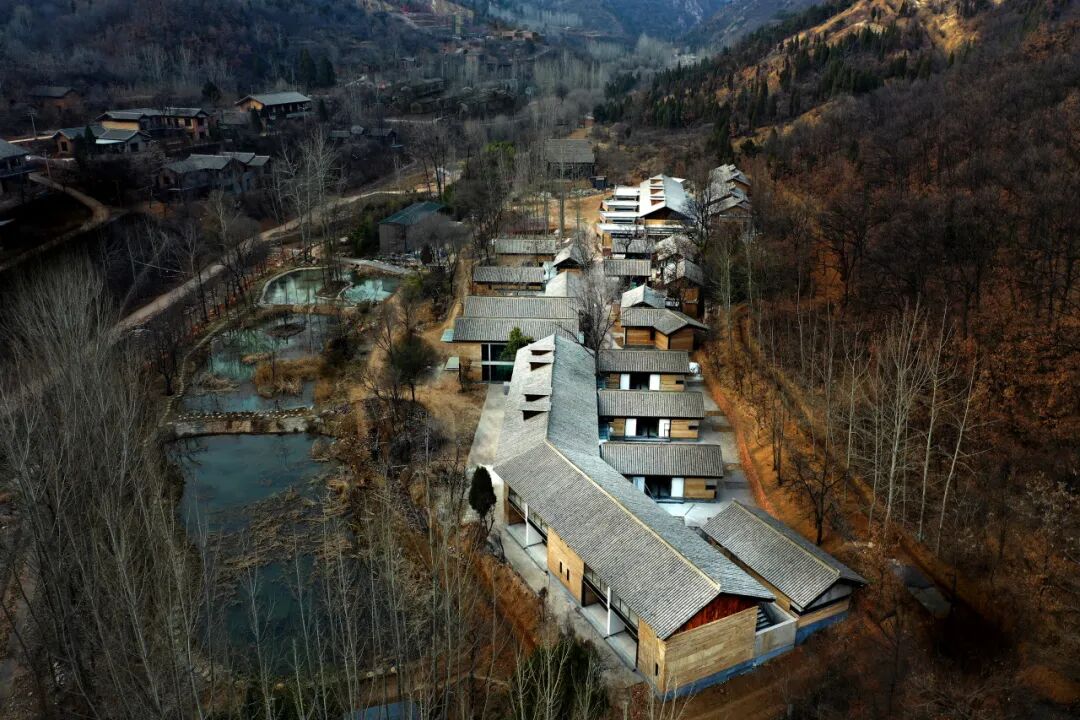
小有河位于河南省济源市王屋山麓,是一处狭长河谷,保留了完整的自然生态与农业聚落形态。借助院落与巷道、平台与阶梯、水塘与树林的有机组合,形成富有层次的聚落结构。
Xiaoyouhe is a narrow river valley situated at the foothills of Wangwu Mountain in Jiyuan, China, where the natural ecology and traditional agricultural settlements remain well preserved. Through the arrangement of courtyards and alleyways, platforms and steps, ponds and woodlands, the retreat offers visitors an immersive experience within the natural environment.

上海市杨浦区四平路1239号