学院介绍
学院介绍
新闻中心



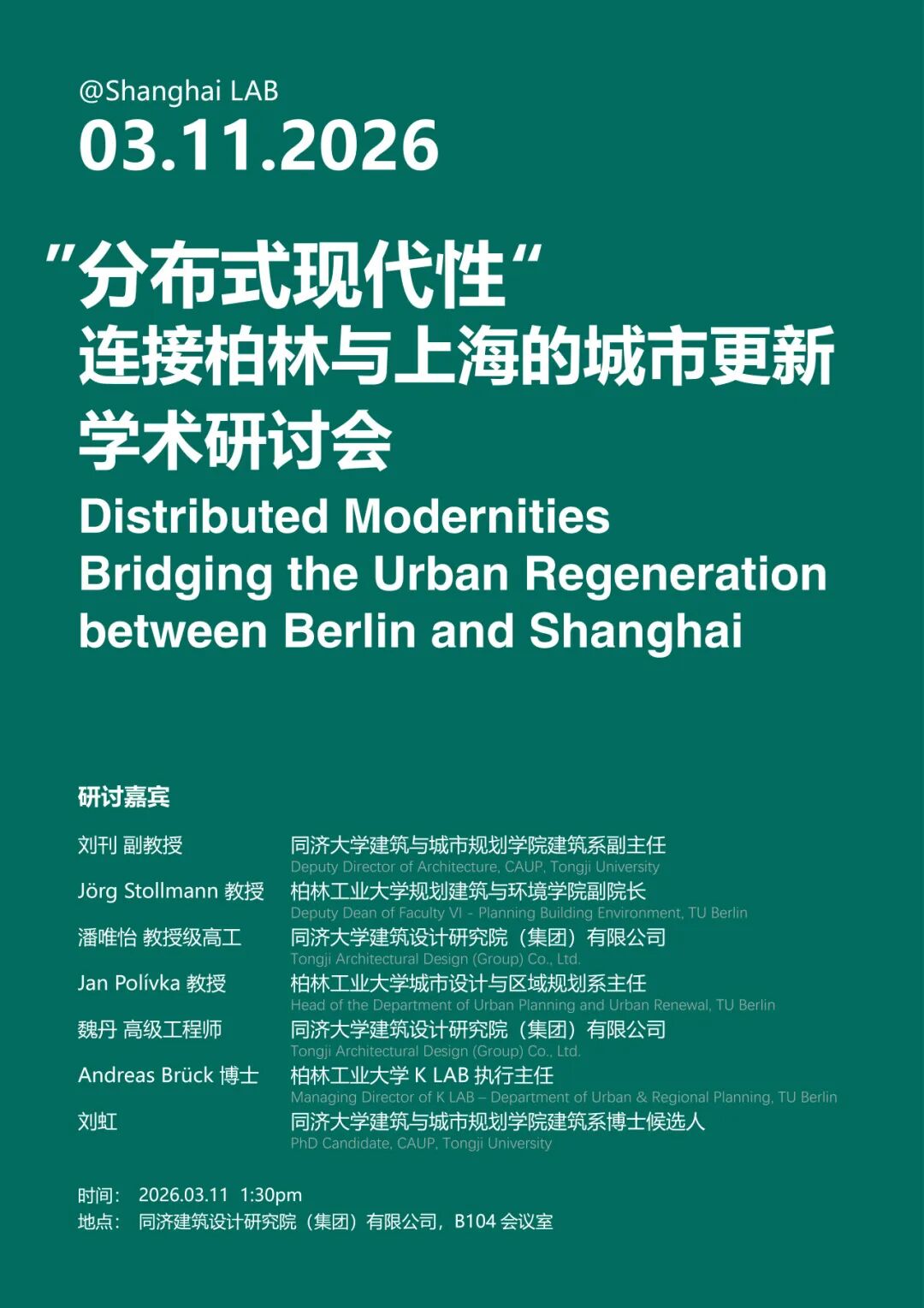
“分布式现代性”:
连接柏林与上海的城市更新
学术研讨会
时间:2026.3.11 下午1:30
地点:同济大学建筑设计研究院(集团)有限公司,B104会议室
分布式现代性(Distributed Modernities)是建筑历史与理论用来阐释多元现代主义的一个核心概念。可以解释现代建筑不是从一个中心产生,而多中心,甚至是网络化的嬗变。不同地区发展出来的现代建筑,但彼此之间又非常不同,承载着不同的“现代性”内涵。在当代建筑实践中,分布式现代性的意义愈发凸显。它意味着建筑师既具备全球化的知识背景与技术视野,也愈发关注地方文化、城市环境、社会经济,以及气候变化与韧性等议题。这种双重关注赋予了设计更广阔的创造力,使当代建筑在全球语境中得以保持地方特征与文化认同。
研讨背景
柏林与上海,两座城市走过了截然不同的现代建筑发展之路。面对城市更新,它们所采取的问题解决方式,以及背后的更新机制,也展现出深刻的差异。上海在经历了近四十年的高速建设发展后,当下所面临的建筑与城市问题,表面上似乎与柏林在过往半个世纪中经历的某些阶段相似,然而细察之下,其问题实质与约束条件又有着诸多不同。反思柏林的城市进程,越来越多的建筑更新议题背后,指向的是城市策略与空间系统的问题:从对现代建筑与城市重建产生深远影响的1957年国际建筑展(Interbau),到深刻塑造城市更新与城市理念的1987年国际建筑展(IBA);从两德统一后的波茨坦广场城市设计,到GMP建筑事务所设计的立体化交通枢纽柏林中央火车站;从柏林文化广场的更新,到柏林博物馆岛、国家美术馆、洪堡论坛等一系列标志性项目的更新实践。城市、建筑与基础设施的空间边界正在消融与重构,这些实践折射出,在复杂的建成环境中,如何直面并解决深层次空间问题,这些实践经历对上海在城市更新的方法探索与反思依然有理论价值和学术意义。
期待本次学术研讨,能够在理论与实践的交互中,架设起一座连接柏林与上海的城市更新对话桥梁。也献给2026年同济大学建筑与城市规划学院与德国柏林工业大学城市设计双学位项目学术交往二十周年,愿以此为纽带,凝聚面向未来建筑与城市领域的新生力量。
研讨嘉宾
●
刘刊 副教授
同济大学建筑与城市规划学院建筑系副主任
●
Jörg Stollmann 教授
柏林工业大学规划建筑与环境学院副院长
●
潘唯怡 教授级高工
同济大学建筑设计研究院(集团)有限公司
●
Jan Polívka 教授
柏林工业大学城市设计与区域规划系主任
●
魏丹 高级工程师
同济大学建筑设计研究院(集团)有限公司
●
Andreas Brück博士
柏林工业大学K LAB执行主任
●
刘虹
同济大学建筑与城市规划学院建筑系博士候选人
Distributed Modernities:Bridging the Urban Regeneration between Berlin and Shanghai
Time: 1:30 PM, March 11, 2026
Venue: Room B104, Tongji Architectural Design (Group) Co., Ltd.
Distributed Modernities is a core concept in architectural history and theory used to interpret pluralistic modernisms. It posits that modern architecture did not emerge from a single center, but through a multi-centric or even networked evolution. Modern architecture developed across different regions, while distinct from one another, carries diverse connotations of modernity. In contemporary architectural practice, the significance of distributed modernities has become increasingly prominent. It implies that architects, while equipped with globalized knowledge and technical vision, are increasingly focused on local culture, urban environments, socio-economics, as well as issues such as climate change and resilience. This dual focus empowers design with broader creativity, enabling contemporary architecture to maintain local identity and cultural recognition within a global context.
Berlin and Shanghai have traversed distinctly different paths in the development of modern architecture. Facing urban regeneration, their problem-solving approaches and underlying mechanisms reveal profound differences. After nearly forty years of rapid construction and development, the architectural and urban challenges Shanghai currently faces may appear superficially similar to certain stages Berlin experienced over the past half-century. However, a closer examination reveals that the essence of these problems and their constraining conditions are substantially different. Reflecting on Berlin’s urban process, an increasing number of architectural renovation topics point toward issues of urban strategy and spatial systems: from the 1957 International Building Exhibition (Interbau), which had a far-reaching impact on modern architecture and urban reconstruction; to the 1987 International Building Exhibition (IBA), which profoundly shaped urban renewal and urban philosophy; from the urban design of Potsdamer Platz after German reunification, to the Berlin Central Station, a multi-dimensional transportation hub designed by gmp Architects; and from the renovation of the Kulturforum to the series of landmark renewal practices including the Museum Island, the Neue Nationalgalerie, and the Humboldt Forum. The spatial boundaries between the city, architecture, and infrastructure are dissolving and being reconstructed. These practices reflect how to confront and resolve deep-seated spatial issues within complex built environments. Such experiences hold significant theoretical value and academic relevance for Shanghai’s exploration and reflection on urban regeneration methodologies.
We look forward to this academic symposium establishing a bridge for dialogue on urban regeneration between Berlin and Shanghai through the interaction of theory and practice. This event is also dedicated to the 20th anniversary of the academic exchange of the Urban Design Dual Degree Program between CAUP, Tongji University and TU Berlin. May this partnership serve as a vital link to galvanize the emerging forces that will shape the future of architecture and urbanism. May this bond serve as a catalyst to galvanize new forces in the future fields of architecture and urbanism.
Discussion Guests
●
LIU Kan
Associate Professor; Deputy-Director of Architecture Department, CAUP, Tongji University
●
Jörg Stollmann
Professor; Deputy Dean of Faculty VI - Planning Building Environment, Technische Universität Berlin
●
PAN Weiyi
Professor of Engineering, Tongji Architectural Design (Group) Co., Ltd.
●
Jan Polívka
Professor; Head of the Department of Urban Planning and Urban Renewal, Technische Universität Berlin
●
WEI Dan
Senior Engineer, Tongji Architectural Design (Group) Co., Ltd.
●
Andreas Brück
Doctor; Managing Director of K LAB – Department of Urban & Regional Planning, Technische Universität Berlin
●
LIU Hong
PhD Candidate, CAUP, Tongji University
本次研讨会由“十四五”国家重点研发计划“双碳目标下的建筑城市一体化与立体化关键技术研究”项目(2023YFC3804100)支撑。
This symposium is supported by the National Key R&D Program of China during the 14th Five-Year Plan Period (2023YFC3804100), titled Key Technologies for Building-City Integration and Three-Dimensional Development under the Carbon Peaking and Carbon Neutrality Target.