学院介绍
学院介绍
新闻中心



自现代建筑运动以来,建筑学借助展览、出版等多元媒介,逐步演变出一种以学科知识体系为核心,兼融设计学、艺术学、媒介研究与传播学的跨学科文化现象。近年来,建筑展览在专业场域与公众话语中的蓬勃兴盛,正不断重塑人们对建筑学的传统认知。
基于此,“当代建筑文化与策展思维(Contemporary Architectural Culture and Curatorial Thinking)” 英文课程以策展思维为方法论抓手,整合历史梳理、理论建构与实践操作三重维度:课程从“策展”的词源考证与概念阐释出发,追溯其在现当代艺术与建筑领域的发展脉络;进而通过解析全球重要建筑展、艺术展及城市双年展,探讨策展机制在空间生产、知识传播与文化建构中的独特价值;最终引导学生系统掌握策展方法论,建立批判性的展览思维与实务操作能力。
本学期,课程由李龙雨(Lee Yongwoo)教授与莫万莉助理教授共同讲解。除课堂讲授与专题研讨外,课程亦延伸至第十五届上海双年展“花儿听到蜜蜂了吗?”嘉源海美术馆城市项目的现场考察,并安排与美术馆公共教育部及参展艺术家的深度对谈。
通过一学期的学习,选课学生以小组合作形式提交一份策展提案。提案需要同时兼顾概念性与可操作性。每份提案需在30万人民币的预算框架中,基于特定主题及其阐释完成包括参展人、展陈设计及展览执行的完整方案。
主讲教师:李龙雨(Lee Yongwoo)、莫万莉
课程助教:杨紫萱
选课学生:
孙圣博、王世言、叶正杭、达米亚(Mohamad Hisham Teh Nur Damia Binti)、王激扬、吴志熹、王严玉、蔡悠然、杜佳、谢冰、王思语、张铭楠、陈乐阳、林正昕、叶清仪(Suryadi Angeline)、左光青(Sai Hein Thiha Swe)、金路易(Kim Lui)、王亚信(Alshamsi Yaseen Saif Ghaseb Kanzoul)、张沛晶(Tiocuardy Winnie)、妮可(Dato Lara Nicole)、徐位萍(Vichitvikrom Pimsai)、安叶英(Aye Nyein Thu)、李沂桓(Ada Lee)、小莲(Xiao Lian Ba Milis)、杨淑雯(Su Wen Yeo)、杨悦(Clara Yang Sayagués)、瓦伦婷(Clara Valentine)、丹玉琪(Ngoc Kim Dang)、郑凯(Shawn Tay)、崔银志(Eunji Choi)、娜丽(Naëlle Attigui)、弗里德(Peer Otto Friedrich)、克莱明(Clemens Laurin Fruth)、邹永彦(Josune Minguela)、约拿宁(Jonathan Schmitz)、宋泽楷(Jack Khai SOONG)
策展方案节选
Selected Curatorial Proposals
辗转难眠的房间:噩梦、记忆与修复
(
ROOMS OF RESTLESS SLEEP: Nightmares, Memories, Repair
)
达米亚(Mohamad Hisham Teh Nur Damia Binti), 妮可(Dato Lara Nicole), 王亚信(Alshamsi Yaseen Saif Ghaseb Kanzoul), 吴志熹(Wu Zhixi), 左光青(Sai Hein Thiha Swe)
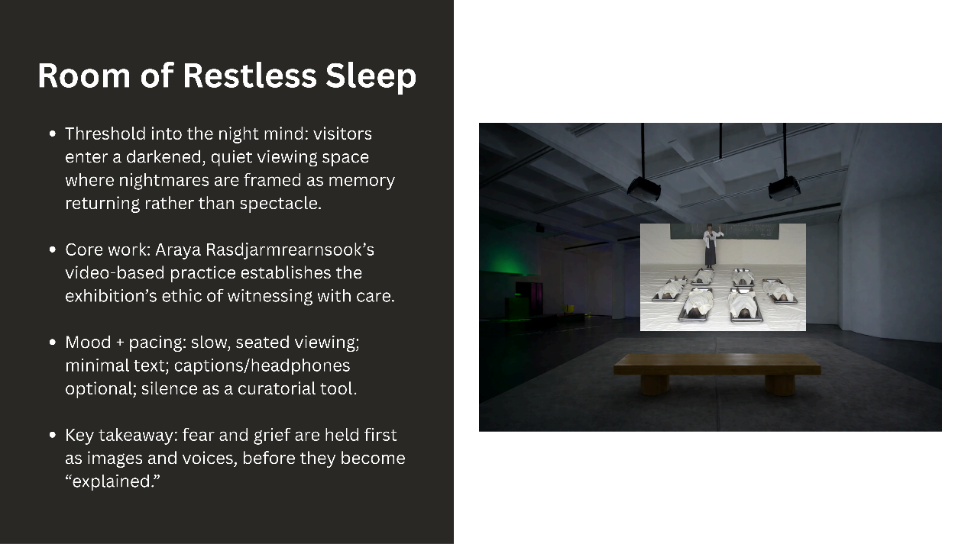
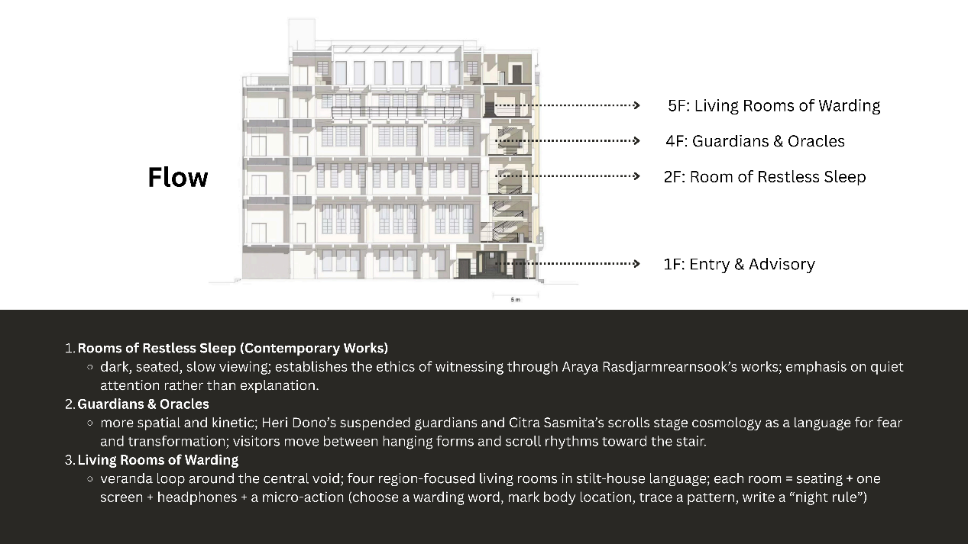
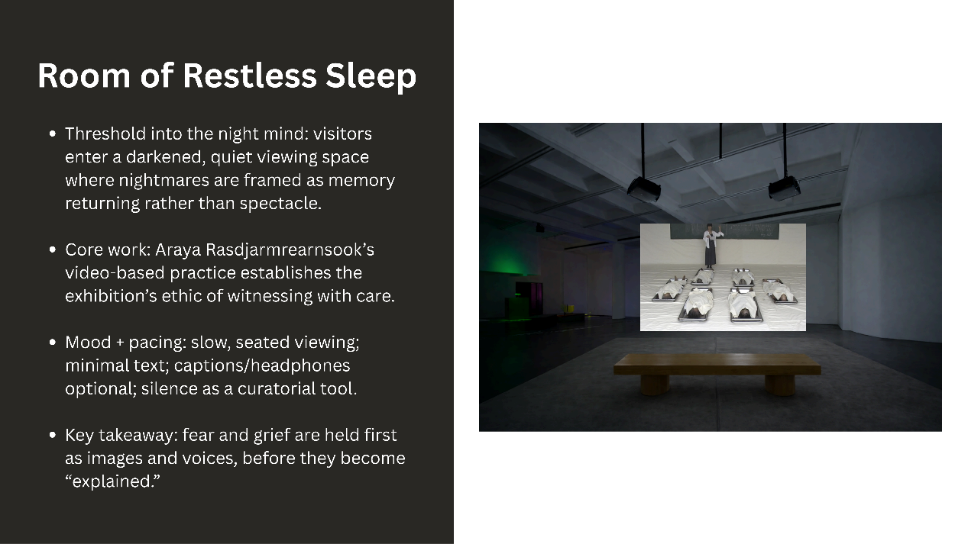
《辗转难眠的房间:噩梦、记忆与修复》将噩梦视为一种呼唤修复的记忆行为。在东南亚地区,艺术家将哀伤与夜间恐惧转化为影像与声景;而各地社群亦以仪式性的防护手段——如织物、护身符、祈祷——来抵御夜色。通过并置录像、装置等当代艺术作品与考古文物,展览探问:图像如何承载恐惧?材料如何承载关怀? 在此,观众得以与那些艰涩的情绪久久共处,并看见艺术、仪式与保护实践如何助人坚忍持存。
Rooms Of Restless Sleep: Nightmares, Memories, Repair frame nightmares as acts of memory that call for repair. In Southeast Asia, artists translate grief and nocturnal fear into images and sounds, while communities counter the night with ritual protections like textiles, talismans, prayers. By pairing contemporary works ranging from videos, installations to archaeological artifacts the exhibition asks: how do images hold fear, and how do materials hold care? visitors can dwell with difficult feelings and see how art, ritual, and conservation practices help people endure.
框中之隐:可见的,与不可见的,在当代城市中
(
[HIDDEN] WITHIN THE FRAME: Visibility and Invisibility in the Contemporary City
)
瓦伦婷(Clara Valentine), 丹玉琪(Ngoc Kim Dang), 约拿宁(Jonathan Schmitz)
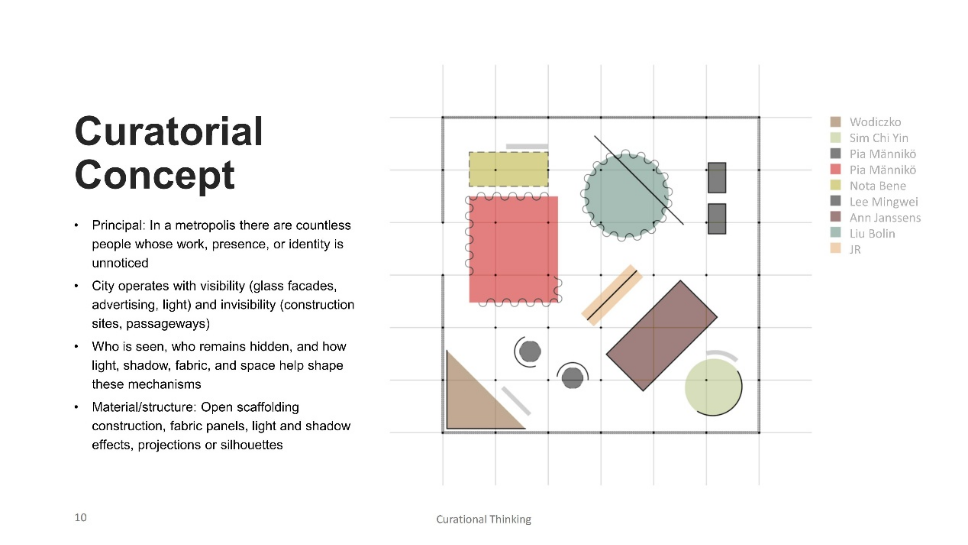
上海同时象征着极度的可见性与匿名性。这座城市的生活由不息的流动、建造与蜕变所塑造,而都市空间被精密地设计,以界定什么应当被看见,什么又该被刻意隐藏。在这一语境中,可见性早已超越视觉层面,转而成为一种社会性、政治性与情感性的状态。本展览旨在探析这些机制如何运作,并追问城市可见表象之下,究竟潜藏着什么。
可见性决定了谁的故事将被讲述,谁的故事又会被遗忘。在城市语境中,被看见往往与特权、资源与表征权力紧密相连;而隐匿则常常遮蔽了那些维系城市日常运转却默默无闻的日常劳作。建筑、光线与社会系统共同强化着这些边界,塑造感知并规训注意力的分配。通过介入这些结构,展览试图揭示显与隐之间那持续的张力。
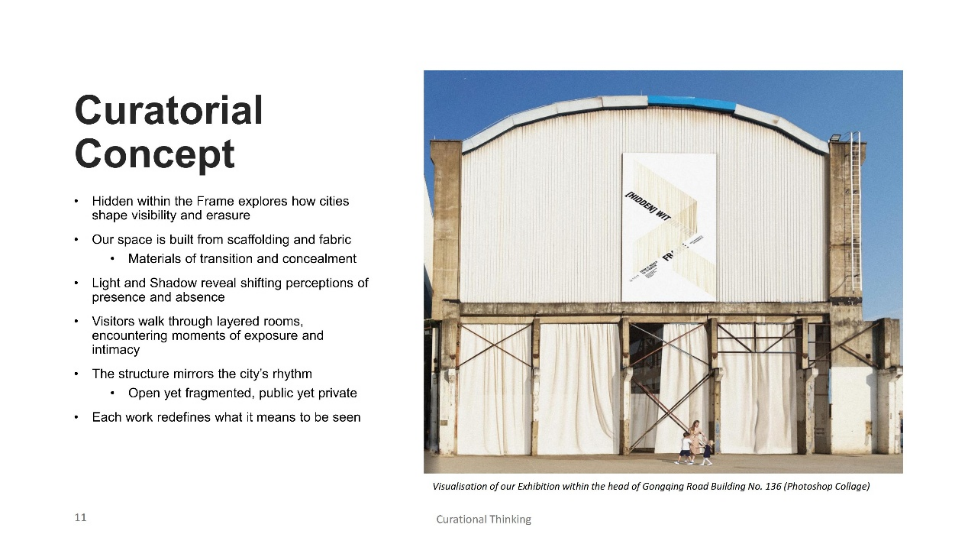
展览以框中之隐为题,探究城市如何同时生产可见性及其抹除。展览空间由敞露的脚手架与织物隔板构建而成——这些材料关联着过渡、临时与遮蔽。光影效果,包括投影与剪影,营造出对在场与缺席的流动感知。观众穿行于层层叠进的房间,遭遇暴露与亲密的片刻,身体与痕迹在此浮现又消散。这一结构映射着城市的节律:开放却碎片、公共却私密。而每一件作品都在重新定义被看见意味着什么,邀请观者反思那些支配城市生活中可见性的微妙系统。
Shanghai represents both hyper-visibility and anonymity. Life in the city is shaped by constant motion, construction, and transformation, where urban spaces carefully define what should be seen and what should remain concealed. Within this environment, visibility is not merely visual but becomes a social, political, and emotional condition. This exhibition explores how such mechanisms operate and questions what lies beyond the visible surface of the city.
Visibility determines whose stories are told and whose are forgotten. In urban contexts, being visible is closely linked to privilege, access, and representation, while invisibility often conceals everyday labor and routine that sustain the city without acknowledgment. Architecture, light, and social systems reinforce these boundaries, shaping perception and regulating attention. By engaging with these structures, the exhibition seeks to expose the persistent tension between what is illuminated and what is hidden.
Titled Hidden within the Frame, the exhibition explores how cities produce both visibility and erasure. The space is constructed from open scaffolding and fabric panels, materials associated with transition, impermanence, and concealment. Light and shadow effects, including projections and silhouettes, create shifting perceptions of presence and absence. Visitors move through layered rooms, encountering moments of exposure and intimacy as bodies and traces emerge and dissolve. The structure mirrors the rhythm of the city – open yet fragmented, public yet private – while each work redefines what it means to be seen, inviting reflection on the subtle systems that govern visibility in urban life.
终点:生活
(
Destination: Life
)
张铭楠(Zhang Mingnan),小莲(Xiao Lian Ba Milis), 杨悦(Clara Yang Sayagués), 邹永彦(Josune Minguela)
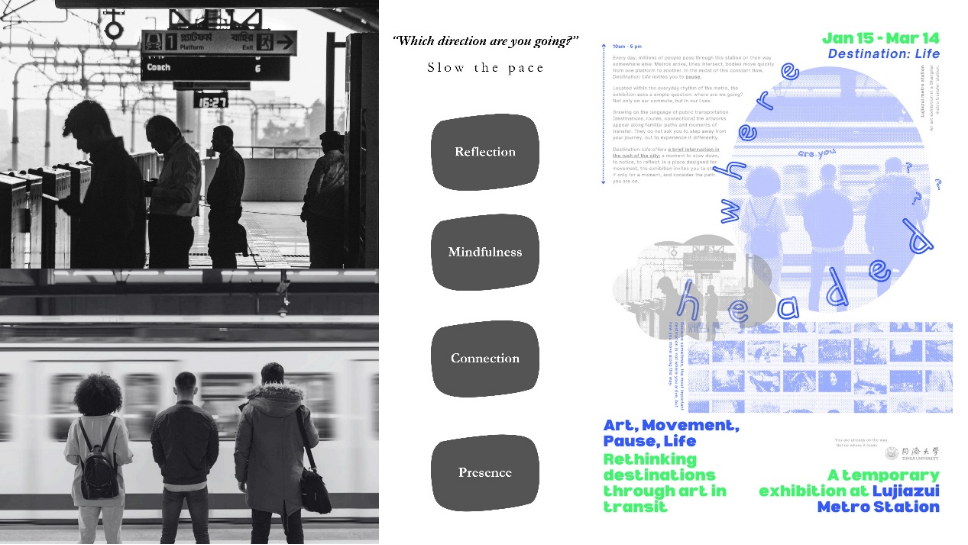
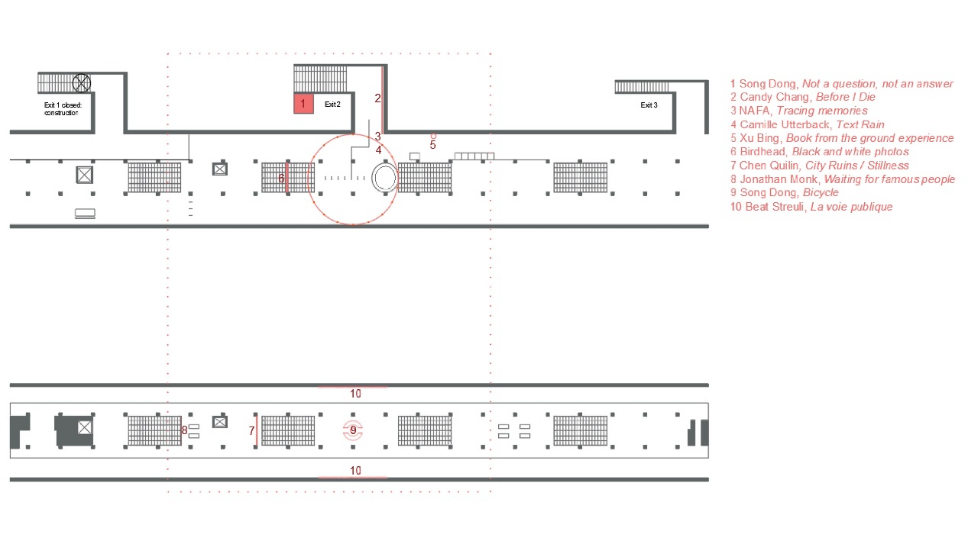
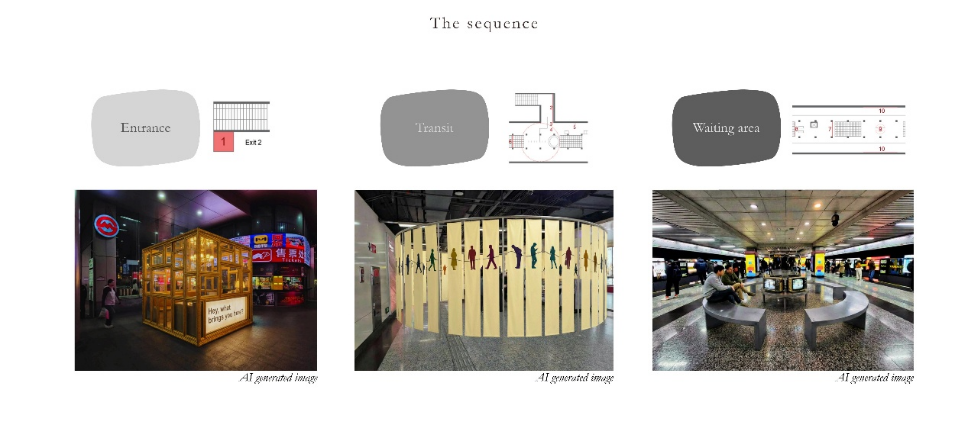
《终点:生活》是一场坐落于上海地铁站的特定场域展览,这个空间以速度、效率与持续流动为本质特征。展览援引公共交通的语汇,重新定义终点的意涵:生活正是在移动、等待与换乘之间铺展的一切。作品融入车站的建筑空间与节律,分布于人们惯常经过的路径与偶然驻足的片刻。
在数百万行人步履不停、穿流而过的场所,这个项目邀请人们在机械化的通行流中获得片刻觉知,促使过客反思自己将去往何方——不仅在地铁线上,更在人生的方向上。展览并未将观者抽离于日常生活,而是在行进中与之相遇。它提出:地铁不仅是基础设施,更是一个生活化的空间,在其中,反思、感知与短暂的在场得以浮现。
在这座以加速与变迁为特征的城市里,《终点:生活》暗示:旅程本身可以是一处场所,而有时候,终点并非抵达,而是存在本身。
Destination: Life is a site-specific exhibition located in a Shanghai metro station, a space defined by speed, efficiency and constant movement.
Drawing on the language of public transportation, the exhibition reframes the idea of destination: Life is what unfolds while moving, waiting and transferring. The works integrate into the architecture and rhythms of the station, appearing along habitual routes and moments of pause.
In a place where millions pass without stopping, the project invites for a moment of awareness within the automated flow of transit, and encourages the passers to reflect about where they are going, not only on the subway but the direction of their lifes.
Rather than removing viewers from daily life, the exhibition meets them in motion. It proposes the metro not only as infrastructure, but as a lived space where reflection, perception and presence can briefly emerge.
In a city defined by acceleration and transition, Destination: Life suggests that the journey itself can be a place, and that sometimes the destination is not arrival, but being.