学院介绍
学院介绍
新闻中心



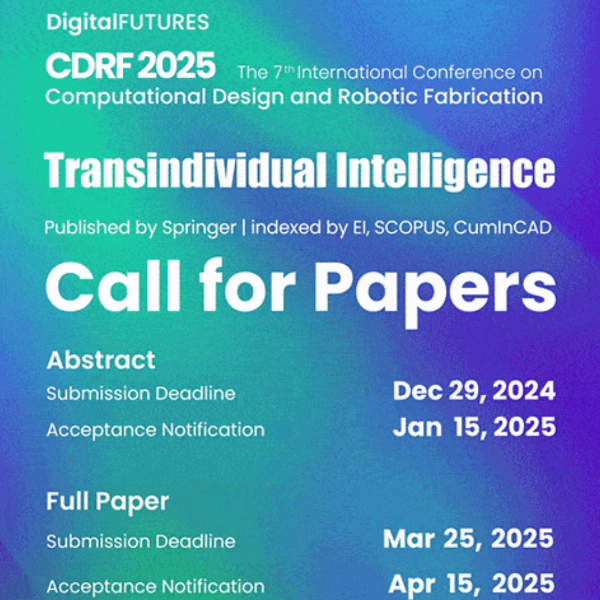
CDRF会议论文被EI检索正式收录
由DigitalFUTURES协会主办,同济大学建筑与城市规划学院、同济大学建筑设计研究院(集团)有限公司、Architectural Intelligence期刊联合承办,上海数字建造工程技术研究中心(SFAB)、上海市建筑学会数字建筑分会共同协办的第七届“数字设计与机器人建造”国际会议(The 7th International Conference on Computational Design and Robotic Fabrication,CDRF2025)征稿正式启动!CDRF国际会议一直以来与Springer出版社合作发表高水平论文。2023年CDRF会议论文实现CumInCAD,Scopus检索收录。2024年7月起,2022年之后收录的CDRF会议论文全部实现EI检索收录!
The 7th International Conference on Computational Design and Robotic Fabrication (CDRF2025), organized by the DigitalFUTURES Association, jointly undertaken by College of Architecture and Urban Planning Tongji University, Tongji Architectural Design (Group) Co., Ltd., and Architectural Intelligence Journal, facilitated by Shanghai Digital Architecture Fabrication Technology Center, and Digital Architecture Branch, The Architectural Society of Shanghai China, has officially opened its call for papers! Over the years, the CDRF conference has consistently collaborated with Springer to publish high-quality papers. In 2023, CDRF conference papers were indexed by CumInCAD and Scopus, and starting from July 2024, all CDRF conference papers accepted after 2022 will be indexed by EI Compendex.


关于 数字未来
About DigitalFUTURES
“数字未来”(DigitalFUTURES)于2011年由同济大学建筑与城市规划学院(CAUP)、上海建筑数字建造工程技术研究中心(SFAB)、上海市建筑学会数字建筑分会联合发起,依托DigitalFUTURES协会、国际建筑师协会、中国建筑学会、国家土建结构预制装配化工程技术研究中心等学术平台,联合全球知名学者、建筑师、设计师及相关企、事业单位和学术媒体共同组织,形成了线上、线下一体化的教育平台(www.digitalfutures.world)。活动涵盖讲座、会议、工作坊和展览等。如今,DigitalFUTURES作为一个全球建筑知识交流共同体,鼓励全球建筑知识的传承与创新、合作与交流,重点关注数字化设计理论、技术以及人工智能算法、机器人建造等在建成环境领域的科学研究。
DigitalFUTURES is jointly launched by College of Architecture and Urban Planning (CAUP), Tongji University, Shanghai Digital Architecture Fabrication Technology Center (SFAB), and Digital Architecture Branch, the Architectural Society of Shanghai China (ASSC) in 2011. DigitalFUTURES (DF), Union International des Architectes (UIA), Architectural Society of China (ASC), National Engineering Technology Research Center for Prefabrication Construction in Civil Engineering collaborate with global renowned scholars, architects, designers, enterprises, institutions, and academic media in this field to establish an online and offline integrated education platform (www.digitalfutures.world). The activities include lectures, conferences, workshops, and exhibitions, etc. Nowadays, as a global architectural knowledge exchange community, DigitalFUTURES encourages the inheritance and innovation, cooperation, and exchange of global architectural knowledge, and emphasizes scientific research on digital design theory, technology, artificial intelligence algorithm, robotic fabrication and other scientific research in the field of built environment.
会议主题:跨个体智能
Conference Theme: Transindividual Intelligence
20世纪中叶,法国哲学家吉尔伯特·西蒙东(Gilbert Simondon)在其开创性著作《心理与集体个体化》(L'individuation psychique et collective)中提出“跨个体”(transindividual)概念,挑战了将个体视为孤立实体的普遍观念。西蒙东认为,个体并非是封闭、自足的,而始终处于与他者、与环境相互作用的动态过程之中。由此出现的“跨个体”是超越个体界限的关系领域。作为心理(内部)和集体(外部)维度交汇的沃土,跨个体领域促成了交流与知识共享,不仅塑造了个体的特征,也形成了超越个体的集体智慧和创造力。
伯纳德·斯蒂格勒在西蒙东思想的基础上,进一步强调了技术在个体化进程中的关键作用。他认为,技术并非仅仅是一种工具,而是构成人类存在的基本要素,它深刻地参与塑造了人类的认知结构、社会组织以及文化演进过程。对斯蒂格勒而言,技术是实现“跨个体化”的重要媒介,而数字技术的兴起则标志着跨个体化进程进入了崭新阶段。在这个阶段,人类与机器、个体与集体形成了前所未有的交织关系,催生出超越个体思维局限的集体智慧和共同创造的可能性。
在建筑领域, “跨个体智能”正在日益显现。人工智能、协作机器人、信息网络等技术的发展,正在打破人与人、人与机器之间的界限,催生出全新的建筑设计与生产范式。建筑师不再是孤立的个体,而成为与智能工具、数据及其他参与者所共筑的“跨个体智能”网络中的重要节点。
2025 年 CDRF 会议以 “跨个体智能 ”为主题,从吉尔伯特·西蒙东和伯纳德·斯蒂格勒的哲学见解中汲取灵感,旨在探讨人工智能时代下,建筑师个体如何与智能技术以及其他个体协同发展,共同创造更具适应性与包容性的未来。
In the mid-20th century, French philosopher Gilbert Simondon, in his groundbreaking work L'individuation psychique et collective, introduced the concept of transindividuality challenging the prevailing notion of the individual as an isolated entity. Simondon argued that individuals are not closed, or self-sufficient; rather, they are always engaged in a dynamic process of interactions with others and the environment. The resulting transindividual is a relational field that transcends individual boundaries. As the fertile ground where psychic (internal) and collective (external) dimensions intersect, this transindividual field fosters communication and knowledge sharing, shaping not only the characteristics of individuals but also the collective intelligence and creativity that transcend individuals.
Building upon Simondon's ideas, Bernard Stiegler further emphasized the pivotal role of technology in the process of individuation. He argued that technology is not merely a tool but a constitutive element of human existence, shaping our cognitive abilities, social structures, and cultural evolution. For Stiegler, technology is a vital medium for achieving transindividuation. And the rise of digital technology marks a new stage of this process, where humans and machines, individuals and collectives, are intertwined in unprecedented ways, creating the potential for collective intelligence and shared creativity that transcends the limitations of individuals.
In the field of architecture, transindividual intelligence is also becoming increasingly evident. The development of artificial intelligence, collaborative robots, and information networks is breaking down the boundaries between individuals, between humans and machines, giving rise to new paradigms of architectural design and production. Architects are no longer isolated individuals but integral nodes within a network of transindividual intelligence that encompasses intelligent tools, data, and other individuals.
The 2025 CDRF conference, themed Transindividual Intelligence draws inspiration from the philosophical insights of Gilbert Simondon and Bernard Stiegler. It aims to explore how architects, in the age of artificial intelligence, can collaborate with intelligent technologies and other individuals to co-create a more adaptive and inclusive future.
研究议题
Research Topics
第七届国际数字设计与机器人建造会议(CDRF 2025)为探讨建筑领域的跨个体智能问题提供了一个全球性平台。论文涵盖的主题包括但不限于以下内容:
智慧人居:智慧建筑, 智慧社区, 智慧城市, 智能感知, 人机交互,建筑环境物联网,能源、照明、声学、人类行为和舒适度的计算, 大数据, 云计算…
虚拟人居:元宇宙, 虚拟现实, 增强现实, 混合现实, 数字孪生, 虚拟社区, 虚拟建筑, 区块链, NFT建筑, 人工智能生成式设计, 数字形态学, 复杂网络…
未来人居:太空人居, 海底人居, 移动人居, 极地人居,极端气候人居,生态城市, 绿色建筑, 生物技术, 动态结构, 基于性能的生形优化,建筑机器人技术,批量定制化, 多智能体系统…
有关会议的更多信息,请访问以下链接:
https://www.digitalfutures.world/conference/19.html
The 7th International Conference on Computational Design and Robotic Fabrication (CDRF 2025) provides a global platform for advanced researches addressing Transindividual Intelligence in architecture. Among the topics covered by the papers include, but not limited to, architecture theories, tools, methods and procedures in:
Smart Habitation: Smart Building, Smart Community, Smart City, Intelligent Sensing, Human-Computer Interaction, IoT in Built Environment, Computational Analysis of Energy, Lighting, Acoustics, Human Behavior and Comfort, Big Data, Cloud Computing…
Virtual Habitation: Metaverse, Virtual Reality (VR), Augmented Reality (AR), Mixed Reality (MR), Digital Twin, Virtual Community, Virtual Architecture, Blockchain, NFT Architecture, AI-augmented Generative Design, Parametric Morphology, Complex Networks…
Future Habitation: Space Habitation, Underwater Habitation, Mobile Habitation, Arctic Habitation, Habitation under Extreme Climate, Ecological Cities, Green Building, Biotechnology, Kinetic Architecture, Performance-based Form-finding, Construction Robotics, Mass Customization, Multi-agent Systems…
For more information about the conference,
please visit the following link:
https://www.digitalfutures.world/conference/19.html
提交截止时间
Dates for Submission
摘要提交截止日期
2024年12月29日
摘要录用公示
2025年1月15日
全文提交截止日期
2025年3月25日
全文录用公示
2025年4月15日
全文终稿提交截止日期
2025年4月30日
会议
2025年7月5日-6日
Deadline for Abstract Submission:
December 29, 2024
Notification of Abstract Acceptance:
January 15, 2025
Submission Deadline for Full Paper:
March 25, 2025
Notification of Full Paper Acceptance:
April 15, 2025
Revised Submission Deadline for Full Paper:
April 30, 2025
Conference:
July 5-6, 2025
投稿指南
Submission Guidelines
论文评审分为两个阶段:摘要和全文。所有论文必须是原创的,并且没有同时提交给其他期刊或会议。严禁抄袭(包括自我抄袭)。论文的原创性将在评审过程中和发表前进行多次检查。委员会将对所有投稿的质量、原创性和相关性进行审阅。
摘要:不超过600词,包括标题、3-5个关键词、1-3个图表和重要参考文献。
全文:按照CDRF论文模板撰写,最多不超过10页。包括标题、摘要、关键词、图表和参考文献。论文模版将在全文投稿阶段发布。
格式:PDF格式
语言:英语
投稿地址:
https://easychair.org/conferences/?conf=cdrf2025
Papers are peer reviewed in two stages: the abstract and the full paper. Submissions must be original and cannot be submitted simultaneously to another journal or conference. We strongly prohibit plagiarism (including self-plagiarism). During the review process and prior to publication, the originality of the paper will be checked several times. Upon submission, all submissions will be reviewed by the Committee for quality, originality, and relevance.
Abstract: Approximately 600 words, including the title, 3-5 keywords, 1-3 figures, and key references.
Full paper: A maximum of 10 pages fitting the CDRF paper template, including the title, abstract, keywords, figures/tables/charts, and references. The paper template will be released during the full paper submission stage.
Format: PDF.
Language: English.
Submission address:
https://easychair.org/conferences/?conf=cdrf2025
出版
Publication
被录用的论文除了被收录在EI, CumInCAD和SCOPUS索引中,还将由Springer出版,发表在2025年第七届数字设计与机器人建造国际会议论文集(CDRF 2025)中。
其中精选的论文(经过适当修改和扩充)将有机会发表在Architectural Intelligence 英文期刊上。
In addition to being included in the EI, CumInCAD and SCOPUS index, accepted papers will be published by Springer in the Proceedings of the 7th International Conference on Computational Design and Robotic Fabrication (CDRF 2025).
In addition, papers that closely address the conference theme may also be published in the Architectural Intelligence Journal (with an extension and additional review process).
历届会议的论文集
Previous conference proceedings
CDRF 2024即将出版
CDRF 2023
https://link.springer.com/book/10.1007/978-981-99-8405-3
CDRF 2022
https://link.springer.com/book/10.1007/978-981-19-8637-6
CDRF 2021
https://link.springer.com/book/10.1007/978-981-16-5983-6
CDRF 2020
https://link.springer.com/book/10.1007/978-981-33-4400-6
CDRF 2019
https://link.springer.com/book/10.1007/978-981-13-8153-9
建筑智能期刊 (ARI)
https://www.springer.com/journal/44223/
CDRF 2024 forthcoming
CDRF 2023
https://link.springer.com/book/10.1007/978-981-99-8405-3
CDRF 2022
https://link.springer.com/book/10.1007/978-981-19-8637-6
CDRF 2021
https://link.springer.com/book/10.1007/978-981-16-5983-6
CDRF 2020
https://link.springer.com/book/10.1007/978-981-33-4400-6
CDRF 2019
https://link.springer.com/book/10.1007/978-981-13-8153-9
Architectural Intelligence Journal (ARI)
https://www.springer.com/journal/44223/
线下会议地点
Local Venue
线下会议将在上海市四平路1239号同济大学建筑与城市规划学院举行。
The conference will be held in College of Architecture and Urban Planning, Tongji University, 1239 Siping Road, Shanghai, China.
联系方式
Contact
所有关于投稿的问题请发邮件至:
digitalfutures@tongji.edu.cn
If you have any questions regarding submissions,
please email to:
digitalfutures@tongji.edu.cn
内容提供 | DigitalFutures
编辑 | Zhu Yalei、Liu Jiyu、Feng Yunning
DigitalFUTURES is launched by College of Architecture and Urban Planning(CAUP), Tongji University and Shanghai Digital Architecture Fabrication Technology Center (SFAB) in 2011. International Union of Architects (UIA), Architectural Society of China (ASC), National Engineering Technology Research Center for Prefabrication Construction in Civil Engineering, and The Architectural Society of Shanghai China (ASSC) collaborate with global renowned scholars, architects, designers, enterprises and academic media in this field to establish an online and offline integrated educational platform relying on Architectural DigitalFUTURES. The events are consisting of lectures, conferences, workshops and exhibitions, etc. Nowadays, DigitalFUTURES as a global architecture exchange community, with the platform www.digitalfutures.world, encourages the inheritance and innovation, collaboration and communication of global knowledge in architecture and emphasizes scientific research about digital design theory, technology and artificial intelligence algorithms, robotic fabrication, etc. in the field of architecture and built environment.