学院介绍
学院介绍
新闻中心



CDRF 国际会议论文实现EI收录检索!
CDRF International Conference papers
are now indexed by EI Compendex!
EI检索链接https://www.engineeringvillage.com/
计算性设计与机器人建造(Computational Design and Robotic Fabrication,CDRF)国际会议连续6年来是DigitalFUTURES 系列活动的核心内容。CDRF会议论文由Springer出版社出版,入选会议论文是通过DigitalFUTURES学术委员会成员,经“论文摘要”和“正文”两轮通讯盲审(Blind Review)评审而出的高水平论文集,累计阅读量达87.6万次。2023年CDRF会议论文实现了CumInCAD,Scopus检索收录。2024年7月起,2022年之后收录的CDRF会议论文将全部进入EI检索收录!
*EI(Engineering Index,工程索引)检索是一个涵盖广泛工程领域的文献数据库检索服务,主要用于工程技术领域的文献和科研成果的检索。它收录了来自全球的科学期刊、会议论文、专利、技术报告、书籍、学位论文等多种类型的文献,覆盖了化工、机械、电子、电气、土木、环境、材料、计算机等多个工程学科领域。通过多种检索方式如基本检索、高级检索、主题检索等,用户可以获取文献的题录信息,并在科研、学术研究和项目开发中广泛应用。
*SCOPUS是目前全球规模最大的文摘和引文数据库,由Elsevier于2004年11月推出。数据库内容全面、学科广泛,覆盖自然科学、技术、工程、医学、社会科学、艺术与人文等众多学科。其收录内容由独立的领域专家遴选,是广大科研人员跟踪学科发展、学科规划的重要工具。
*CumInCAD是全球数字建筑领域的最权威、全面、专业的高水平引文数据库,收录了来自于ACADIA, CAADRIA, eCAADe, SIGraDi, CAAD futures等顶级国际会议的论文成果。其公开的CumInCAD记录通过开放档案倡议协议(OAI-PMH)提供,并可通过多个在线文献档案和引文索引获得。
For the past six years, the International Conference on Computational Design and Robotic Fabrication (CDRF) has been a core component of the DigitalFUTURES series of events. The conference papers of CDRF are published by Springer, and the selected papers are high-quality works chosen through a two-round blind review process (including abstract and full paper) conducted by members of the DigitalFUTURES Academic Committee, accumulating a total of 876,000 reads. In 2023, CDRF conference papers were indexed by CumInCAD and Scopus. Starting from July 2024, all CDRF conference papers accepted after 2022 will be indexed by EI Compendex.
*EI (Engineering Index) is a comprehensive literature database retrieval service covering a wide range of engineering fields. It is primarily used for retrieving literature and research achievements in the engineering and technology sectors. EI indexes a variety of documents including scientific journals, conference papers, patents, technical reports, books, and dissertations from around the world. It encompasses numerous engineering disciplines such as chemical engineering, mechanical engineering, electronics, electrical engineering, civil engineering, environmental engineering, materials science, and computer science. Through various search methods like basic search, advanced search, and subject search, users can obtain bibliographic information on documents, which are widely utilized in scientific research, academic studies, and project development.
*Scopus is currently the largest abstract and citation database in the world, launched by Elsevier in November 2004. The database offers comprehensive content across a wide range of disciplines, including natural sciences, technology, engineering, medicine, social sciences, arts, and humanities. The content in Scopus is selected by independent subject matter experts, making it an essential tool for researchers to track developments and plan research in their respective fields.
*CumInCAD is the most authoritative, comprehensive, and professional high-level citation database in the field of digital architecture worldwide. It includes papers from top international conferences such as ACADIA, CAADRIA, eCAADe, SIGraDi, and CAAD Futures. CumInCAD records are made publicly available through the Open Archives Initiative Protocol for Metadata Harvesting (OAI-PMH) and can be accessed through multiple online literature archives and citation indexes.

CDRF2024投稿一览
About Architectural DigitalFUTURES
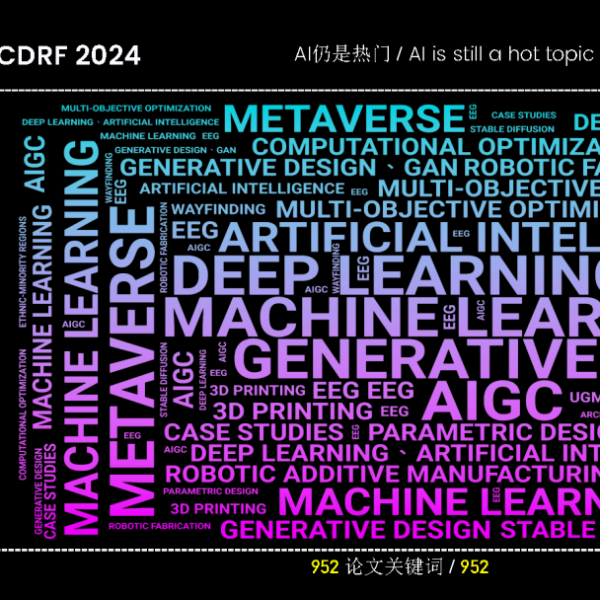
CDRF2024收到摘要423篇,正文投稿241篇,涵盖29个国家,103家海外机构以及94家国内机构。最终收录论文49篇,正文录用率20.33%,论文围绕“共生智能”(Symbiosis Intelligence)主题,展开了包括跨学科设计、人工智能增强设计、材料计算、性能设计、智能建造等多方面的研究讨论。
之后,DigitalFUTURES组委会将再精选10篇扩展论文发表在《Architectural Intelligence》英文期刊上。
CDRF 2024 received 423 abstracts and 241 full paper submissions from 29 countries, 103 international institutions, and 94 domestic institutions. Ultimately, 49 papers were accepted, resulting in a full paper acceptance rate of 20.33%. These papers focus on the theme of Symbiosis Intelligence and cover various topics such as interdisciplinary design, AI-enhanced design, computational materials, performance design, and intelligent construction.

历届会议的论文集
Previous conference proceedings
CDRF 2024即将出版
CDRF 2023
https://link.springer.com/book/10.1007/978-981-99-8405-3
CDRF 2022
https://link.springer.com/book/10.1007/978-981-19-8637-6
CDRF 2021
https://link.springer.com/book/10.1007/978-981-16-5983-6
CDRF 2020
https://link.springer.com/book/10.1007/978-981-33-4400-6
CDRF 2019
https://link.springer.com/book/10.1007/978-981-13-8153-9
CDRF 2024 forthcoming
CDRF 2023
https://link.springer.com/book/10.1007/978-981-99-8405-3
CDRF 2022
https://link.springer.com/book/10.1007/978-981-19-8637-6
CDRF 2021
https://link.springer.com/book/10.1007/978-981-16-5983-6
CDRF 2020
https://link.springer.com/book/10.1007/978-981-33-4400-6
CDRF 2019
https://link.springer.com/book/10.1007/978-981-13-8153-9
DigitalFUTURES组委会将再精选10篇扩展的优秀论文发表在Architectural Intelligence英文期刊上。
Subsequently, the DigitalFUTURES Committee will select an additional 10 extended papers for publication in the English journal Architectural Intelligence.

About Architectural Intelligence
Architectural Intelligence(ARI)以设计科学思维为引领,面向智慧人居、虚拟人居、地外人居三大未来场景。Architectural Intelligence(建筑智能/ARI)致力于推动以科学实证为支撑的研究方法,重构建筑科学知识体系,打造学科交叉的国际学术平台,建立以可持续发展为目标的新研究范式。
本刊涵盖多个主题,涉及多学科要素(建筑、结构、设计、材料、环境、能源、机械、软件等),包含设计生成、 模拟、优化 、建造、运维、人居等专题内容。同时综合六大领域的交叉学科方向,即建筑科学、结构与材料、环境与能源、数学与计算性以及行为与社会学。
Architectural Intelligence 期刊编委会由来自国际顶尖高校和研究机构的96位具有国际影响力的资深学者组成,涵盖14个不同国家,49所国内外高校与机构。
Architectural Intelligence
https://www.springer.com/journal/44223/
Architectural Intelligence (ARI) is driven by design science thinking and focuses on three future living scenarios: smart living, virtual living, and extraterrestrial living. ARI aims to promote research methods grounded in scientific evidence, reconstruct the knowledge system of architectural science, create an international academic platform for interdisciplinary collaboration, and establish new research paradigms centered on sustainable development.
The journal encompasses multiple themes and multidisciplinary elements, including architecture, structure, design, materials, environment, energy, mechanics, and software. It covers topics such as design generation, simulation, optimization, construction, operation and maintenance, and habitation. Furthermore, it integrates interdisciplinary directions from six major areas: architectural science, structures and materials, environment and energy, mathematics and computation, and behavioral and social sciences.
The editorial board of Architectural Intelligence (ARI) comprises 96 internationally renowned senior scholars from top universities and research institutions across 14 countries, representing 49 domestic and international universities and institutions.
Architectural Intelligence Journal (ARI)
https://www.springer.com/journal/44223/

关于 数字未来
About DigitalFUTURES
“数字未来”(DigitalFUTURES)于2011年由同济大学建筑与城市规划学院(CAUP)、上海建筑数字建造工程技术研究中心(SFAB)、上海市建筑学会数字建筑分会联合发起,依托DigitalFUTURES协会、国际建筑师协会、中国建筑学会、国家土建结构预制装配化工程技术研究中心等学术平台,联合全球知名学者、建筑师、设计师及相关企、事业单位和学术媒体共同组织,形成了线上、线下一体化的教育平台(www.digitalfutures.world)。活动涵盖讲座、会议、工作坊和展览等。如今,DigitalFUTURES作为一个全球建筑知识交流共同体,鼓励全球建筑知识的传承与创新、合作与交流,重点关注数字化设计理论、技术以及人工智能算法、机器人建造等在建成环境领域的科学研究。
DigitalFUTURES was founded in 2011 by the College of Architecture and Urban Planning (CAUP) at Tongji University, the Shanghai Digital Fabrication Engineering Technology Research Center (SFAB), and the Digital Architecture Committee of the Shanghai Architectural Society. Supported by the DigitalFUTURES Association, the International Union of Architects, the Architectural Society of China, and the National Engineering Research Center for Prefabrication in Civil Engineering, DigitalFUTURES brings together leading scholars, architects, designers, companies, institutions, and academic media from around the world. It has developed an integrated online and offline educational platform (www.digitalfutures.world), offering lectures, conferences, workshops, and exhibitions. As a global community for the exchange of architectural knowledge, DigitalFUTURES promotes the preservation and innovation of architectural knowledge worldwide, fosters collaboration and communication, and focuses on scientific research in digital design theory, technology, artificial intelligence algorithms, and robotic construction in the built environment.